Showing posts with label creation. Show all posts

Friday, 9 February 2018

Ultimate Purpose and reflections from Genesis 1-3

Justin Brierley's brilliant Unbelievable show resumes its traditional format of atheist versus Christian format after a more in-house discussion on the tricky genocidal aspects of Yahweh's instructions to his invading people to violently invade and dominate the Promised Land (I have blogged a little about the Old Testament violence issue already here).

What do you think about the argument of our life's purpose? Do we even ask these questions correctly? Without going into the Unbelievable debate in any detail (you can check it out Can we find God in a suffering world?), I was once again left to ponder, unsatisfied, on our definitions of such a fundamental issue as "purpose", but also strangely drawn to the apparent inevitability of the connection to suffering. But let's leave suffering for a moment.

My Christian heritage is founded on the biblical idea that originally, we could have inhabited a world without any suffering whatsoever. No death - except maybe that of vegetation. Yet, despite that eventuality of pain, there was a purpose.

Genesis 1

Then God said, ‘Let us make mankind in our image, in our likeness, so that they may rule over the fish in the sea and the birds in the sky, over the livestock and all the wild animals, and over all the creatures that move along the ground.’

So God created mankind in his own image,
    in the image of God he created them;
    male and female he created them.

God blessed them and said to them, ‘Be fruitful and increase in number; fill the earth and subdue it. Rule over the fish in the sea and the birds in the sky and over every living creature that moves on the ground.’

Then God said, ‘I give you every seed-bearing plant on the face of the whole earth and every tree that has fruit with seed in it. They will be yours for food. And to all the beasts of the earth and all the birds in the sky and all the creatures that move along the ground – everything that has the breath of life in it – I give every green plant for food.’ And it was so.

On this basis, Jews, Christians and Muslims share that there is a purpose that supercedes that of the animal kingdom. Vegetation exists in order to be eaten. Animals exist in order to eat and be eaten. Humans, however are to thrive and rule. Eating is clearly pretty important - it comes up quite a bit, but it is never provided as the reason or purpose. The mandate for humans is to share in a divine mandate, to share in the gods' work of order and rule, all of which ultimately comes under the presidency of Yahweh himself. The delegation is so great that humankind get to name the animals. That's huge and weird if you think about it, not naming what you created, maybe a bit like asking your kid to name their younger sibling. Maybe. 

So what this story has taught us is that there are layers of meaning. We all have "purpose". The question really is just how up the ladder do we want to climb? Do we just want to be physically fulfilled? Do we desire that deeply for our family and close friends too (layer 2)? Or do we feel empathy and a call to act to right wrongs in our society that may not even affect us directly (layer 3?)

One of the problems with the Genesis 1-2 scenario (there are quite a few actually, depending on how you read the text) is the notion of order. The jurisdiction and domination over creation without suffering often overlooks a lurking clue to the source of evil. There was still chaos. Where there is no order, there is not a vacuum, and the Old Testament language continues to revisit and enrich the Israelite understanding of order and disorder. I guess that's even why naming comes in. Give something nameless a name, you reduce its uncertainty, you provide it with blissful parameters.

So our purpose is to rule over our God-appointed spheres of influence. Before "the Fall", this was not to eat, but to weigh in on ruleless "chaos" and provide order. I think that is really where I want to leave it today, so here's a quick summary and then a quick idea about the serpent of Genesis 3:

  • "Purpose" is not about ground-level existence, it's minimum one rung up from that since this is essentially the plant and animal level.
  • An orderlessness, or a need-to-be-ordered, pre-existed any bad human choices.
  • Naming carries big responsibility.

The exchange with the serpent

So what about that crafty serpent of Genesis 3? Was it the one Jesus referred to as Satan? Who knows, but one thing that today's reflection has clarified for me is that both Adam and Even shirked their responsibility, climbed down their ladder of purpose, and allowed the creation to dictate ideas and mandates of its own. The serpent is a created beast here, albeit an admittedly developed one endowed with the faculties of speech. But there has been no mention of it having received any other special privilege such as giving orders or holding responsibility on God's behalf. The great fall merits its capitalised "The Fall" when we realise that mankind has abandoned its remit of good order and been dictated to by the very creature over which rule was supposed to be exercised. This was the greater "sin" in my view - as bad as the fruit-eating episode was. So how should Adam and Eve have responded to the crafty serpent? "No, I won't eat the fruit" - is that really all that they were being tested here? Most certainly not - the serpent was "a beast" and needed severe punishment for threatening the rule. A simple refusal could still be a recognition of upset lines of authority and order.


Friday, 30 September 2016

Let's extinguish the flames of the god of the gaps

".... so how can you explain X, then?!"


And so concludes the unthinking Christian apologist. He thinks he is cleverly guiding folk toward an inevitable fact, that God is the cause of X because no-one can come close to explaining X in his day and age. Approaching the question from the faith perspective seems to make X just so blindingly obvious. X is a Gap in knowledge. Let's hold on to that word "blind" word for a moment. If it were so blindingly obvious, then we can see why the only reason very intelligent - and let's grant them some reasonable moral standing too - people could NOT see that self-evident divine explanation, is that must have been spiritually blinded, right? Here not only does the faith provide a dangerous logic loop (you could literally prove whatever you fancied), but it has  other poisonous side-effects.


All those Christians who are cheering along this methodology are in fact, without realising it, welcoming the highly toxic GOD OF THE GAPS into Christianity. Let's call him GG. GG only **really** acts when he does so directly, working through agents or over colossal expanses of time really is not so cool to be an impressive god. The Bible has stacks of counter examples to that claim, however - thus the apologist appeals to his rubbish logic over and against the far more profound shape of the inspired book he seems to have forgotten about. He blinds believers, and any converts to his perspective, to a god who is God of the Whole, of the Bible and of the cosmos, without whom everything would just collapse. Since the apologist is in the business of blinding, he goes a step further. He unwittingly has an infuriating tendency to label anything coincidental "miraculous". Finally, he unwittingly sows potentially catastrophic seeds of future **doubt** into his listeners, because once scientific consensus affects majority opinion to actually provide credible explanations on a certain point, church stances on those issues inevitably, albeit awkwardly, tend to negotiate their way towards it. I am amazed to see even in the generation transition I have witnessed just how many more Christians do not want to bury their heads in the fossil-filled sand and ignore evolution theory any more. It's not going away.

Multiverse options are also increasing their presence in mainstream consciousness at what seems to be to be an exponential rate. A majority of scientists agree that a theory of this type is correct. The most open and cutting-edge Christian media I listen to is engaging with these ideas, I am glad to hear. But given that GG has yet to be put into extinction, we cannot expect any real openness to how TG (True God) might have gone about his work, proven by some still shamefully brandish their 6000 year-old universe theories, and many more simply wishing this issue doesn't concern their Christian faith.

Tuesday, 10 May 2016

Movie review: A Matter Of Faith [2014].

I knew from previous reviews that the film might not be amazing, but for me the issues involved are interesting so I decided to brave it out and see (much to the chagrin of my wife). It really is every bit as bad as people have said, not just in wooden actors (the best actor for me actually doesn't have any major role), but also clumsy plot development. But that's just the beginning I'm afraid. This film attempts to villainise the biology lecturer character, giving him some really underhand and evil intentions. This is implied to be necessarily attached to the theory of evolution - that it is an evil plot to undermine the truth. This is then placed in sharp contrast with the humility of the student's father, who accepts the challenge for what culminates in a total anticlimax (and farce) of a debate with the aforementioned biology lecturer. There were a couple of good points from both sides in this debate, but anyone interested in a Christian vs atheist science debate can do soooooo much better on youtube or Unbelievable podcast for a real informative exchange on the issues.

I'm a Christian. I believe God made the whole universe. I do not believe the Bible is a science textbook, it's so much better than that. There are so many examples of powerful symbolism, hyperbole and anthropomorphism that reveal deeper truth in a way a stupid shallow film like this never could! (The student's father even gets his knickers in a twist at the mention of the word "story").

I would never EVER show this to a non-Christian.

Here's the trailer if for some reason you are still interested!


Friday, 29 April 2016

Responsibility (2)

Hullo!

This is a small update on my first post about the wonderful discovery of responsibility. While on my retreat, I realised that issues in me that I didn't want to recognise (they really "suck" as Americans would say) held me back from deeper relationships. Fragmented identity is a killer in our modern societies, and more than once I have heard French philosophers wax lyrical about the fatigue and pain of simply being.

At least some of what Christianity understands as "sin" in our lives, makes existing really hard work, simply trying to "hold it all together". As a fragmented person, as soon as I meet someone, I am confronted with complex decisions like: what aspect of who I am should I reveal to that person? Shall I try and impress them falsely to feel better about myself? If there is no real sense of cohesion in my identity, then my relationships will instantly suffer and level out, for the simple reason that folk aren't dupe. We all sense when what you see is NOT what you get. That discrepancy has potential to ruin relationships. Because our potential friends do not seem knowable or trustworthy even to themselves. In the New Testament of the Bible, James says:

Anyone who listens to the word but does not do what it says is like someone who looks at his face in a mirror and, after looking at himself, goes away and immediately forgets what he looks like

In fact the first chapter of James is really hot on deep sincerity, and not just with other people. With ourselves.

Taking responsibility is a wonderful spiritual process that has its place in what Christians call repentance. Taking responsibility is taking ownership of everything you are (the bits you love and the bits you'd hate anyone else to point to you) and all the negative consequences of your existence on others, intentional or otherwise. Most of the time it is otherwise.

Roadworks make you late for your husband, who regularly criticises you. This is a very tough one. But can you imagine a you who has the depths of grace to dig soooo deep down to find the genuine sorry, even though it is not your fault? One of my grievances about the 1st century Palestinian context in which Christ's life and record are indelibly marked, is that some of these "grace notes" of please, thank you, so sorry, and so on have yet to be developed.

This is a good point to address a mistake I made in my previous post, where I overly connected the idea of sin and responsibility. I appended a small comment about this to the post itself to state:
A couple of issues in the relationship between responsibility and sin here ... If God took his responsibility with respect to his oath, Responsibility is not a.k.a. "sin", as I casually asserted .... Responsibility is about truly being in the universe, without any discrepancy between word and deed, word and thought, thought and deed, repressed desire and thought, and so on. Since sinning is affecting me and others in the universe, and I often ignore it, then this is an example of failure to  *be* in the universe and take my responsibility. Taking responsibility creates re-alignment in the chaos, and is truly a most beautiful thing.

What could we say with respect to he who was without sin, Jesus Christ? Jesus' human path of self-realisation is nothing short of extraordinary. It is assumed by some that Jesus actually may have coined the term "hypocrite". For Jesus, this inner cohesion is  E S S E N T I A L  for the holy life of his followers. I think perhaps the best way to understand the spiritually mature Jesus (and apparently he was streets ahead even at age 12!), is to realise that he became totally incorruptible. You could tempt him all you liked, but sin had zero hold on him, because he truly loved his Father God and cultivated his relationship with God. And it was mutual. When you see in John's gospel especially all this Jesus-talk of I depend on the Father for this and I depend on the Father for that, Jesus (theologically and I am certain historically) must have been a grand master of humility (see John 5:19 and 12:49, for example). Amazing. Without the Father, Jesus would have had no source for his abilities, words, wisdom, than himself, and this perspective strapped to a human brain has a highly reliable pride-generating mechanism.

As a slight aside: I'd like to announce plans to launch a website at some point in the next few months dedicated to promoting the love shared between the father and the son in the Christian faith. There will be a subsection about Christian worship too. Regular readers of the blog might already be aware that I am quite concerned by the modalistic tendencies in some churches (the Father, Son and Holy Spirit are so "one" that they are basically the same person, he's called "God", and he loves me), fuelled by a plethora of confusing Christian worship songs. The goal here is not to smash the modalism (that won't change anything), but again to promote what is so precious and at stake by confusing the Father and Son. Love itself.

Saturday, 23 April 2016

Responsibility

I have been thinking about responsibility, taking responsibility for all that constitutes our identity.

There is a possibility, I have to grant it, that the roots of what we call "sin" go back a long, long way.

Not long ago, many Christians would be most offended at any so-called Christian taking the Genesis creation account non-literally. Nowadays, most don't approach the subject because of the problems (and let us be frank, offense) that any direct discussion on the topic can generate. That non-discussion doesn't mean there are millions of secret old-Earth Christians out there. Most simply "don't go there". It's a bit like the Trinity in many non-traditional churches, in which both the teaching and worship practice simply "don't go there".

I believe the current estimate for the age of humankind from an evolutionary perspective is 65 million years, intelligence only emerging in homo sapiens in the last quarter of a million years. As I may have shared before, I don't believe in a young Earth. My main problem with this position is not so much the age of the universe relative to the biblical "days" (or the order of those days). My main problem as a Christian is to explain how humans came to be made in God's image and be responsible for their sin, thus staying faithful to the symbolic nature of the Genesis account, but in a potentially very gradual fashion.

My options seem to be:
- Human intelligence and responsibility were given in an instant (a.k.a. God breathing into Adam's nostrils) in the last few thousand years after huge periods of biological and geological preparation. That would have been pretty cool, however, it is not my favourite based on the historical archaeological data. For example, there seems to be slow emergence of sophistication in design of the axe-head, and much older forms of spirituality are shown to have existed much earlier than literal biblical dating could possibly permit. We also have ancient fish-brain tumours, which question the sudden recent arrival of suffering, brokenness and injustice in the world.
- God caused increasing intelligence and morality to develop within this species. 250,000 years sounds ridiculously long, but in evolutionary terms, it's a blink. I remember how stunned I was to learn how long dinosaurs had been around without ever evolving intelligence as we have it now. If they had followed the same evolutionary curve as us, they would be populating the next solar system by now, and we'd be their pets.

I do just want to say that I wish I could be less symbolic about these things with respect to Genesis, which is an amazing (and I still take to be inspired) writing.

The title of this post is "responsibility", and that is where I want to head now. Since my retreat, it has been such a breath of fresh air to acknowledge and own some of my own twisted motivations, manipulations, power games, self-promotion, pride and destructive thoughts. Why would that be? Simply because beforehand, I knew that they were there, but it seemed so much more comfortable in the short term to try to ignore them, to disown them. Their ugliness was in sharp tension with the self-image I wanted and my parents instilled in me. There were problems connected to this situation.

As a Christian, I failed to realise that avoiding surrendering parts of me for which I would just feel repulsed by or never fully recognise my responsibility over, was a failed enterprise. Secondly, I had believed a lie: if I wasn't intentionally the cause of some evil within me or some inconvenience or even harm to someone else, then my responsibility is not incurred. This is such a wicked lie that can cause unspeakable inner tension. It has held me captive for many years to increasing degrees, and I thank God so much for setting me on a new path toward greater honesty.

Much, much more could be said about this, but what about the evolution of humans? What if some of the evil in us could be connected to necessary evolutionary processes - would that excuse us? NO WAY. That is precisely my point. Trying to reduce our responsibility to this tiny slice of intentional harm (how often do we intentionally harm?!) is to not step up to the plate, and become leaders. Leaders first of our own spheres of influence, which begins a few centimetres behind the eyes you and I are reading this. Too long I have felt God's Spirit had to do this magically and directly (in 2007 I had a major faith wobble on this exact issue at God's apparent inertia in my own character). So if God slowly (although in fact remarkably rapidly) created in us the capacity to reflect, it need not be a problem for us in terms of responsibility. I see taking responsibility as God's gracious gift to integrated living and deeper relationships. Taking responsibility: it is part of the "image".

Luke 18.
'I fast twice a week; I pay tithes of all that I get.' 13"But the tax collector, standing some distance away, was even unwilling to lift up his eyes to heaven, but was beating his breast, saying, 'God, be merciful to me, the sinner!'14"I tell you, this man went to his house justified rather than the other; for everyone who exalts himself will be humbled, but he who humbles himself will be exalted."

Jesus rejoices because this man just "imaged" the humble God.

Atheists and more fundamentalists might strike up a temporary friendship against me at this point, as I still might seem to have a problem concerning the cause of the evil in me. But what the words I said above need to sink in deeper (even within me). If there is unintentional and harmful pride or competitive attitudes or defensiveness that can be somehow traced genetically to necessary evolution for human beings to reach their current state, how can that be my responsibility? How is it not God's responsibility, if he set things up this way?

Obviously we are not going to sort the problem of evil in a single blog post! There are no simple answers of evil stemming from a good God's creation in unwitting creatures. The option that I am trying to develop, however, in today's post is to do away with this unwarranted assumption that the creature only bears responsibility for what it has intelligently dreamed up. The image bearing is the assumption of the responsibility in the way God is and does. So yes, the cat who bullies the neighbour's cat is unwittingly responsible. The owner of the bullying cat even more so for not intervening.

Christians believe that this chain of responsibility for the bullying cat can continue all the way up to God for the simple reason that he was not found wanting. He did intervene in sending his Son, Jesus Christ. We see God as fully taking his responsibility where we failed to do so, and permitting us to reach out to him to receive the extraordinary love and grace that inhabits his heart, and subjugate the earth with it. And subjectively, it feels so right when we glimpse it in ourselves, doesn't it?

Theologically, that might seem tricky. If God is free, then he was not "bound" to sending his Son for our (and the cat's) salvation. He would have been quite within his rights to let us continue on our self-destructive course, unless...

Unless he had bound himself with an oath. The Bible emphasises the seriousness with which God took the covenant that he had made with Abraham.

Further to that, the physical and timely events of the cross were somehow eternally etched in God's mind:
All inhabitants of the earth will worship the beast -- all whose names have not been written in the book of life belonging to the Lamb that was slain from the creation of the world. (Revelation 13:8, NIV)

It's time to wrap up this post, as it is already (but necessarily) a bit long. I began by noting that my old-Earth position creates the problem of responsibility (a.k.a. Acknowledging and owning "sin") and of being made in God's image. Having discussed the responsibility side a little, we can move on in the next post (with a little help from Michael Heiser) to focus more on the question of being made in God's image.

Genuinely sorry if this was a bit boring, waffly or unclear. I would love to be more concise I promise!

Tuesday, 22 March 2016

The Son of God: Three Views of the Identity of Jesus (2)

This is part 2 of my response to Irons' opening case, which is very focussed on a few specific arguments. This is important to note, as some apologists are not nearly so focussed and are banking on a cumulative effect. For some folk, like myself, this is a less profound or impacting methodology. So, apologies if the previous post was quite critical - it is nothing against Irons or his methodology (except the comment about his and Holmes' use of "being", which I think, is quite telling of the difficulty of the position to which he and other "one-self" Trinitarians hold).

Irons is going to have a lot to say about John - this is right. In my own research I found dozens of suggestive passages in this gospel, and it is the boldest in the claims it attributes to Jesus, and the absolute quietest on the Kingdom of God. One thing Irons rightly highlights is John's emphasis on Jesus coming "in the flesh". Why say that Jesus came in the flesh? That sounds like a strange thing to say if you did not have to defend against faulty thinking about the Christ, one that came from God not in the flesh. So it is readily agreed and understood to be an early or prototype anti-docetic affirmation, a heresy that for some reason Irons neither mentions nor explains. A reason for this perhaps is his keeness to show that the pre-existence of Christ is simply self-evident in such a passage as this. It is a good point that he needs to make in defense of a Trinitarian view, but here it needed better situating, which would have nuanced his quick conclusion somewhat.

Irons leaves John briefly to visit Paul, anticipating the argument that John's writings are late first century, allowing for christological development. He heads unswervingly to Philippians 2, the great, and early christological poem (p12). However, like with some translations (the NIV being among the worst in this instance), Irons does a little paraphrasing. He states:

"Jesus' decision not to regard equality with God as something to be used for his advantage".

Here the lexical decisions are all made for us and all ambiguity removed without any discussion whatsoever. That is a pity.  The Greek word used here by Paul/the poem is rare and difficult to trace within the canon, but outside it is used. Main usage seems to be (and I have checked this in other ancient literature) to pillage, take what is not already owned, like in a raid. So by assuming that this equality with God is something that Christ already has, Irons is steering the translation of Harpagmos away here from a common definition of the word. This assumption ignores other probable (and incompatible) meanings, justified primarily by the exact place he wants to take his readers: pre-existent coequality, which is a separate argument to pre-existence alone. This is therefore a little misleading given the subtitle he provides the reader (simply referring to pre-existence in Paul). A more likely translation is therefore "grasped after", and a more neutral translation that leads both options open (like the NET translation) is simply "grasped": He did not consider equality with God something to be grasped, full-stop. The Greek does not allow for anything more.

Now Irons continues by conflating that Jesus:
"humbled himself by becoming a man".

This is a conflation of the Greek. Irons strikes me again as slipping in his conclusion too early into his argumentation. If you want to look more into this you can check out the "raw" Greek here. There is not space here to discuss Philippians 2 more, but I recently did a post on the conclusion to the poem here.

Two tests of ontological deity

"Does divine sonship mean ontological deity in the sense of being eternally part of the divine being?...That is precisely what I believe the New Testament teaches." 

Where does it teach it? Teaching is explicit right? And how does that square with Irons' inconsistent use of "being"? We already saw that just two pages earlier, p11, he has stated that "the Word existed as a divine being distinct from God the Father". Irons is really confusing me now. Quite how does he define being

When he criticises (p. 13) his finally-fictitious counter-arguments for saying that the Trinitarian claim is a noxious exaggeration, I simply noted in the margin that you cannot exaggerate to a category not yet identified, by which I mean Christ's status as the Christ and Son of God is so totally unique and awesome by everyone's standards, that exaggeration is hardly the name of the Trinitarian game. Irons is trying to battle against 17th century Unitarians, but they just aren't present in this discussion.

His first test of ontological deity is one of my own top-suggestive themes in the New Testament: Creation. John, Hebrews and Paul share this creation-by-God-through-Christ language. 

1. John 1 - there is some great context for understanding John's presentation of logos through Philo, which I found while thinking about this. Wikipedia has a great little summary here on Philo. It is important because it precedes John by a few decades and gives us access into a wider philosophical current, and takes us away from thinking that this kind of language was just invented by God who downloaded it to John this way. This passage fails to defend the eternal begetting hypothesis, or that the pre-incarnate Word pre-existed as a son. He might have been, but like any Christian doctrine, you have to widen the search from any one passage, which Irons I think also agrees with, since he continues.


3. Colossians 1:16. This one is a whopper. Unfortunately, especially for someone who claims to be more influenced by the Greek stream (starting with three and working out how they are one), he opts for the confusing preposition "by" in translating "ἐν". What am I talking about? God the Father is always and consistently the source of creation, and that is precisely why the New Testament authors never place the active emphasis of creation on the Son. If the Son (if he was already the Son, but let us assume that for the moment) was both the active instigator and the means of creation, then the Father's role is totally annulled. The roles as clearly delineated and distinguished in the 1 Corinthians passage above do not permit anyone, especially Trinitarians, to translate "ἐν" with "by". NIV realised this on the 2011 revision and changed this. Irons prefers "by", and leaves me wondering why he thinks he is so Greek in his thinking.

The second argument of ontological deity from Irons is Aseity. I feel fairly sure that David Bercot would disagree with Irons, and fundamentally challenge his so-called Greek-allegiance. They would agree on the definition, a se, a latin phrase meaning that one's being is "from oneself". But they would not agree that aseity is a good Trinitarian-Scriptural argument. If you have some time - check out Bercot's video on the doctrine of the Trinity. Some other time I will probably look at it in more depth on the blog.


Aseity is often argued by evangelicals, even when they don't use the word. What it often looks like, in its most ugly guises, is WHO CARES if there is a Father or his empowering Presence? Jesus is everything, he doesn't need anything or anyone, he is GOD. Of course, Irons is not nearly so crass, but the argumentation, heavily reliant on a single verse (John 5:26) - sorry, I meant John 5:26b. For me, Irons scores much better on his creation argumentation than his aseity. We will see what Dixon and Smith have to say later.

In the next post, let us see how Irons treats the exaltation of Christ.

Saturday, 12 September 2015

Creationists arguments anticipated and another highjacking

Yesterday I posted about what I anticipated to be the key creationist (6-day creation) arguments. (Today's post is my hundredth published post, hurrah.)

Watching this debate between Bill Nye and Ken Ham made me realise that I was pretty close when it came to Ham's six-day view. I actually would really encourage you to check out this video, it highlights some of the incompatibilities well, along with some of the difficulties for folk like me who don't really agree with either position.


Before we get stuck into these four creationist arguments, I want to briefly point the finger back at Ken Ham (in a loving way of course!) when it comes to the high-jacking of various terms. He claims that "science" and "evolution" are high-jacked. That might be true, but every movement enjoys a bit of high-jacking, and creationism is just as bad. When people talk about "creationist views", they are not, as you might think, talking about views whereby God created the universe. The term has been well and truly high-jacked to mean a literal six-day creation according to the first of the two accounts provided by Genesis (the six-day version is a totally different source to the Genesis 2 account, where Yahweh suddenly is the key name). So because of the sad state of affairs in the world of "creationism", we must yield to the more commonly understood (high-jacked) definition and be careful what we mean by "creation", even if for millions like me, it simply means, God did it.

The first argument of there being no observable way of looking back is a pretty solid one. We have to work in the present and make assumptions about the past being like how we see it today. I think that is pretty solid, but it has some limitations. The one I considered and indeed featured in this debate, is that we know the speed of light. If it can be shown that certain observable galaxies are sufficiently far enough away that the light we perceive on Earth has taken longer than 6000 (or 7500) years to get here, then "creationists" seem to be in trouble. Another limitation that we must face as believers if we are to have a credible face in the world today is reasonableness. If I were to tell you that there is a prancing pink pony prancing along the rings of Saturn, what would you say to me? You're a nut case. However, what if I said back to you: show me the evidence it is false, have you photographed, simultaneously, every single square metre of Saturn's rings to show me that there is no prancing pony? Regarding the past, the ridiculous notion of the pony could be said of the past: we prancing-pony worshippers believe according to our sacred book that the reason we have all the different beautiful colours in Saturn's rings is that our beloved Pony pranced throughout them all at the dawn of time before entering the next dimension. Now you definitely cannot disprove that. Granted.


Secondly, I anticipated an issue with biblical interpretation, that as Christians we need to trust the one person, God, who was present to observe it all. This argument is not aimed so much at atheists as at Christians who do claim that the Bible is authoritative but not literal in some aspects of the stories. That argument was indeed put fourth by Ham, although it sounds like he adopts a 10-commandments-style, God writing the thing through human hands approach. Actually, if Nye had known more about theology, he could have picked up on this by illustration of the second, Yahweh-focussed creation account to illustrate the existence and use of multiple human sources to compile this joint-account. The only places where we have God literally writing, off the top of my head, are:
- 10 commandments (twice)
- "the writing on the wall" (Daniel 5)
- God through Jesus in the textually-disputed passage of John 8, with the woman caught in adultery.

Of course He gets quoted speaking a lot, always in the language of men, especially in the prophets and the book of Job. But there is no quoting going on in the key Genesis 1 passage.

Well this argument seems to hinge on the genre of Genesis 1. Ham conceded of course that there were multiple genres, and sometimes context meant we can interpret certain biblical prescriptions as only necessary for a certain time and place. However, as for Genesis, this remains a strictly historical account for him, hence his insistence that we treat it as such (although both debaters seemed oblivious to the textual issues). The problem he states for all the Christians who accept that scientific research points to a massively older world, is that they still have to come up with some kind of explanation as to why sin and suffering entered the world if the garden of Eden was more myth than reality. The question then needs proper treatment, but we must just leave it hanging for now: can God speak through myth?

Thirdly, I predicted that there are prominent scientific researchers who, although a minority, remain convinced that the Biblical dating method is consistent with the evidence we can gather. Well here I am afraid we can smell a big rat, and again Nye should have smelled it out. There is absolutely no connection between one's intelligence and how much people are affected by their past and beliefs. Take any high-level debate. Take any political debate, scientific debate, theological debate. In general these people are highly-educated, very smart individuals with radically opposed viewpoints, definitions and analysis of the relevant data. That is the first point. Secondly: WHERE ARE THE ATHEIST SIX-DAY CREATION SCIENTISTS? If that is where the evidence could be stacking up, then there should at least be some. Nye missed out on asking a key question: Which of these scientists you reference, Dr Ham, are not Christians? What fundamentalism sadly seems to fail to recognise in this debate is that scientific advance toward knowledge of the universe is not motivated by disproving the biblical perspectives. Much of the religious unbelieving scientific community is simply neutral toward faith unless antagonised.

Fourthly, "creationists" may think they can counter claims that they are theologically-motivated because their opponents (maybe atheistic evolutionists) could also be shown to be motivated by personal convictions, not necessarily arising from the data. My response to this point is a repeat of the previous: it is a mistake to assume that the unbelieving faith community are on some kind of charge to disprove the existence of God. You can really feel the weight of some of that assumption when you listen to Ham arguing.

I think it is clear we can have good grounds for being unconvinced and unconvicted by the literal six-day view.

Friday, 11 September 2015

"Literal" creationists hit on a textual conundrum

Let's look back a bit, as everyone does from time to time.


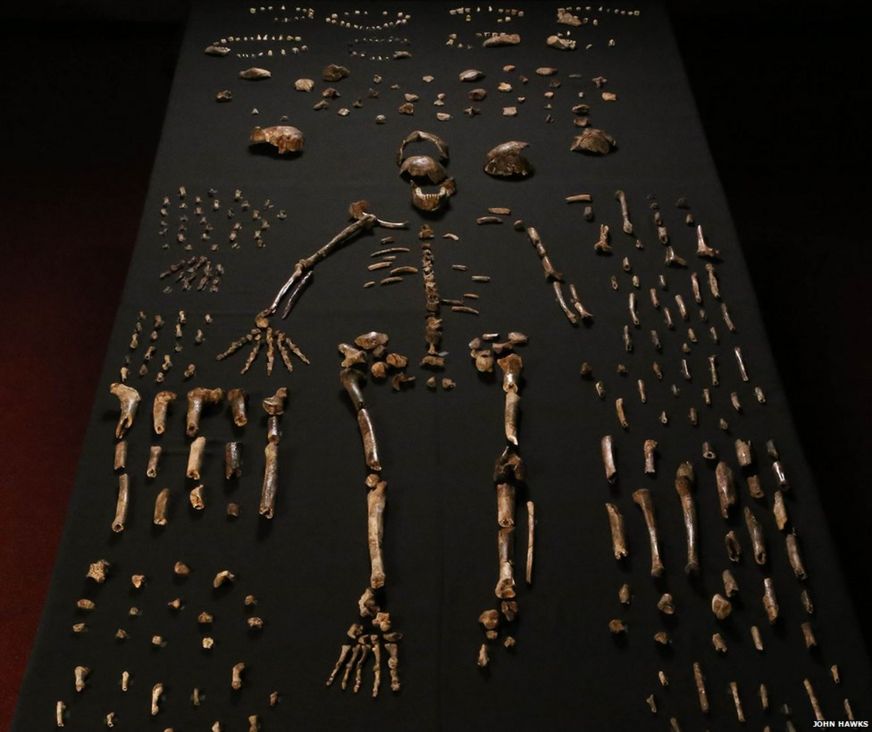
Last night I went through the latest archaeological findings reported on the news in South Africa (see a BBC summary here and the formal research written up here) regarding another finding of skeletons of very human-like creatures in South Africa in 2013.
I don't know about you, but as a Christian believer growing up in an increasingly science-affected culture and world-view, I guess I have become increasingly agnostic about questions of the age of the universe. Apparently time machines are and will remain impossible, so how on Earth will we ever be able to know about this issue for sure? Why do Christians get so wound up about this anyway?
Well, I suppose it is (once again) because of the insecurity created by asserting (in a believer's words), that God could assert anything powerful in a non-literal way. Creationists have a hard time with that, not because they are limited or less intelligent or bigoted, but because they want to hold to the literal truth of the Bible. And they have some interesting ammunition (and they need it).
Firstly, as already noted, we cannot scientifically observe an ancient Earth/universe. No time machines.
Secondly, if as a believer you go down a not-everything-in-the-Bible-is-literal track, then how on EARTH (excuse the pun) can you make a judgement call on what is and what is not literal? Pure liberalism would assert, of course, that it all may be non-literal.
Thirdly, there are prominent scientific researchers who, although a minority, remain convinced that the Biblical dating method is consistent with the evidence we can gather.
Fourthly, they may think they can counter claims that they are theologically-motivated because their opponents (maybe atheistic evolutionists) could also be shown to be motivated by personal convictions, not necessarily arising from the data.
They may have other good arguments too, but these are the ones in my mind at the moment.

Before we get into those, let me just share something quite awkward I never knew about for biblical dating of the universe, and it brings us back once again to that world of textual criticism that so many would prefer simply did not exist. But it does and it affects what Christians could believe to be foundational, even the 100% literal guys. UNDERLYING THE LITERAL TRUTH INTERPRETATION IS THE ASSUMPTION OF ONE, SOLID ORIGINAL BIBLICAL TEXT THAT WE HAVE ACCESS TO TODAY. Sorry, was I shouting? Here I go again:
The Masoretic (Hebrew) texts and the Septuagint (Greek) provide very different figures, if trying to add up the years literally via the genealogies (the literal "days" of creation in Genesis not really adding anything extra to this total). If you are a creationist, then you need to be able to say that you take ONE of these texts as authoritative, but which one? If you go with the Septuagint, then you have a universe dating back 7500 years; if you go with the Masoretic version, then it's 6000 years.
That is 1500 years of existence that may or may not have been. For a creationist, that is a huge expanse of time, but I have never heard it mentioned.

I say "they" in referring to creationist because I am not in the "they" camp. I am not a creationist; I do not believe in a 6-day creation, either at around 5500 BC ago or 4000 BC.

Part of the reason for this is that I believe that it is impossible for any Christian to truly treat the texts as some kind of mono-genre factual-knowledge book, as this textual problem should be making obvious. If it is a book of facts then why can't we know for sure if the Septuagint was an inaccurate translation of Hebrew source texts of those genealogies and that the Masoretic text was the accurate copy? Copyists and translators made mistakes and changes: accept it or shove it under the carpet.

So creationists are not "playing it safe" with the Bible. The opposite is true. By hiding textual realities and important exegetical concerns like genre, they can contribute to devaluing the credibility of the book they think they defend.