Showing posts with label Jewish expectations. Show all posts

Saturday, 4 November 2017

John’s third impacting figure: Dr Dale Tuggy

Fatscript Episode 7 show notes, John’s third impacting figure: Dr Dale Tuggy


Wednesday, 5 July 2017

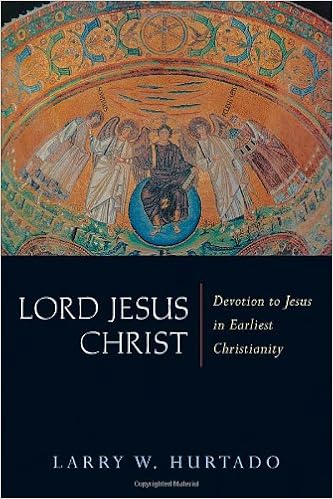
Lord Jesus Christ, by Larry Hurtado, Part 13: The Religious Environment

MONOTHEISM CONTINUES TO be a major discussion point among historians of Christian origins, and we looked for quite some time at that factor (Parts 5, 6, 8, and 9), that is to say, a factor or force that influenced the worship of Jesus by the first generations of Christians. I think it can legitimately cause us to marvel afresh at how these factors combined to permit monotheistic Jews to worship a human being. There was a considerable lot more going on, however, within both Judaism itself and the imperialist Roman regime's religious dimension.

Hurtado does not want to shy away from the possibility that early Christians, presumably including those who penned parts of what we call the New Testament, would have been affected by the environment in which they lived, with its opportunities and constraints. I'd wholeheartedly agree. I'm trying to push as firmly as I can in my unsophisticated way toward a realisation that the principles of the hermeneutical circle apply constantly, are basic to our humanity, and certainly applied to the authors of the New Testament. For instance, first-century hermeneutics will be an important part of my argument for the gospel of Matthew's treatment of misconstrued understandings of Jesus' baptism and a reinvigorating of Jewish Christianity in his own day and age. The voie longue of Ricoeur says that if we want to understand best what happened at a point then we have to follow that circle and even identify our own place in it. Anyway, the point is that acknowledging influence is good, but can be developed, I think, usefully according to hermeneutics theory.

For the remainder of today's post, I propose to simply list the examples provided of influences affecting Christ devotion, bearing in mind that they were clearly not intended to be exhaustive.

Religious influences of external origin (Greek/Roman):

  • The literary genre of bios adopted by the four canonical gospel writers (I wasn't particularly clear at first how this was relevant to the question of Jesus-devotion, but when we take the experiences described in the previous post I was reminded of just how far we have gone in the post-modern West from the holistic thinking evidenced in these diverse early Christian communities)
  • Message differentiation, in a very real sense those early Christians were asking for trouble! Check this interesting connection Hurtado makes: the rising frequency in the Christological use of divine sonship language that we see in the Christian writings of the late first century and thereafter may very well reflect a reaction against the contemporaneous increase in the use of the same rhetoric in the emperor cult under the Flavians and thereafter. (p. 75)
  • Making a stand - following their great example, Jesus, who was vindicated by God after making his own stand at the cross, Christians would have been aware of the high potential costs of making a stand as a follower of the Way. Or... not. Jesus had set a polarizing set of wheels in motion, which the brutal regime would reinforce through various forms of pressure.

Religious influences of Jewish origin

  • Calling Jesus, Christos, "a claim directed to Jewish hopes of the time for God's messianic mercy" (p. 75)
  • Christian baptism echoing John's baptism. That is correct to file this under "Jewish", however, Ehrman, Crossan and others I feel are correct in identifying a particular strand of Judaism into which both John and Jesus fitted, that of Jewish apocalypticism, no doubt strongest in the occupied homeland. Regarding impact on cultic practices, a connection could easily be made between this pressing concern for divine world clean-up and eager charismatic expectations of Christ's return.
  • Hostile Jewish criticism, themselves under pressure from the Roman regime to enforce a peace of submission. In fact, some were even led to interpret Roman Emperors in a messianic light. Here again, I was initially unclear as to the direct effect on Jesus-devotion, but the basic point seems to be that this might have reinforced the polarization effect already described. What might the positive end of that polarization look like (this is my addition)? Devotion to Jesus can and could be a bonding and entrenching proclamation; a proclamation that is imbued with significance because, in the communal setting, we are bound to our common belief in the face of criticism and mistrust from the establishment and even close family members. I wonder if the experience of hostility from religious family members could have felt similar to that experienced in many Muslim countries today by indigenous converts, whereby in both cases believers could receive consolation and purpose in the communal worship context.
  • Clearer definition of the people of God in countering the Jewish Christian insistence of Gentile circumcision. Actually, this is just an example to the wider influence of Jewish religious practice and belief of what it means to be God's chosen people. It seems to me that there could be other Jewish theological influences affecting the cultus, but these examples give a good flavour.

Universal

  • Symbolic meals. I'm separating this one out as it seems to me that the young Christian community would have naturally integrated special meals, being influenced from both sides to that end. Jewish followers of the Way would certainly expect something along those lines, and so would Roman, Greek and other converts. I would expect meals to have a universal quality about them.

That's it! We have reached the end of factor no. 4, having already looked at Hurtado's treatment of monotheism, Jesus himself, revelatory religious experiences and now the religious environment. In tomorrow's post, we can summarise and I'll recall Hurtado's chapter structure alongside the corresponding posts from this series. Thank you for following along and your input.


Saturday, 3 June 2017

Lord Jesus Christ, by Larry Hurtado - Part 4: No to history-of-religions explanations; No to naive christian apologetics explanations.

IT IS POSSIBLE to resume the remainder of Hurtado's introduction fairly succinctly - I will try to hold back on Triune Hub compatibility comments unless there are key links to be stressed.

Hurtado does not hold back on his thesis - I think that's excellent to get it out there so quickly. I have felt tempted in my own manuscript to allow the journey slowly unfold for the reader in a fashion similar to my own experience, but that does not necessarily constitute good writing. So his thesis in three points about Jesus worship is that
1. religious devotion to Jesus took place phenomenally early, waaay before Paul,
2. expands on point 1 to say that it was very intense and diverse (not entirely sure if the diversity is illustrated quite as well by Hurtado as the intensity, but let's put that question on hold for now)
3. expands on points 1 and 2 to underscore that all this was going on within the Jewish "matrix" of monotheistic religious thought and practice. This is Hurtado's groundbreaking argument really, which is aptly summarised at Kindle location 200 (sorry no page number available): Jesus functions as divine in the religious life of Christian groups of the first two centuries. If we link that to his opening sentence's usage of the word "centre", upon which we reflected here, then I feel confident that Hurtado could agree that "divinity" in the context of monotheistic "function", is fairly equivocal with his own usage of (quasi-spatial) religious centrality. However - Hurtado is not presuming to mean here in his Introduction anything akin to what Dunn labels "Jesus-olatry", making an idol of Jesus. Hurtado in this book will refer to Dunn at various junctures (as anyone writing in this field would have to; likewise for Hurtado), but is in agreement on that this binitarian devotion is only possible as through (extraordinary) appointment by God himself. One of my critiques of Hurtado will nonetheless be an insufficiently vigorous analysis of the distinctions between through and alongside with respect to Jesus' reception of worship, and where the respective emphases might lie between Pauline and Johannine churches.

Remember what I said yesterday: being religious, as Hurtado will point out in outstanding clarity, is not just about what you believe; it is also about what your beliefs bring you to do, which is why the study of worship patterns are so important in mapping out the evolution of Christian belief from within Judaism.

Hurtado is going to take on a major project here mapping out Jesus devotion in the first two centuries, but he senses, correctly in my view, that he does this in opposition to two critical pressure points, themselves opposed to one another. One of these is a liberal historical-critical method inspired by 20th century and earlier German theologians, which assumes that it can reconstruct the emergence of Jesus as a divine figure through normal historical (by which he might mean "merely human") process of inquiry that involved the syncretism of various worldviews. I think Hurtado also means by this that it does not require religious experience to account for Jesus' meteoric rise.

The second pressure point is from Christian apologetics, who would want to assume that no such historical inquiry is of any use since the New Testament - divinely inspired - has it all neatly laid out already, then any further work is probably a waste of time.

Hurtado will convincingly show both positions to be false: both the naive view and the familiar history-of-religions view are wrong in portraying early devotion to Jesus as basically simple, unremarkable, and not difficult to understand. (Kindle location 243). It was not simple inserting Jesus into a monotheistic framework and to find the suitable language (and reshape the framework without compromising it critically) - so the naive view is wrong. And its religious intensity is argued cogently in this book to be too early for the history-of-religions methodology, which downplays the necessity of religious experience. This earliness is underlined by an assumption (which I believe is justified, but that is another big body of research - feel free to click on "lord" as keyword on this blog to see some references and work into the LXX translation of Yahweh) that the earliest Christian Jews would have been familiar with "Lord" language and its associations for their fellow Greek-speaking Jewish converts. That said, from the chapters I have read so far, particularly chapter 1 that develops the thesis, that assumption and its limitations are not developed sufficiently in my view (e.g. widespread usage of Kyrios in ways that do not imitate LXX usage, c.f. even the flawed efforts to present 1 Cor 8:6 as "splitting of Shema", see 1 Cor 9, which immediately applies Kyrios to Christ in a non-LXX/Yahweh compatible fashion. Sorry. Pet topic.

That's the end of the introduction. In the next two posts I will summarise the first chapter of the book as it sets out the explanations for how and why Jesus worship arose in Christian circles. I hope you are excited - it really is a brilliant chapter.

Part 5 coming next...


Friday, 2 June 2017

Lord Jesus Christ, by Larry Hurtado - Part 3: Opening words of "Centrality" hit the nail on the head

THE OPENING WORDS of Hurtado's magnum opus were instant confirmation to me that I was holding the perfect book for my area of interest. Page 1, line 1, reads:

The indisputable centrality of the figure of Jesus in early Christian devotion is the premise for this book.

My emphasis. Being the theological nut that I am, I had to share this line with a friend instantly. I knew there was going to be overlap between my thesis and Hurtado's, but the opening line?! What am I so excited about here exactly? Everyone knows that Christians worship Jesus, he's the big deal Christians are so excited about, right? The point is, as will become apparent, is that the first Christians weren't just random folk who wanted their sins forgiven. They were Jewish. It has taken me a fair while to move from "ok, sure, so they were Jews" to really allowing this thought to take root and truly marvel at the ramifications. The first followers of Jesus understood their master to be a Jew and themselves to be Jews, and saw no reason for them to quit their heritage and ethnic identity. The first Christians did not convert to Christianity from Judaism. They remained Jews and continued to attend synagogue meetings where possible.

The reason why word three of this 650 page (100 pages of references as well) epic is so meaningful to me is that "centrality" is what a hub is all about. There is an as-yet underdeveloped semantic tool that will be able to help us better understand what is going on when religious people apply words like "divinity", and it is to do with religious centricity. The religious hub is the dynamic centre around which all else turns, yes, like a wheel. Being religious, as Hurtado will point out in outstanding clarity, is not just about what you believe; it is also about what your beliefs bring you to do. What Hurtado calls "devotion" is a catch-all phrase that he will later go on to define with a number of other technical terms, like "giving obeisance", reverence, prostration, song... it's dynamic action. But for a monotheistic faith like Judaism, there is only one who occupies that central dynamic core with which the people interact in such a way. Until now. Now those Christian "converts" who remained Jewish had integrated Another into the key interaction point of the very core of their belief system: worship. So I like "centre"; I like "centricity"; I like "core"; I like "heart". The reason why my absolute favourite is "hub" finally as the most suited term for the incredible Jewish revolution that is going on through Christ, is that a hub is both perfectly central and moving.

Sorry for that excursion - I just wanted to make it clear why I place so much value on the general emphasis of the book. Let's get back to Hurtado's own introduction and stated aims, my emphases again:

"I have proposed that in this development we have what amounts to a new and distinctive “mutation” or variant form of the monotheistic practice that is otherwise characteristic of the Jewish religious matrix out of which the Christian movement sprang. In this book my aim is to offer a full-scale analysis of the origin, development, and diversification of devotion to Christ in the crucial first two centuries of the Christian movement (ca. 30-170 C.E.)." [p. 2]

Not much comment required here really, as it simply confirms my earlier comments. Regarding the extended analysis into the second century, this is an interesting inclusion which follows Bousset's own presentation, which Hurtado explicitly affirms as his useful trailblazer. For me, the latter sections of this analysis will also be useful given my conviction that the philosophical work done around the hermeneutical circle are correct in their methodology. Therefore, if we are to understand texts that seem to us of deep importance written 1950 years ago, a great way to fill out the understanding is to see how the first interpreters emphasised and prevented from "misconstrual". By decompressing the New Testament canon as Hurtado does very successfully in my view, we can see evidence of the hermeneutical circle already at work. Hurtado's "mutation" is put in quotes simply because he does not want to put off the readership by a term that has been viewed by some as pejorative (see p. 50). However, it prepares the reader well for the dramatical inclusion of God's divine "vehicle" (yes, he quite likes that term in this book) in the sacred centre reserved for the one true God of Israel.

Part 4 coming soon.


Thursday, 9 October 2014

Son of God, Messiah, Jewish Religious Establishment's expectation on national salvation


Are you the Messiah, the Son of the Blessed One?’

62‘I am,’ said Jesus. 


This quote is from Mark chapter 14. The key point of this quote for me, as with my other post about Mark 12's present tense descriptions of the Messiah, is that we are able to access a 1st century jewish worldview here, because we can consider that we are accessing (for the moment, see the obvious assumption below) what a Jewish LEADER is thinking, teaching and upholding at the time of Jesus' ministry. That is a pretty cool peace of research if we can claim it.
For this high priest, we could say that he is aiming for total unambiguity here. Because he does not want any confusion to surround the "blasphemous" claims of Jesus, he makes it totally plain to us that for Jews at this time, there is a truly great Messiah to be expected, and who is also defined as the Son of God. The priest takes his vocation very seriously here of course and refers, like Matthew frequently does, to a synonym for God, "Blessed One". So for the Jewish establishment, represented here by the high priest, we can see that

THE MESSIAH = THE SON OF GOD


The assumption we must recognise of course is that the report we are reading through a follower of Jesus, Mark, has accurately reported the words of the high priest. I am very happy with this assumption, especially as we generally see a less stylised and earlier account through this gospel.

I would like to think that while the Jewish establishment were theologically favourable toward resurrection, that we do not have as much solid evidence that they were expecting a triune God to show up in his second hypostasis taking on flesh in Jesus in a hypostatic union (!). For the Jewish establishment, what is blasphemous here IS NOT that God would have a son, that was a given, but the issue of blasphemy here is that JESUS WOULD CLAIM HE WAS GOD'S ANOINTED ONE WHEN HE WAS NOT (or so it was presumed). It is difficult for us to imagine what is going through the High Priest's mind at this stage. The outrage. The fury. This man is trying to shake up and down his life, responsibilities, doctrine...

We have not even looked at the centurion's reaction as Jesus "breathed his last", but the implications of this mini-study on Jewish establishment perception on Messiahship and son of God, while less far-reaching perhaps on the unitarian vs trinitarian debate, can perhaps help us (certainly me) in dialogue with other faiths that do consider being "son of God" to be a blasphemous statement on totally different premises.