Showing posts with label The Son of God. Show all posts

Tuesday, 22 March 2016

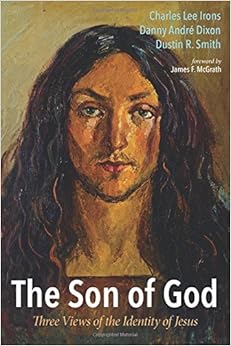
The Son of God: Three Views of the Identity of Jesus (2)

This is part 2 of my response to Irons' opening case, which is very focussed on a few specific arguments. This is important to note, as some apologists are not nearly so focussed and are banking on a cumulative effect. For some folk, like myself, this is a less profound or impacting methodology. So, apologies if the previous post was quite critical - it is nothing against Irons or his methodology (except the comment about his and Holmes' use of "being", which I think, is quite telling of the difficulty of the position to which he and other "one-self" Trinitarians hold).

Irons is going to have a lot to say about John - this is right. In my own research I found dozens of suggestive passages in this gospel, and it is the boldest in the claims it attributes to Jesus, and the absolute quietest on the Kingdom of God. One thing Irons rightly highlights is John's emphasis on Jesus coming "in the flesh". Why say that Jesus came in the flesh? That sounds like a strange thing to say if you did not have to defend against faulty thinking about the Christ, one that came from God not in the flesh. So it is readily agreed and understood to be an early or prototype anti-docetic affirmation, a heresy that for some reason Irons neither mentions nor explains. A reason for this perhaps is his keeness to show that the pre-existence of Christ is simply self-evident in such a passage as this. It is a good point that he needs to make in defense of a Trinitarian view, but here it needed better situating, which would have nuanced his quick conclusion somewhat.

Irons leaves John briefly to visit Paul, anticipating the argument that John's writings are late first century, allowing for christological development. He heads unswervingly to Philippians 2, the great, and early christological poem (p12). However, like with some translations (the NIV being among the worst in this instance), Irons does a little paraphrasing. He states:

"Jesus' decision not to regard equality with God as something to be used for his advantage".

Here the lexical decisions are all made for us and all ambiguity removed without any discussion whatsoever. That is a pity.  The Greek word used here by Paul/the poem is rare and difficult to trace within the canon, but outside it is used. Main usage seems to be (and I have checked this in other ancient literature) to pillage, take what is not already owned, like in a raid. So by assuming that this equality with God is something that Christ already has, Irons is steering the translation of Harpagmos away here from a common definition of the word. This assumption ignores other probable (and incompatible) meanings, justified primarily by the exact place he wants to take his readers: pre-existent coequality, which is a separate argument to pre-existence alone. This is therefore a little misleading given the subtitle he provides the reader (simply referring to pre-existence in Paul). A more likely translation is therefore "grasped after", and a more neutral translation that leads both options open (like the NET translation) is simply "grasped": He did not consider equality with God something to be grasped, full-stop. The Greek does not allow for anything more.

Now Irons continues by conflating that Jesus:
"humbled himself by becoming a man".

This is a conflation of the Greek. Irons strikes me again as slipping in his conclusion too early into his argumentation. If you want to look more into this you can check out the "raw" Greek here. There is not space here to discuss Philippians 2 more, but I recently did a post on the conclusion to the poem here.

Two tests of ontological deity

"Does divine sonship mean ontological deity in the sense of being eternally part of the divine being?...That is precisely what I believe the New Testament teaches." 

Where does it teach it? Teaching is explicit right? And how does that square with Irons' inconsistent use of "being"? We already saw that just two pages earlier, p11, he has stated that "the Word existed as a divine being distinct from God the Father". Irons is really confusing me now. Quite how does he define being

When he criticises (p. 13) his finally-fictitious counter-arguments for saying that the Trinitarian claim is a noxious exaggeration, I simply noted in the margin that you cannot exaggerate to a category not yet identified, by which I mean Christ's status as the Christ and Son of God is so totally unique and awesome by everyone's standards, that exaggeration is hardly the name of the Trinitarian game. Irons is trying to battle against 17th century Unitarians, but they just aren't present in this discussion.

His first test of ontological deity is one of my own top-suggestive themes in the New Testament: Creation. John, Hebrews and Paul share this creation-by-God-through-Christ language. 

1. John 1 - there is some great context for understanding John's presentation of logos through Philo, which I found while thinking about this. Wikipedia has a great little summary here on Philo. It is important because it precedes John by a few decades and gives us access into a wider philosophical current, and takes us away from thinking that this kind of language was just invented by God who downloaded it to John this way. This passage fails to defend the eternal begetting hypothesis, or that the pre-incarnate Word pre-existed as a son. He might have been, but like any Christian doctrine, you have to widen the search from any one passage, which Irons I think also agrees with, since he continues.


3. Colossians 1:16. This one is a whopper. Unfortunately, especially for someone who claims to be more influenced by the Greek stream (starting with three and working out how they are one), he opts for the confusing preposition "by" in translating "ἐν". What am I talking about? God the Father is always and consistently the source of creation, and that is precisely why the New Testament authors never place the active emphasis of creation on the Son. If the Son (if he was already the Son, but let us assume that for the moment) was both the active instigator and the means of creation, then the Father's role is totally annulled. The roles as clearly delineated and distinguished in the 1 Corinthians passage above do not permit anyone, especially Trinitarians, to translate "ἐν" with "by". NIV realised this on the 2011 revision and changed this. Irons prefers "by", and leaves me wondering why he thinks he is so Greek in his thinking.

The second argument of ontological deity from Irons is Aseity. I feel fairly sure that David Bercot would disagree with Irons, and fundamentally challenge his so-called Greek-allegiance. They would agree on the definition, a se, a latin phrase meaning that one's being is "from oneself". But they would not agree that aseity is a good Trinitarian-Scriptural argument. If you have some time - check out Bercot's video on the doctrine of the Trinity. Some other time I will probably look at it in more depth on the blog.


Aseity is often argued by evangelicals, even when they don't use the word. What it often looks like, in its most ugly guises, is WHO CARES if there is a Father or his empowering Presence? Jesus is everything, he doesn't need anything or anyone, he is GOD. Of course, Irons is not nearly so crass, but the argumentation, heavily reliant on a single verse (John 5:26) - sorry, I meant John 5:26b. For me, Irons scores much better on his creation argumentation than his aseity. We will see what Dixon and Smith have to say later.

In the next post, let us see how Irons treats the exaltation of Christ.

Saturday, 19 March 2016

Critiqued: The Son of God: Three Views of the Identity of Jesus (1)


If like me you are interested in Christology and the ways in which the interpretation of Scripture is affected by the lenses theologians adopt through their respective traditions, and if like me you would like to be more informed of the various arguments out there in a context of respect, then this book is a GOLD MINE. I don't know about you, but I often feel a bit swept away by an author I am reading. 

Here, however, we have three authors superbly sparring and bringing their alternative readings, and it forces you (unless you are partisan) to take a small step back and think for yourself. It is also a golden opportunity for me to critique all three views for apparent inconsistencies and unwarranted assumptions as per my own personal quest. The book is excellently prefaced by James McGrath, who also points out the friendship between the authors, which highlights the potential for fruitful dialogue rather than a shouting match.

Charles Lee Irons kicks off with his main presentation, which I will be covering here. It is well written and focusses on some good points, although I think there are some flaws in his approach which I will be pointing out.

Irons kicks off on page 3 by quoting Ralph Waldo Emerson, 19th Century New England Unitarian minister: "noxious exaggeration about the person of Jesus". He then states: "Dixon and smith... Presumably would agree with him there." They never do.

On the following page he points out that the doctrines of the Trinity and the incarnation are interconnected and inseparable. I think that is a point that most would broadly agree with, although, as we shall, his doctrine of the Trinity could be quite Augustinian. When Irons states for the first time that "God... gave him [Jesus] divine honor fitting for one who is eternally divine.... God exalted him -I scribbled a question in the margin that for me is a point I have yet to hear a satisfactory answer from hard-core Trinitarians -> [exalted] for the first time?

On page 6, Irons continues in his tactic to use loaded vocabulary: The "Son of God" title cannot be reduced to "Son of David" or "Messiah". It is true that the titles in Christ overlap without being identical, but Irons needs to be careful here, because are the other two titles he uses necessarily synonymous? By continuously throwing in words like "noxious exaggeration", "reduced", "mere", and so on, Irons is preparing both himself and his readers to not listen clearly to quite how the alternative views they are going to hear differ. Even within his own thinking it does not make much sense to talk about "reduced to" here, since Christ Himself fulfils all these roles. He is clearly desperate not to apply reductionist ideas to Christ, and I think fails to realise that this goal overlaps fully with both of his interlocutors.

On page 7, Irons lays out an argument that I find distinctly weak, because he reads a passage from the synoptic tradition where Jesus' identity is shown to be more than (or different to) a simplistic understanding of "Son of David". So if he's right in stating that this tradition states something correctly, why do I call the argumentation weak? The passage is based on Jesus' question to the Pharisees, which has a rhetorical climax that Irons misses, as he does not seem to fully understand the functional organisation of the rhetoric in Jesus' questioning of the Pharisees. There are three questions:

1. What do you think about the Christ?
2. Whose son is he? --> this is still part of the build-up, but here Irons interjects that the rhetorical climax is already revealed, thus diminishing the climax: "Yes, he is the son of David, but that cannot be all he is, for...". No. There are a few pages analysing how Jesus was shown to use rhetoric in my paper Trinitarian Interpretations, where I try to establish how, in line with general function of rhetoric, there is an unspoken form of required negative response, so obvious that it does not need stating. Whose son is he is not rhetorical, if it were, then the correct and obvious rhetoric response would be "no-one's son"! But this is a normal question requiring the normal answer.
3. How is it then that David calls him Lord?
When Irons now paraphrases: What ancestor calls his descendant "Lord", he seems to misplace the climax of the rhetorical questioning, which only arrives at #3, not #2, as Irons supposes.
The unfortunate conclusion in this paragraph of Irons is that "son of" = less than the person you are son of. Caution! Irons could be on very thin ice if he wants to demonstrate that in actual fact the Son is coequal with the Father.

On page 8, Irons seems weak again as he attempts to demonstrate a fundamental difference between Christ's sonship and the sonship of his disciples, stating that Jesus always makes the distinction of my Father and your Father, but never of "our Father", only, as Dustin Smith also later points out, Jesus does indeed state "our Father" in the Lord's prayer!

Irons soon gets to work on the charges of blasphemy to which Jesus was held answerable. I am not generally impressed by the blasphemy arguments, in part because the word "blasphemy" does not mean "to claim that you are Almighty God". Literally, the Greek word means "slander" and is impossibly translated elsewhere as a claim to ultimate divinity. With that in view, along with all the other clear distinctions made between Christ and God in the gospel of John, I argued in my paper that the John 10:33 passage could legitimately be translated "Make yourself god", rather than trying to replace God Almighty's functions or actually simply claim to be him (an argument bolstered by the fact that the word theos is anarthrous).

On page 9, Irons makes something of another messianic claimant (AD 131 - 135, a hundred years later, which leaves big fat wodge of assumptions that are presumably deemed unsignificant - same political climate, same number of followers, same threat over local unrest...), Simon bar Kosiba. My question concerning bar Kosiba: How did he treat the established religious authorities?

On page 10, Jesus is developed as the Revealer or Image of the Father. Since I am still going through Michael Heiser's Unseen Realm, I couldn't help thinking that this would have been really good to draw in Heiser's work on Genesis here, showing God's intention for man to be Yahweh's imagers on Earth, subdue it and govern it on his behalf as he would. No-one until Christ managed that. Irons also disses James Dunn's understanding that "there is more to God that what could be seen in and through Jesus" using Col 1:19 "in him all the fullness of God was pleased to dwell" --> Here I really wanted to know what Irons thought of the kenosis of Philippians 2: if he sides with the giving up of certain divine prerogatives, then Irons can't include here that which the Kenosis of Phil 2 precludes, right? Of course maybe he does not treat Philippians 2 that way. We will no doubt see later, but the point is you can't argue a full-throttle Col 1:19 on the one hand, and then scale back when it suits you, so I am kind of hoping that Irons does not attempt that manoeuvre.

Irons concludes this section with "To see the Son is to see the Father". He seems to take this in a rather literal, wooden way, not recognising the poetic nature of John's writings designed to cause readers to reflect deeply.

Page 11 discusses pre-existence and the incarnation, and I was encouraged to see Irons' care to state that sonship of God, as a sacred relationship that was so scandalous it provoked the Jewish leadership to charge Jesus with blasphemy. --> THIS STILL IS THE CASE IN ISLAM! (Some Muslims confusingly argue that Christians are misguided in thinking that Christ is fully divine according to our own Scriptures, and yet also, on a separate battlefield, will claim that those same texts are in fact corrupted anyway).

Our first author now focusses on preexistence specifically in the Johannine literature, and seems to make another strange and unorthodox move with his use of "being": "the Word (the Logos) existed as a divine being distinct from God the Father". This is an interesting statement, as while most Trinitarian theologians are keen to highlight that God is a single being, (within that one being there are not three other beings, but three persons, or hypostases), I notice some other brilliant scholars saying similar things, including one of my favourites, Stephen Holmes, as in his Fuller lecture that I mention in the end of my Trinitarian Interpretations paper.

When Irons quotes John 1: "He was in the beginning with God", I noted as a point of interest in my margin that this "he" in some French bibles is actually a "she" (elle), since what is actually be referred to is THE WORD, which is the feminine word la parole. There is nothing inherently masculine in the Greek word, unless you want it there of course.

On the subject of "wanting" the text to say things it doesn't - and I don't think either Dixon or Smith, the other contributors to this great book, pick up on this - Irons is without doubt guilty of this at points on the question of pre-existence and exaltation. On page 11 he writes:

there are several passages where Jesus speaks of three phases of his existence: the time before he came into the world, his earthly ministry, and the time when he goes back to the Father. For example, he says, "I came from the Father and have come into the world, and now I am leaving the world and going [back????] to the Father" (John 16:28). 

The first "back" is from Irons' interpretive position, supposedly preparing the reader for precisely that same clear reality in the text, where it is precisely missing.

OK - this was longer than I thought so I guess I should pause here for tonight!

Saturday, 12 December 2015

Bart Ehrman - mistaken on Judas?

Bart has done a few posts on the crucifixion. In a recent one he doubts that Paul was aware of the whole betrayal incident by Judas (in fact he even goes so far as to say "It is worth noting that the apostle Paul knows nothing of the tradition that Judas betrayed Jesus or that he killed himself". Before I say why he thinks that and why I am not at all convinced, let me share first something he had already said that was very interesting.


Based on the work of Albert Schweitzer, Bart agrees that maybe what happened was that on a deeper level of betrayal, Judas spilled the beans about the Messianic secret, which tied in closely with being the "Son of God", a messianic title. Bart states: "But what do the Jewish authorities accuse Jesus of?  They accuse him of calling himself the messiah (Mark 14:61-62; note: the “king of Israel” was also called “the son of God” – see 2 Sam. 7:11-14).

And that is the charge Pilate tries him on.  Pilate asks him “Are you the King of the Jews,” and [...] this is the reason he had him crucified."

This makes more sense to me than the simple garden-kissing incident alone.

So that is where I feel Bart sheds some potential light. However, where I am much more sceptical (it's so refreshing being sceptical of a sceptic!) is his take on Paul and Judas. He argues that Paul knew nothing of this betrayal. He bases this on two points (I only take serious issue with the first)

1. The fact that the word the gospel writers use for "betray" can also be used to mean "hand over", and not only that, but Paul never uses the word to mean "betray", According to Bart, this means that when Paul writes PARADIDOMI in 1 Cor. 11:22-24,  “On the night in which he was betrayed”, he is very unlikely to be referring to Judas' betrayal, but more the "handing over" of God. 

2. 1 Cor 15:5-8, Paul recounts eye-testimony to the resurrection:  first he appeared to Cephas, then to the twelve, then he appeared to more than 500... 12 minus 1 = 11! Fair point. They were only restored to the number of 12, according to Acts, after Jesus had ascended to the Father.

This is my response to Bart Ehrman on his blog (I shall post any follow-up correspondence if interesting):

What is not so clear is that PRODIDOMI has to mean betray. In Romans 11:35 it definitely doesn’t. Bart may well be right (that Paul was not referring to Judas but instead to God handing him over), but the assumptions of clear-cut definitions as he puts them here failed to satisfy me today.

Another thing PARADIDOMI doesn’t mean betray?!
Bart does specify that PAUL doesn’t use it this way, but he also does not draw attention to the fact that all four gospel writers use this word EXTENSIVELY to describe Judas and his act. If Paul doesn’t focus on Judas in his writings (or the very few writings that WE have), what other occasion would he have had to use PARADIDOMI in a betrayal sense? Finally, (smaller point) when Paul (and “Peter”) use PARADIDOMI, it is a bit wider than simply God delivering his son; Jesus also gives himself up, people are delivered to their own depravity, it’s quite general and not specifically located in a narrative, unlike this one passage in 1 Cor. 11:22-24. 


Sunday, 3 May 2015

John 10:33

We have traditionally understood the divine and the created orders as utterly distinct, separated as if by an unbridgeable chasm. Basil of Caeserea. That's the work of Christ, to bridge that chasm. Others have pointed to more of a spectrum of divinity, a hierarchy, although not emphasised in Isaiah but strong in other OT and extra-canonical writings. What I believe this passage indicates (in Greek, not this translation so much) is that there IS a chasm AND a spectrum, that the title that Jesus had assumed of himself SON OF GOD was considered a divine claim and condemnable as blasphemy. It also appears likely from :
- Jesus' response, which has no quotes in the Greek around the word "gods" (v34),
- the anarthrous theos, god, and the anarthrous anthropon, man (v33),
--> that the allegation in v33 carries indeed the sense of the indefinite article "a".
The " mere " of "mere man" I think is a stylistic interpolation of the NIV that while comprehensible may do nothing to draw us closer to the original meaning of these fascinating verses.

Thursday, 20 November 2014

Time-locked language Part 3

Update on posts Time-locked language Parts 1 and 2

We should note that Zizioulas (Holmes, QFT, p13) strongly emphasises the Father's causing principle within the trinity. Holmes says Zizioulas qualifies this causation as something "free and personal, not something mechanical and fixed." The question and challenge raised for this article on time-locked language, is now to find something that is "free and personal" that can be caused in a non-time-dependant way. Can you think of anything?

I think I finally see a way through here in looking back at the Greek word, αἰτία, an old theological principle to which Zizioulas wants to remain loyal. In Strong's Greek NT 156 we have indeed something less mechanical. Here we speak of "guilt", responsibility, accusation, fault, grounds, reason. I cannot deny that this opens a quite different discussion in terms of NT authors' perspective around the notion of causation, however, it really must not be forgotten that this word is not used for this purpose prior to the patristic period, that is hundreds of years AFTER the scriptures were written (it would seem particularly around the debates surrounding the Filioque clause, St Maximus the Confessor, and the 15th Century Council of Florence). Where the Scriptures speak of the interpersonal relationships between God the Father, Jesus Christ and the Holy Spirit vocabulary other than αἰτία is used. The word "send" jumps out very strongly in my mind.

Friday, 17 October 2014

Time-locked language (Part 2)

Source.

Generate.

Spirate.

Proceed.

Cause.

...................Beget. 

?


b. From doctrinal to Scriptural usage: a leap of faith

The Holy Scriptures agree about the time-rootedness of these words. Even in the closest we get to anything like a present tense, which I think might be Psalm 7:2 and its quotation (and validation?!) in Hebrews 1:5, we are still utterly time-bound. Today, yes, but: "I have begotten you". If that information is to be comprehended by a language-speaking educated human, then they are no longer at a conception stage or age, they are at an adoptive age. I am not saying that Jesus was adopted as Son of God here, in either a human way or even an ungraspable divine way, although some think this was one of the earliest christologies that may have existed (and by no means a bad thing either, check out Ehrman on the superiority in the Roman mind at least, of being adopted over a natural child). Whatever our later doctrinal take or attempt at expanding the past-tense of begotten - I just love the KJV's begat, I don't know why! - Scripturally we find ourselves more at home temporally and conceptually.

But if I am to nurture the concept of a big God, I need to get more comfortable with his surpassing my human limitations, right? Much is said and now written about "mystery" arguments of doctrine. What I retain is that to believe something you have to understand it and find it reasonable at least to some degree in order to believe in its truthfulness. Of course some of these "mysteries" are directly in the authoritative texts themselves (I am sure not all of those would seem mysterious to the original beneficiaries of the writings). But the greatest mysteries are not located there, they are unashamedly standing at the heart of the Nicean 4th Century Trinitarian declarations (i.e. not Tertullian, or other Logos theologians), the 5th Century's hypostatic union of Christ and perhaps finally in the two-willed Christ dyothelite (culminating as Holmes wholeheartedly reaffirms, in agreement of it not being the son of God praying in Gethsemane, for there is but one divine will).

So why does the doctrinal language attempt this language-leap? Why not just come up with their own jargon?
Well they do come up with a lot of jargon actually, as some of the previous paragraph should show. But not all. The leap in tense of beget, which is a scriptural word, is to do with this development of son of god to God the Son, son of God the Father (Nicea), while hanging on to the authority of scripture's key idea of begetting - although I might one day have more experience to debate the successfulness of that "hanging on" (not yet). Begetting usually means causing, and is at least close in meaning. But it is very difficult to hold out that both Jesus is eternal and that in the past at some point he was caused, was begotten, etc., even if that is what the Bible says (another less-known one, although this is more anecdotal really, is that Jesus is always said to have loved us, i.e. love through action at the cross). The way around this of course is to choose a "more suitable" tense that connects us better - although in good and right recognition of God's ineffability, not perfectly - to the deeper connections within the "Godhead" that unlock us slightly from time. Assumption: the Scriptures are perfect, holy, infallible but a bit too time-locked.

A trinitarian conclusion: perhaps we can humanly make progress to comprehending a triune God's timeless begetting, being begotten, sending and proceeding, when we think in terms of non-specific effect. So in this line of thinking, we might just possibly be able to conceive of the effect of fathership and sonship... (and spiritship!) to be mutually, permanently and effectively caused. "Sustained" still seems closer to me, though.

Thursday, 16 October 2014

Time-locked language (Part 1)

Source.

Generate.

Spirate.

Proceed.

Cause.

...................Beget. 

?

In today's post, I am going to somewhat vaguely, air something of a theological frustration of mine. This frustration is more felt against theologians than God, and more aimed at ancient theologians than recent ones, which should be a big clue to me to go and do some more homework. The frustration is based on:

a. the way causing works in most (if not all) instances in human languages - I argue it is semantically time-locked, or if not completely time-locked, limited to general non-specific effects, and effects which are inherently about change.
b. the way in which the tenses shift from scripture to doctrine (i.e. Jesus was begotten by the Father in scripture, and the Father begets [eternally generates] the Son, in doctrinal parlance).

Because a. took me longer to write than I initially thought, I will post b. separately.

A Time-locked causation

When we try, sometimes I get the impression of "try desperately", to make the doctrinal ideas fit Scripture and the Scripture the doctrinal ideas (Church fathers), or indeed to make the Scriptures agree with one another within the model of the doctrine (Holmes), we forget, or we forgot, something that is very basic indeed. The above words (cause, generate, beget, etc.) cannot be used, or only very rarely used, in describing the eternal or permanent. In my two languages of English and French, these words are inseparable from the notions of time and movement. Of course, that may not be the case in Greek, I need to check, but needless to say, I anticipate issues there also for the simple reason that we have chosen these words as apt and suited for translation purposes. This is why my questions to a fictive, English-speaking, 4th-century pro-Nicene theologian might be: "what does it mean to cause something that has always existed?" "What is there left in the word 'cause' once you remove time from its very essence?" 
And finally: "Please, would you stop misreading (Holmes' word, not mine) Isaiah 53:8?!"

As Christians, we do not believe that any human language is divine, in the sense, for example, that Muslims believe the Arabic language comes directly from Allah. Greek is just Greek, and so on, developed necessarily by humans to express and comprehend their needs and lives. When rain falls and the sun shines and the seeds are sown, and the gods smile, the crops grow. They were not, and now they are. Causation. There is little in causing-vocabulary that lends itself to describing an eternal or permanent action.

This said, I would first like to take a moment to try very hard and disprove my own objection to be sure. Look at two natural examples with me that may seem to create "mind space" for this kind of perpetual causation, examples that would be valid for people back then as they area now: first the moon, then the sun.

1. The moon's gravitational effect


We cannot be sure what people presumed about the phenomena of tides, but for the sake of this article let us assume that some kind of causal connection was made between the location of the moon the tide. Does the moon perpetually cause tides? Yes I think for the sake of this counter-argument, we could say it does. But let us be clear here, we are not saying that one huge lump of water is produced or removed over and over, all we can say is that this phenomenon is perpetually caused by the position of the moon. A permanent effect. So the moon's gravity on our oceans helps us provide a little leg-room on the perpetual side, while still absolutely being locked into movement.

2. Heat from the sun

Let's keep it astral. So does the sun's steady warmth (leaving aside seasons, weather fluctuations, day and night and everything else) provide us with more linguistic head space? Unlike the moon's gravitational effects on the ocean's movements, the heat we sense does not change, and yet this warmth is caused continuously, without it, we would freeze to death in an instant.
Here we certainly can discount 1st or 4th century notions of vibrating molecules, and their movement, besides that would just be getting a bit too theoretical! Well, what is warmth? Warmth is a sensation I feel after I have been feeling cold. So while there is change and time-lockedness there, we could move on to simply say the warmth of the sun is essential to life. The warmth of the sun (in combination with other factors), causes life. Continuously.

So having identified some room for this notion of perpetual causation from natural phenomena, we should note the following key points: 1) permanent causation examples seem fewer and are theoretical, i.e. no two actual tides are identical even in the same location, 2) the only permanent cause examples seem to be phenomenal change-inducing effects, i.e. the warmth of the sun helps cause the crops to grow. There is no specific thing or creature or person that is perpetually begotten or caused in our human languages.

So, as mentioned in the intro, I argue that causing is semantically time-locked, and where not completely time-locked, limited to general non-specific effects, and effects which represent change.

Update: Note that Zizioulas (Holmes, QFT, p13) strongly emphasises the Father's causing of the Trinity. Holmes qualifies this causation as something "free and personal, not something mechanical and fixed." The question and challenge raised for this article on time-locked language, is now to find something that is "free and personal" that can be caused in a non-time-dependant way. Can you think of anything?

I think I finally see a way through here in looking back at the Greek word, αἰτία, an old theological principle to which Zizioulas wants to remain loyal. In Strong's Greek NT 156 we have indeed something less mechanical. Here we speak of "guilt", responsibility, accusation, fault, grounds, reason. I cannot deny that this opens a quite different discussion in terms of NT authors' perspective around causation, however, it really must not be forgotten that this word is not used prior to the patristic period, that is hundreds of years AFTER the scriptures were written (it would seem particularly around the debates surrounding the Filioque clause, St Maximus the Confessor, and the 15th Century Council of Florence).

Thursday, 9 October 2014

Son of God, Messiah, Jewish Religious Establishment's expectation on national salvation


Are you the Messiah, the Son of the Blessed One?’

62‘I am,’ said Jesus. 


This quote is from Mark chapter 14. The key point of this quote for me, as with my other post about Mark 12's present tense descriptions of the Messiah, is that we are able to access a 1st century jewish worldview here, because we can consider that we are accessing (for the moment, see the obvious assumption below) what a Jewish LEADER is thinking, teaching and upholding at the time of Jesus' ministry. That is a pretty cool peace of research if we can claim it.
For this high priest, we could say that he is aiming for total unambiguity here. Because he does not want any confusion to surround the "blasphemous" claims of Jesus, he makes it totally plain to us that for Jews at this time, there is a truly great Messiah to be expected, and who is also defined as the Son of God. The priest takes his vocation very seriously here of course and refers, like Matthew frequently does, to a synonym for God, "Blessed One". So for the Jewish establishment, represented here by the high priest, we can see that

THE MESSIAH = THE SON OF GOD


The assumption we must recognise of course is that the report we are reading through a follower of Jesus, Mark, has accurately reported the words of the high priest. I am very happy with this assumption, especially as we generally see a less stylised and earlier account through this gospel.

I would like to think that while the Jewish establishment were theologically favourable toward resurrection, that we do not have as much solid evidence that they were expecting a triune God to show up in his second hypostasis taking on flesh in Jesus in a hypostatic union (!). For the Jewish establishment, what is blasphemous here IS NOT that God would have a son, that was a given, but the issue of blasphemy here is that JESUS WOULD CLAIM HE WAS GOD'S ANOINTED ONE WHEN HE WAS NOT (or so it was presumed). It is difficult for us to imagine what is going through the High Priest's mind at this stage. The outrage. The fury. This man is trying to shake up and down his life, responsibilities, doctrine...

We have not even looked at the centurion's reaction as Jesus "breathed his last", but the implications of this mini-study on Jewish establishment perception on Messiahship and son of God, while less far-reaching perhaps on the unitarian vs trinitarian debate, can perhaps help us (certainly me) in dialogue with other faiths that do consider being "son of God" to be a blasphemous statement on totally different premises.