Copyright

Showing posts with label christology. Show all posts
Showing posts with label christology. Show all posts
Saturday, 11 November 2017

Wednesday, 4 October 2017
Figures who have impacted my journey: Larry Hurtado
Some notes:
- Book chapter is out! Check it out here. Almost works as a standalone paper.- Quote from James McGrath review of Ehrman's most recent book: Accurate memory is preserved, even in the process of distorting or reinterpreting it. And so it is frustrating when Ehrman discusses the work of famous form critics such as Bultmann and Dibelius but talks only about the fabrication of memories to meet the needs of churches in the pregospels period, to the neglect of the more interesting question of how the needs of those churches might have led to the reinterpretation of things the early Christians remembered about what Jesus said and did that were not pure fabrication (64–65). Some will suspect that Ehrman is still influenced here by his fundamentalist background, which tends to think of matters of authenticity or historicity in an all-or-nothing manner.
By the way, apologies to McGrath for probably mispronouncing his name!
- John's gospel criticism, please don't misunderstand me on the Jesus is/is not God thing!
- Dr. Hurtado's blog: https://larryhurtado.wordpress.com/
- Dr. Hurtado's interviews on Trinities here, here, here and here
- Dr. Hurtado's personal recommendation to my series on his post here
- Tetragram/tetragrammaton , relief from trinity work. First contact. Explain the project *dormant*
- My "gleanings" from my first response series (first series summary here) to Lord Jesus Christ
- Key terms: programmatic inclusion alongside. Binitarian.- Question of centrality (see my post on Hurtado's opening words here)
- mutation proponent, and "unsuccessful mutations"
- methodology
- Jesus as LORD/Lord.... more on that next time!
Tuesday, 11 July 2017
Hermeneutic Circle and asking better "why" questions
I have been making the newbie mistake of calling this circle a hermeneutical circle - sorry about that! The hermeneutic circle is a process of interpreting a text (or an author via his text) as developed in particular by Heidegger and Gadamer. In short, the disappointing news is that where the circle is operative, it is de facto going to bar your access to a text in any objective way.
The text is understood to have two important conditions. It must be terribly important to the reader, and it must be at least in part(s) difficult to comprehend. This difficulty is not necessarily readily apparent, I don't think, but is evidenced through the inevitable gap in "horizons" separating the author and the reader, differing worldviews affected by time in history, geographical location, culture, and so on.

Unfortunately, because hermeneutics was only developed in the last few hundred years, I am not sure how effectively it has been applied to our key question at hand: the emergence of the Triune God around the end of the fourth century, and indeed to other theological matters that "crystallised" in various directions. Even during the first century, I believe that we have the necessary ingredients to see the circle clearly in operation, and that is very significant if we are ever going to be able to move Christian apologetics away from frankly unconvincing anachronistic importations from a later time and yet still hold to some form of sensible first-to-fourth century continuity. If we are to achieve this goal, then hermeneutics is key. Not primarily in the sense of how we bridge the gap to today, our own contexts and our own lives, but to see how earlier gaps might have been bridged by Christians in the past, long before the word "hermeneutic" had ever been dreamed up. First century Judea was not fourth century Constantinople!
The text is understood to have two important conditions. It must be terribly important to the reader, and it must be at least in part(s) difficult to comprehend. This difficulty is not necessarily readily apparent, I don't think, but is evidenced through the inevitable gap in "horizons" separating the author and the reader, differing worldviews affected by time in history, geographical location, culture, and so on.
Unfortunately, because hermeneutics was only developed in the last few hundred years, I am not sure how effectively it has been applied to our key question at hand: the emergence of the Triune God around the end of the fourth century, and indeed to other theological matters that "crystallised" in various directions. Even during the first century, I believe that we have the necessary ingredients to see the circle clearly in operation, and that is very significant if we are ever going to be able to move Christian apologetics away from frankly unconvincing anachronistic importations from a later time and yet still hold to some form of sensible first-to-fourth century continuity. If we are to achieve this goal, then hermeneutics is key. Not primarily in the sense of how we bridge the gap to today, our own contexts and our own lives, but to see how earlier gaps might have been bridged by Christians in the past, long before the word "hermeneutic" had ever been dreamed up. First century Judea was not fourth century Constantinople!
But what is this hermeneutic circle? Very simply put and as I understand it, it is the to and fro between the (Christian canonical) text and the reader's conceptual framework of meaning, out of which she is making sense of that text ("WHOLE", below). Each of these crisscrossing "trips" effects both elements (the whole and interpretation of the part), by which I mean the reader's general and multilayered understanding (right up to "their theology") and their interpretation of what the text is saying.

History of Christianity doesn't seem to embrace this concept enough, but perhaps it does attempt it under different guises.
One historian of Christian antiquity whose work I continue to respect is Bart Ehrman. His book How Jesus Became God arrived at a critical time in my deconstruction process in 2014 and the entire journey to which this blog bears witness. But it is his earlier and lesser known academic volume (and it is a sizeable book to be sure) The Orthodox Corruption of Scripture, that I think carries a fantastic example of what I am trying to get at here. This book is of considerable note because it is really Ehrman's original field of expertise, textual criticism - since then it seems that he has strayed a bit into other areas in a (successful) bid to write for a wider audience. In The Orthodox Corruption of Scripture, Ehrman carefully and correctly insists that not all the changes that Christian scribes copying the texts made were accidental. The evidence for that is pretty irrefutable, multifaceted and extensive. Although I felt at times the book development made for some hypothesis-supporting conjecture, i.e. a too-tight association of a deliberate scribal corruption according to a specific heresy, the fundamental point that the scribe is safeguarding against misconstrual (rather than, in the scribe's mind, "corrupting" the text) is vital and all that matters for my purposes here. Ehrman has stacks of examples, but one that is perhaps the most deeply inscribed into my memory is Jesus' added titles. At various points in the codexes, scribes would deliberately add "Christ" and "Lord" at points they considered significant in the new copies they were transcribing. Why? There are other points in Scripture that contain combinations of "Lord Jesus", "Jesus Christ" and even "Lord Jesus Christ", so why add it to the new transcription? Here's Ehrman's reasoning, and it makes sense: some branches away from "orthodox" Christianity would read the Christian texts according to a variant "whole" (see above diagram), which included a "separationist Christology" (incredibly, that is still affirmed by popular Franciscan priest, Richard Rohr: Jesus is sharply and explicitly differentiated from "the Christ", "the Cosmic Christ", etc). According to this "whole", the Holy Spirit scene at Jesus' baptism was construed as the moment when the cosmic Christ entered into Jesus, before leaving him at his death on the cross (by the way, I am not saying that this is the conclusion Rohr makes, I'm sure it isn't). Back in the early Christian centuries, by adding "Christ", scribes certainly did not think they were the ones doing the corrupting. Quite the opposite, actually. By emphasising the inseparability of Jesus Christ (or Jesus from Christ), the scribes would have seen themselves as safeguarding a better interpretation against corruption.
There is always meaning to be found.
So, why would the church perform some almighty U-turn by suddenly switching from a Unitarian God to a Triune God sometime around the Niceno-Constantinopolitan Creed of 381? Put this way, as Biblical Unitarians sometimes infer, it seems impossible, random, unbiblical, and... meaningless. I follow Dale Tuggy's work quite closely on his blog trinities.org (definitely worth checking, loads of great material in there), and I even get to contribute in a couple of very small ways to his show. But the closest I have seen to an answer to this fundamental "why" question, is that Greek mythology was rife with divine triads, and the fourth century was very complicated theologically for the church. But even as Tuggy does an expert job (in my opinion) at unravelling some of that fourth-century complexity, the listener is left with a decidedly bleak impression that these were such chaotic and political times, that there must, therefore, be a degree of randomness there that subverted Orthodox belief away from the Truth, and that this has stuck for a really, really long time.
I no longer buy it. We need to mine these controversies afresh to see what the deeper meaning is behind these debates, from both sides as far as we can understand them. For me, and I have probably mentioned this before, but it does no harm in repeating, there is one particular treasure to be mined in this transitional period, that is the very creed orthodox tradition has since labelled "The Blasphemy", officially: The Second Creed of Sirmium (357). It states: And the whole faith is summed up and secured in this, that the Trinity must always be preserved, as we read in the Gospel, Go ye and baptize all nations in the Name of the Father, and of the Son, and of the Holy Ghost. Complete and perfect is the number of the Trinity.
I've said it before, I'll say it again: they were all Trinitarians, they all believed that since Jesus and the sending of the Holy Spirit, there was a new centre to the faith that emerged from Judaism. So here's the crazy thing: the very creed that is dubbed "The Blasphemy" contains the very goal that united everybody. The problem with Sirmium was the interpretation of Jesus' words: "The Father is greater than I". So if the "Whole" comprises the three in (roughly) equal measure, and you want to push for "greater greatness" in one of the Three, what might be the interpreted outcome? I'll tell you exactly what I think the worry really was. Greatness in religion corresponds, I would argue nearly perfectly, with centricity. And if you make Father, Son or Spirit more central, then it is precisely that preservation of the Trinity that is thrown out of whack.
Look, I am not saying that the Triune God is "biblical", but I am going to give it credit for this: it posed a stable platform and standard from which further theological reflection could be realised without messing about with this important centricity issue, which up until this time lacked vocabulary. Where it had beforehand lacked vocabulary, it had not lacked meaning. So what do I think about the Triune God? It's interpretative. I've been saying that for two years now, but now with the help of the hermeneutic circle, I think we can see the strength of that claim. The Triune God solution is not random - it has purpose and is in line with the perceived threats of that time. It also includes quite a lot of ambiguity, as Tuggy points out, which actually dotes the stability also with flexibility.
I'm really eager to take this discussion soon back to Ricoeur's work, whose ideas about "ontology" (and its pitfalls) speak profoundly to the debates around the Trinity doctrine. Ricoeur also has helped me realise that it is possible that despite their best intentions, Biblical Unitarians might actually be importing some of the fourth-century baggage into their first-century analysis in precisely the ways they lament sloppy Triune-God advocates do, everyone failing to integrate historical hermeneutics into their models. My Triune Hub model must not make that mistake!
As chaotic and turbulent a century as the fourth century was to Christianity, it is vital that we see continuity as well as discontinuity. Sometimes the discontinuity at the time that seems huge to us from our vantage point might have seemed like a minor point of a whole series of adjustments that, just like in Ehrman's textual example, avoided misconstrual of a historically preceding idea, and guess what: it is "terribly important" and "difficult to understand".
Hermeneutics, we welcome you to the first four centuries of Christianity!

History of Christianity doesn't seem to embrace this concept enough, but perhaps it does attempt it under different guises.
One historian of Christian antiquity whose work I continue to respect is Bart Ehrman. His book How Jesus Became God arrived at a critical time in my deconstruction process in 2014 and the entire journey to which this blog bears witness. But it is his earlier and lesser known academic volume (and it is a sizeable book to be sure) The Orthodox Corruption of Scripture, that I think carries a fantastic example of what I am trying to get at here. This book is of considerable note because it is really Ehrman's original field of expertise, textual criticism - since then it seems that he has strayed a bit into other areas in a (successful) bid to write for a wider audience. In The Orthodox Corruption of Scripture, Ehrman carefully and correctly insists that not all the changes that Christian scribes copying the texts made were accidental. The evidence for that is pretty irrefutable, multifaceted and extensive. Although I felt at times the book development made for some hypothesis-supporting conjecture, i.e. a too-tight association of a deliberate scribal corruption according to a specific heresy, the fundamental point that the scribe is safeguarding against misconstrual (rather than, in the scribe's mind, "corrupting" the text) is vital and all that matters for my purposes here. Ehrman has stacks of examples, but one that is perhaps the most deeply inscribed into my memory is Jesus' added titles. At various points in the codexes, scribes would deliberately add "Christ" and "Lord" at points they considered significant in the new copies they were transcribing. Why? There are other points in Scripture that contain combinations of "Lord Jesus", "Jesus Christ" and even "Lord Jesus Christ", so why add it to the new transcription? Here's Ehrman's reasoning, and it makes sense: some branches away from "orthodox" Christianity would read the Christian texts according to a variant "whole" (see above diagram), which included a "separationist Christology" (incredibly, that is still affirmed by popular Franciscan priest, Richard Rohr: Jesus is sharply and explicitly differentiated from "the Christ", "the Cosmic Christ", etc). According to this "whole", the Holy Spirit scene at Jesus' baptism was construed as the moment when the cosmic Christ entered into Jesus, before leaving him at his death on the cross (by the way, I am not saying that this is the conclusion Rohr makes, I'm sure it isn't). Back in the early Christian centuries, by adding "Christ", scribes certainly did not think they were the ones doing the corrupting. Quite the opposite, actually. By emphasising the inseparability of Jesus Christ (or Jesus from Christ), the scribes would have seen themselves as safeguarding a better interpretation against corruption.
There is always meaning to be found.
So, why would the church perform some almighty U-turn by suddenly switching from a Unitarian God to a Triune God sometime around the Niceno-Constantinopolitan Creed of 381? Put this way, as Biblical Unitarians sometimes infer, it seems impossible, random, unbiblical, and... meaningless. I follow Dale Tuggy's work quite closely on his blog trinities.org (definitely worth checking, loads of great material in there), and I even get to contribute in a couple of very small ways to his show. But the closest I have seen to an answer to this fundamental "why" question, is that Greek mythology was rife with divine triads, and the fourth century was very complicated theologically for the church. But even as Tuggy does an expert job (in my opinion) at unravelling some of that fourth-century complexity, the listener is left with a decidedly bleak impression that these were such chaotic and political times, that there must, therefore, be a degree of randomness there that subverted Orthodox belief away from the Truth, and that this has stuck for a really, really long time.
I no longer buy it. We need to mine these controversies afresh to see what the deeper meaning is behind these debates, from both sides as far as we can understand them. For me, and I have probably mentioned this before, but it does no harm in repeating, there is one particular treasure to be mined in this transitional period, that is the very creed orthodox tradition has since labelled "The Blasphemy", officially: The Second Creed of Sirmium (357). It states: And the whole faith is summed up and secured in this, that the Trinity must always be preserved, as we read in the Gospel, Go ye and baptize all nations in the Name of the Father, and of the Son, and of the Holy Ghost. Complete and perfect is the number of the Trinity.
I've said it before, I'll say it again: they were all Trinitarians, they all believed that since Jesus and the sending of the Holy Spirit, there was a new centre to the faith that emerged from Judaism. So here's the crazy thing: the very creed that is dubbed "The Blasphemy" contains the very goal that united everybody. The problem with Sirmium was the interpretation of Jesus' words: "The Father is greater than I". So if the "Whole" comprises the three in (roughly) equal measure, and you want to push for "greater greatness" in one of the Three, what might be the interpreted outcome? I'll tell you exactly what I think the worry really was. Greatness in religion corresponds, I would argue nearly perfectly, with centricity. And if you make Father, Son or Spirit more central, then it is precisely that preservation of the Trinity that is thrown out of whack.
Look, I am not saying that the Triune God is "biblical", but I am going to give it credit for this: it posed a stable platform and standard from which further theological reflection could be realised without messing about with this important centricity issue, which up until this time lacked vocabulary. Where it had beforehand lacked vocabulary, it had not lacked meaning. So what do I think about the Triune God? It's interpretative. I've been saying that for two years now, but now with the help of the hermeneutic circle, I think we can see the strength of that claim. The Triune God solution is not random - it has purpose and is in line with the perceived threats of that time. It also includes quite a lot of ambiguity, as Tuggy points out, which actually dotes the stability also with flexibility.
I'm really eager to take this discussion soon back to Ricoeur's work, whose ideas about "ontology" (and its pitfalls) speak profoundly to the debates around the Trinity doctrine. Ricoeur also has helped me realise that it is possible that despite their best intentions, Biblical Unitarians might actually be importing some of the fourth-century baggage into their first-century analysis in precisely the ways they lament sloppy Triune-God advocates do, everyone failing to integrate historical hermeneutics into their models. My Triune Hub model must not make that mistake!
As chaotic and turbulent a century as the fourth century was to Christianity, it is vital that we see continuity as well as discontinuity. Sometimes the discontinuity at the time that seems huge to us from our vantage point might have seemed like a minor point of a whole series of adjustments that, just like in Ehrman's textual example, avoided misconstrual of a historically preceding idea, and guess what: it is "terribly important" and "difficult to understand".
Hermeneutics, we welcome you to the first four centuries of Christianity!
Saturday, 3 September 2016
Another opportunity to push Ehrman on John
Another opportunity has arisen to quiz Bart Ehrman on his confusing presentation of John's Christology. My previous efforts, to which he did not respond, you could read here, but were echoed and encouraged elsewhere. See also another correspondence with him here. You can't help but feel he is dodging the issue a bit. Here's the latest, from his post concerning the plurality of theological perspective in the New Testament, entitled: Different Ways of Describing the Theology of the New Testament (I agree with him that it differs internally more than systematic theologians like to permit, but that's not the point) (sorry, part of his post will not be visible if you are not a subscriber to his blog).
Bart wrote, typically, that for John: "Christ is a divine figure who is equal with God who has come from God to reveal the truth that can bring eternal life". Ehrman likes to contrast John's Christology with a radically different perspective from Mark or Luke, make John's a huge leap toward 4th century doctrinal solutions.
I responded: Dr Ehrman, do you not think it is actually possible that John is addressing a real or potential **misconception** within his community that Christ was equal with God, when he has Jesus saying that he is going to the Father, because he (the Father) is greater than him (Jesus)?
I responded: In which case (still thinking about your original statement), would it be more accurate (and wordy) to say that John incorporates a plurality of traditions, some of which affirm Christ’s equality with God and others that refute it? Personally, I would see this as too detached and inconsistent for John whose views I think you would agree are omnipresent.
The point is that the author cannot be saying just that Christ is equal with God if he explicitly has Jesus saying that he is not equal with the Father. Logically then it is either
a) Jesus is both equal and not equal (somehow)
or
b) Jesus is not equal.
The author is not writing a compendium of different traditions. He's going for it and even explicitly writes down why it was written down this way John 20:31.
Let's see if Bart does answer though, maybe he can give the further clarification I and others have found he has often lacked on John.
Bart wrote, typically, that for John: "Christ is a divine figure who is equal with God who has come from God to reveal the truth that can bring eternal life". Ehrman likes to contrast John's Christology with a radically different perspective from Mark or Luke, make John's a huge leap toward 4th century doctrinal solutions.
I responded: Dr Ehrman, do you not think it is actually possible that John is addressing a real or potential **misconception** within his community that Christ was equal with God, when he has Jesus saying that he is going to the Father, because he (the Father) is greater than him (Jesus)?
Bart responded: I think instead that it’s very complicated, that John incorporated traditions that emerged at different periods in his community’s history, and these traditions are sometimes at odds, christologically.
From my experience, I'd say it is unlikely that he will continue the conversation further. But hopefully you get the point I keep trying to expose. What I meant by this final sentence that is not adequate to retreat back from the initial assertion about John see's Jesus as equal with God (and on previous occasions, Bart has just flat out declared that for John, "Jesus is God", something that even some relatively conservative evangelical scholars are hesitant to express in these terms) with talk of John just incorporating multiple traditions. John is not simply gathering diverse materials about Jesus. Unlike the synoptics that are based on textual sources (or at least Matthew and Luke), John is totally fresh and the content shaped by its strong theological message. Unlike what Ehrman says about the author of John (he knows nothing of the local context and was not at all an eyewitness or connected to any eye-witnesses), I would say some of the specific details in John's gospel show that this is either who it is traditionally connected with (son of Zebedee), or more likely, someone intimately connected with that resulting circle (I actually have a pet theory/speculation that John had recently died at the point of the writing of John's gospel, for the exact and perhaps commissioned purpose of not losing this teaching).
The point is that the author cannot be saying just that Christ is equal with God if he explicitly has Jesus saying that he is not equal with the Father. Logically then it is either
a) Jesus is both equal and not equal (somehow)
or
b) Jesus is not equal.
The author is not writing a compendium of different traditions. He's going for it and even explicitly writes down why it was written down this way John 20:31.
Let's see if Bart does answer though, maybe he can give the further clarification I and others have found he has often lacked on John.
Friday, 1 July 2016
A new (very small additional) argument for a Triune Divinity from canonicity
...The second part that is overlooked is early Christianity. Did the early christians think that Jesus was Fully Divine, where that means that Jesus has all the Divine attributes? No they didn't. It's a matter of record that leading mainstream theologians taught that Jesus was not eternal, Jesus does not know as much as the Father, Jesus doesn't have the same kind of power, Jesus isn't good in the same way - his goodness depends on the goodness of God, whereas God has his goodness independently. Who am I talking about? Mainstream theologians in the 100s, and in the 200s and even into the 300s. When they came to a text like: "The Father is greater than I", they just said: yes, see: "greater". They didn't say greater with respect to his human nature but equally great with respect to his divine nature". And when he said he didn't know the day or the hour, they said "yes, only God is omniscient". Jesus isn't omniscient, he says he doesn't know something, you don't want to say he's a liar, right? You just don't find most early Christians saying that Jesus is fully divine. You see them saying things that go very clearly against that. Even after they're speculating about the pre-existent logos, the logos is divine, even after they're calling Jesus "our God", they'll turn right around and say the one True God is the Father, and only he is eternal, only he is perfect in knowledge and so on. And as we have just looked at, this claim that Jesus is fully divine is fully loaded with problematic speculations; it always was.
- Dale Tuggy, 2016, http://trinities.org/blog/podcast-145-tis-mystery-immortal-dies/ at ‘Tis Mystery all - 21st Century Reformation Theological Conference 30/04/2016
For me, originally a die-hard exegesis fan (and the die-hard is not dead yet), this argument is very significant. In my paper Trinitarian Interpretations, I argued that if we are right about the early church Fathers not believing that God was Triune, then we have a problem. One of the solutions I considered, which I have never heard argued, is that the inspired 1st century authors were so inspired that they were literally centuries ahead of their subsequent interpreters. Most people prefer to argue that the earlier (Ehrman would call them "proto-orthodox") theologians, were roughly right, but they were less refined or something like that.
I think there are quite a few theologians who believe the conciliar Christologies are basically on track and that this perspective simply takes a very long time to work out (and it is not finished yet, and its various interpretations today are multiple and mutually-incompatible). That might mean that non-triune things are said in the Scriptures, which, if all are to be considered true on a deep level, that you end up with something looking like a form of Trinitarianism. But God set the whole thing up for a huge debate from an obscure beginning in order for it to stand somehow (because it didn't come easily; paradoxically because it was not as blazingly obvious as evangelical apologists like to assume and argue today). That's an argument I'd be more open to: but I think I have another option still. These beliefs about the Triune God began around about the same time the canon was sealed, so to speak. It could be argued that the wrestling and debating going on with regard to canonicity are not independent of the christological wrestling. Had the canon been clearer earlier, then maybe the Triune God perspective would have emerged earlier too. The same church that decided these are the books, is the church that said, this is our Christ.
My position might be considered to drift. It isn't, or hasn't much. I still firmly believe given the lack of clarity and the supreme position of the Scriptures, the close proximity of the church Fathers in terms of chronological interpretive distance, that we have to allow for greater breadth and tolerance and welcome differing views of the Father and of the Son and of the Holy Spirit. For me, the Father and the Son and the Holy Spirit remain central to church life, individual faith and the advancing Kingdom of God. And that has always been the case for me.
This is where the Biblical Unitarian communities, I think, also need to be careful. They can be so sceptical of a whiff of a "divine" Christ, that it could be harder for them (I speculate) to worship Jesus, even if they knew it was to the glory of God the Father, as explicitly stated in Philippians 2.
Let the debate roll on!
- Dale Tuggy, 2016, http://trinities.org/blog/podcast-145-tis-mystery-immortal-dies/ at ‘Tis Mystery all - 21st Century Reformation Theological Conference 30/04/2016
For me, originally a die-hard exegesis fan (and the die-hard is not dead yet), this argument is very significant. In my paper Trinitarian Interpretations, I argued that if we are right about the early church Fathers not believing that God was Triune, then we have a problem. One of the solutions I considered, which I have never heard argued, is that the inspired 1st century authors were so inspired that they were literally centuries ahead of their subsequent interpreters. Most people prefer to argue that the earlier (Ehrman would call them "proto-orthodox") theologians, were roughly right, but they were less refined or something like that.
I think there are quite a few theologians who believe the conciliar Christologies are basically on track and that this perspective simply takes a very long time to work out (and it is not finished yet, and its various interpretations today are multiple and mutually-incompatible). That might mean that non-triune things are said in the Scriptures, which, if all are to be considered true on a deep level, that you end up with something looking like a form of Trinitarianism. But God set the whole thing up for a huge debate from an obscure beginning in order for it to stand somehow (because it didn't come easily; paradoxically because it was not as blazingly obvious as evangelical apologists like to assume and argue today). That's an argument I'd be more open to: but I think I have another option still. These beliefs about the Triune God began around about the same time the canon was sealed, so to speak. It could be argued that the wrestling and debating going on with regard to canonicity are not independent of the christological wrestling. Had the canon been clearer earlier, then maybe the Triune God perspective would have emerged earlier too. The same church that decided these are the books, is the church that said, this is our Christ.
My position might be considered to drift. It isn't, or hasn't much. I still firmly believe given the lack of clarity and the supreme position of the Scriptures, the close proximity of the church Fathers in terms of chronological interpretive distance, that we have to allow for greater breadth and tolerance and welcome differing views of the Father and of the Son and of the Holy Spirit. For me, the Father and the Son and the Holy Spirit remain central to church life, individual faith and the advancing Kingdom of God. And that has always been the case for me.
This is where the Biblical Unitarian communities, I think, also need to be careful. They can be so sceptical of a whiff of a "divine" Christ, that it could be harder for them (I speculate) to worship Jesus, even if they knew it was to the glory of God the Father, as explicitly stated in Philippians 2.
Let the debate roll on!
Saturday, 26 March 2016
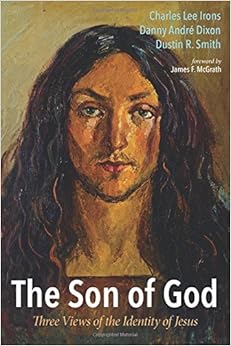
The Son of God: Three Views of the Identity of Jesus (3)
This is the third instalment of Iron's presentation in the book I am covering:
 In the second post, we looked at his primary arguments of creation (Jesus falls on the creator side of the creator-creature divide, his better argument) and aseity (one's being is from oneself, his weaker argument), and I questioned his true allegiance to the Eastern side of Trinitarian development. Today, we will see that Irons resumes a theme he already opened up slightly earlier around page 11, when he talks of the three stages of Christology, for which I already noted a lack of Scriptural evidence because of the phrasing of the divine exaltation language (there is no sense of resuming or taking BACK what was already his rightfully - or ontologically, if we use a word Irons would use). Let us see if he has anything fresh to add to this problem for his position.
Wow - given some of the difficulties we have already identified in his methodology I struggle to see how he thinks this kind of language helpful to open and thought-provoking dialogue. If it is proven already, then it's game over, right?
He continues: Some have attempted to argue for a 2-stage christology that eliminates the preexistence phase. But this would mean that a human being has been exalted to a position of divine honor that does not properly belong to him according to...ONE OF ... His ontological natureS.
The capitals are mine. As with his inconsistent application of the noun "being", we also see a rather particular use of "nature". Perhaps it is Irons' insistence on Christ being as ontologically divine as the Father that causes him to place greater emphasis on his divine nature. But if he truly believes in the two-natures hypothesis (Christ, fully God and fully man), then we need to qualify this statement to argue that the Father exalted Christ to his right hand, that is Christ's right by virtue of his divine nature. Or have I missed something here? This is explained a bit in this video here.
Regarding the point itself, no, that is not the picture I clearly or directly retrieve from Scripture. If this were the first century picture, then I would like to ask Irons why it is that the notion of Christ resuming his previously-owned divine prerogatives is not made more evident? Does he think it is implied? In Philippians 2 it is a clear act of God the Father to exalt his Son. Christ has now inherited the Name, of Lord. Inheritance is not about resumption is it? He has been sat precisely at God's right hand by God and to God's own glory (Philippians 2:11). Irons nuances things slightly now, but leaves us with the unfortunate Trinitarian predicament that prior to his incarnation, the pre-existent Son, was ontologically divine but NOT of the same status to which he was later exalted. Perhaps it was always ascribed to be his, or something like that.
Pages 17-18 show us the features of Christ's exaltation, however, which according to Irons do demonstrate that his divine honors are linked to his ontological deity as the preexistent Son, rather than some active great action of God the Father (I reject any down-playing of active and necessary involvement of the Father, especially when in direct contradiction of Scripture):
Firstly, Christ's sovereignty is Yahweh's. No mere creature could be given that divine authority as Lord of all creation. Neither Dixon nor Smith accept this conceptualisation of their respective positions, for as I pointed out previously, the 17th century unitarians Irons seems keen to engage with are not present in this debate. I think this "mere creature" lingo is nonsense on quite a few levels. One that is less developed by either Smith or Dixon, is that I also don't think humans are "mere creatures" anyway: I'll reserve that for the bugs and the bees, Deuteronomy 4:15-18. Also humans are God's imagers. The bugs and the bees aren't. If you have a bit of time, see Heiser on this and popular misreadings that contradict sanctity of human life ethics with a theology equating divine image bearing with criteria such as intelligence or choice: https://www.youtube.com/watch?v=589NDmbH9nk
Secondly, Christ himself is worshipped through his exaltation. "…the NT, which was largely composed by men brought up within and committed to strict Jewish monotheism that abhorred the worship of any creature…" This is particularly with reference to animal idols presumed to contain the spirits of other nations' gods. This has nothing to do with the natural and normal expectation for people before human kings is to prostrate before them (unless they are self-promoting themselves into that realm, as we see with Pharaoh or Caesar for example).
Irons' quote of Larry Hurtado indicates to me he is off-track here: the OT passage [taken from LXX Isa 45:23], the one that is "among the most fervent expressions of God's uniqueness," has been "adapted (and apparently interpreted) to affirm Jesus as supreme over all creation." - Hurtado, How on Earth, p. 50. Hurtado definitely sees that early Christians understood that Christ was made Lord, i.e. God granted "kyrios-ship" to Jesus. This is a very different picture Irons is painting on early Christian worship. I can only hope that either Irons is misreading Hurtado here; anything else could be deliberate mis-representation.
Thirdly, Christ's third feature of exaltation is his Divine Name. Isa 42:8 "my glory I give to no other" - good spot. If we wanted to be picky, we could perhaps remember that Isaiah doesn't say my name of Lord or my authority I will not give to another.
On Philippians 2:10, Irons paraphrases "God has highly exalted his obedient Son Jesus as the one who bears the divine name (my emphasis, we can note that he has a distinct preference for the verb "bearing" over the vocabulary provided in the text itself, which is interesting.) Irons also presumes YHWH in Hebrew or Kyrios in Greek to be synonymous.
A) YHWH IS KYRIOS = OK, ALTHOUGH NON-IDENTICAL
B) KYRIOS IS YHWH = NOT OK AS ASSUMES A) TO BE A STATEMENT OF IDENTICALS, OR INDISCERNIBILITY
Bascially, they are not quite the same. Yahweh is a proper name, Kyrios is not or certainly does not need to be. Any lexicon will point this out that the meaning goes all the way from God Almighty down to "sir". No-one debates that flexibility, and no-one debates that that YHWH is a proper name for Israel's Almighty God. That said, Larry Hurtado also is helpful to us here, as on his blog he quotes research into the usage of Kyrios in the LXX, wherein it is asserted that without the article, especially in the Pentateuch, Kyrios is used as a name when translating YHWH. This is actually data I think Irons could have used to defend his case, but he did not reach to it in later cross-examination.
"The granting of the divine name, YHWH, to the Son is legitimate...". This is interpretative, and it would have been nice of Irons to acknowledge this before throwing it out there. Why? Because, as pointed out by Hurtado and other scholars (see the above link), while YHWH = KYRIOS (in the relative sense), KYRIOS is not identical to YHWH. Irons is going much, much further than the text explicitly permits, which is **simply** (!) a granting of YHWH's "kyrios-ship". The biblical language regarding the nature of this transferral you can check for yourselves: "granting", "inheriting", "giving", etc. It is from the Father to the Son (see my inquiry into causation language here). Therefore trying to state that "the granting of the divine name, YHWH, to the Son is legitimate" is a muddle even on Irons' own terms, because he is on the verge of saying that YHWH is basically the Father, and he would (correctly) avoid at all costs saying that the Father has granted his name of Father to the Son".
And so we arrive at a page which contains for me the two most intriguing quotes of the whole book. It's page 20, and Irons says two quite striking things. The first telling quote:
"YHWH is basically the name of the Father"
His argument on the preceding page about YHWH not sharing his glory with another would seem to go against that understanding. If YHWH is the Triune God, then YHWH is not basically the name of one member of the Trinity, but the whole shebang, unless he is arguing for some kind of limited revelation of Isaiah. If that is the case, a lot of his Isaiah argumentation is on shaky ground anyhow. But he doesn't make that concession, so we are simply left to wonder quite how he holds his position together. The confusion continues in quite explicit fashion as he repeats:
"Thus, when the Son is exalted, he receives the divine name, YHWH, because it is fitting in terms of his ontological status."
Let us move on directly to the second intriguing quote, later congratulated by Smith:
Great! And do you know why? It is because Irons is acutely aware of the problems around the "fallacy of equivocation" (changing the meaning of a word in a philosophical argument). He proceeds in his most key paragraph (I think) of the whole book, wherein he implicitly lays out the problem of confusing nature, personal attributes and order, which Burcot connects with Latin Augustinian Trinitarianism and the subsequent "Athanasian Creed" (see Bercot video around 24 minutes in, nested in the previous post here).
Irons wraps up (p21-22) with a reminder of two grammatically disputed references to Christ being our great God, "No wonder he is called "our (great) God and Savior Jesus Christ" (Titus 2:13; 2 Pet 1:1), and stating: "Millions of ordinary Christians throughout history have confessed that Jesus is the Christ, the Son of God, exalted at God's right hand as sovereign Lord over all creation, and have put their faith and trust in him as their divine Savior and have worshipped him as such." Oh. This is a surprising ecumenical conclusion that takes the reader quite by surprise, since all parties are likely to agree with this.
Next: Dixon and and Smith's response highlights.
The Exaltation of Christ
Unfortunately, Irons shows excessive confidence in his position for such a discussion when he introduces his progress thus far in this chapter: "At this point, the ontological deity of the eternal Son has been proven. Yet the New Testament has still more to say to "seal the deal" (my emphasis). We will see!Wow - given some of the difficulties we have already identified in his methodology I struggle to see how he thinks this kind of language helpful to open and thought-provoking dialogue. If it is proven already, then it's game over, right?
He continues: Some have attempted to argue for a 2-stage christology that eliminates the preexistence phase. But this would mean that a human being has been exalted to a position of divine honor that does not properly belong to him according to...ONE OF ... His ontological natureS.
The capitals are mine. As with his inconsistent application of the noun "being", we also see a rather particular use of "nature". Perhaps it is Irons' insistence on Christ being as ontologically divine as the Father that causes him to place greater emphasis on his divine nature. But if he truly believes in the two-natures hypothesis (Christ, fully God and fully man), then we need to qualify this statement to argue that the Father exalted Christ to his right hand, that is Christ's right by virtue of his divine nature. Or have I missed something here? This is explained a bit in this video here.
Regarding the point itself, no, that is not the picture I clearly or directly retrieve from Scripture. If this were the first century picture, then I would like to ask Irons why it is that the notion of Christ resuming his previously-owned divine prerogatives is not made more evident? Does he think it is implied? In Philippians 2 it is a clear act of God the Father to exalt his Son. Christ has now inherited the Name, of Lord. Inheritance is not about resumption is it? He has been sat precisely at God's right hand by God and to God's own glory (Philippians 2:11). Irons nuances things slightly now, but leaves us with the unfortunate Trinitarian predicament that prior to his incarnation, the pre-existent Son, was ontologically divine but NOT of the same status to which he was later exalted. Perhaps it was always ascribed to be his, or something like that.
Pages 17-18 show us the features of Christ's exaltation, however, which according to Irons do demonstrate that his divine honors are linked to his ontological deity as the preexistent Son, rather than some active great action of God the Father (I reject any down-playing of active and necessary involvement of the Father, especially when in direct contradiction of Scripture):
Firstly, Christ's sovereignty is Yahweh's. No mere creature could be given that divine authority as Lord of all creation. Neither Dixon nor Smith accept this conceptualisation of their respective positions, for as I pointed out previously, the 17th century unitarians Irons seems keen to engage with are not present in this debate. I think this "mere creature" lingo is nonsense on quite a few levels. One that is less developed by either Smith or Dixon, is that I also don't think humans are "mere creatures" anyway: I'll reserve that for the bugs and the bees, Deuteronomy 4:15-18. Also humans are God's imagers. The bugs and the bees aren't. If you have a bit of time, see Heiser on this and popular misreadings that contradict sanctity of human life ethics with a theology equating divine image bearing with criteria such as intelligence or choice: https://www.youtube.com/watch?v=589NDmbH9nk
Secondly, Christ himself is worshipped through his exaltation. "…the NT, which was largely composed by men brought up within and committed to strict Jewish monotheism that abhorred the worship of any creature…" This is particularly with reference to animal idols presumed to contain the spirits of other nations' gods. This has nothing to do with the natural and normal expectation for people before human kings is to prostrate before them (unless they are self-promoting themselves into that realm, as we see with Pharaoh or Caesar for example).
Irons' quote of Larry Hurtado indicates to me he is off-track here: the OT passage [taken from LXX Isa 45:23], the one that is "among the most fervent expressions of God's uniqueness," has been "adapted (and apparently interpreted) to affirm Jesus as supreme over all creation." - Hurtado, How on Earth, p. 50. Hurtado definitely sees that early Christians understood that Christ was made Lord, i.e. God granted "kyrios-ship" to Jesus. This is a very different picture Irons is painting on early Christian worship. I can only hope that either Irons is misreading Hurtado here; anything else could be deliberate mis-representation.
Thirdly, Christ's third feature of exaltation is his Divine Name. Isa 42:8 "my glory I give to no other" - good spot. If we wanted to be picky, we could perhaps remember that Isaiah doesn't say my name of Lord or my authority I will not give to another.
On Philippians 2:10, Irons paraphrases "God has highly exalted his obedient Son Jesus as the one who bears the divine name (my emphasis, we can note that he has a distinct preference for the verb "bearing" over the vocabulary provided in the text itself, which is interesting.) Irons also presumes YHWH in Hebrew or Kyrios in Greek to be synonymous.
A) YHWH IS KYRIOS = OK, ALTHOUGH NON-IDENTICAL
B) KYRIOS IS YHWH = NOT OK AS ASSUMES A) TO BE A STATEMENT OF IDENTICALS, OR INDISCERNIBILITY
Bascially, they are not quite the same. Yahweh is a proper name, Kyrios is not or certainly does not need to be. Any lexicon will point this out that the meaning goes all the way from God Almighty down to "sir". No-one debates that flexibility, and no-one debates that that YHWH is a proper name for Israel's Almighty God. That said, Larry Hurtado also is helpful to us here, as on his blog he quotes research into the usage of Kyrios in the LXX, wherein it is asserted that without the article, especially in the Pentateuch, Kyrios is used as a name when translating YHWH. This is actually data I think Irons could have used to defend his case, but he did not reach to it in later cross-examination.
"The granting of the divine name, YHWH, to the Son is legitimate...". This is interpretative, and it would have been nice of Irons to acknowledge this before throwing it out there. Why? Because, as pointed out by Hurtado and other scholars (see the above link), while YHWH = KYRIOS (in the relative sense), KYRIOS is not identical to YHWH. Irons is going much, much further than the text explicitly permits, which is **simply** (!) a granting of YHWH's "kyrios-ship". The biblical language regarding the nature of this transferral you can check for yourselves: "granting", "inheriting", "giving", etc. It is from the Father to the Son (see my inquiry into causation language here). Therefore trying to state that "the granting of the divine name, YHWH, to the Son is legitimate" is a muddle even on Irons' own terms, because he is on the verge of saying that YHWH is basically the Father, and he would (correctly) avoid at all costs saying that the Father has granted his name of Father to the Son".
And so we arrive at a page which contains for me the two most intriguing quotes of the whole book. It's page 20, and Irons says two quite striking things. The first telling quote:
"YHWH is basically the name of the Father"
His argument on the preceding page about YHWH not sharing his glory with another would seem to go against that understanding. If YHWH is the Triune God, then YHWH is not basically the name of one member of the Trinity, but the whole shebang, unless he is arguing for some kind of limited revelation of Isaiah. If that is the case, a lot of his Isaiah argumentation is on shaky ground anyhow. But he doesn't make that concession, so we are simply left to wonder quite how he holds his position together. The confusion continues in quite explicit fashion as he repeats:
"Thus, when the Son is exalted, he receives the divine name, YHWH, because it is fitting in terms of his ontological status."
Let us move on directly to the second intriguing quote, later congratulated by Smith:
"I hesitate to say "Jesus is God," nor would I say "Jesus is not God."
Great! And do you know why? It is because Irons is acutely aware of the problems around the "fallacy of equivocation" (changing the meaning of a word in a philosophical argument). He proceeds in his most key paragraph (I think) of the whole book, wherein he implicitly lays out the problem of confusing nature, personal attributes and order, which Burcot connects with Latin Augustinian Trinitarianism and the subsequent "Athanasian Creed" (see Bercot video around 24 minutes in, nested in the previous post here).
Irons wraps up (p21-22) with a reminder of two grammatically disputed references to Christ being our great God, "No wonder he is called "our (great) God and Savior Jesus Christ" (Titus 2:13; 2 Pet 1:1), and stating: "Millions of ordinary Christians throughout history have confessed that Jesus is the Christ, the Son of God, exalted at God's right hand as sovereign Lord over all creation, and have put their faith and trust in him as their divine Savior and have worshipped him as such." Oh. This is a surprising ecumenical conclusion that takes the reader quite by surprise, since all parties are likely to agree with this.
Next: Dixon and and Smith's response highlights.
Tuesday, 22 March 2016
The Son of God: Three Views of the Identity of Jesus (2)
This is part 2 of my response to Irons' opening case, which is very focussed on a few specific arguments. This is important to note, as some apologists are not nearly so focussed and are banking on a cumulative effect. For some folk, like myself, this is a less profound or impacting methodology. So, apologies if the previous post was quite critical - it is nothing against Irons or his methodology (except the comment about his and Holmes' use of "being", which I think, is quite telling of the difficulty of the position to which he and other "one-self" Trinitarians hold).
Irons is going to have a lot to say about John - this is right. In my own research I found dozens of suggestive passages in this gospel, and it is the boldest in the claims it attributes to Jesus, and the absolute quietest on the Kingdom of God. One thing Irons rightly highlights is John's emphasis on Jesus coming "in the flesh". Why say that Jesus came in the flesh? That sounds like a strange thing to say if you did not have to defend against faulty thinking about the Christ, one that came from God not in the flesh. So it is readily agreed and understood to be an early or prototype anti-docetic affirmation, a heresy that for some reason Irons neither mentions nor explains. A reason for this perhaps is his keeness to show that the pre-existence of Christ is simply self-evident in such a passage as this. It is a good point that he needs to make in defense of a Trinitarian view, but here it needed better situating, which would have nuanced his quick conclusion somewhat.
Irons leaves John briefly to visit Paul, anticipating the argument that John's writings are late first century, allowing for christological development. He heads unswervingly to Philippians 2, the great, and early christological poem (p12). However, like with some translations (the NIV being among the worst in this instance), Irons does a little paraphrasing. He states:
"Jesus' decision not to regard equality with God as something to be used for his advantage".
Here the lexical decisions are all made for us and all ambiguity removed without any discussion whatsoever. That is a pity. The Greek word used here by Paul/the poem is rare and difficult to trace within the canon, but outside it is used. Main usage seems to be (and I have checked this in other ancient literature) to pillage, take what is not already owned, like in a raid. So by assuming that this equality with God is something that Christ already has, Irons is steering the translation of Harpagmos away here from a common definition of the word. This assumption ignores other probable (and incompatible) meanings, justified primarily by the exact place he wants to take his readers: pre-existent coequality, which is a separate argument to pre-existence alone. This is therefore a little misleading given the subtitle he provides the reader (simply referring to pre-existence in Paul). A more likely translation is therefore "grasped after", and a more neutral translation that leads both options open (like the NET translation) is simply "grasped": He did not consider equality with God something to be grasped, full-stop. The Greek does not allow for anything more.
Now Irons continues by conflating that Jesus:
"humbled himself by becoming a man".
This is a conflation of the Greek. Irons strikes me again as slipping in his conclusion too early into his argumentation. If you want to look more into this you can check out the "raw" Greek here. There is not space here to discuss Philippians 2 more, but I recently did a post on the conclusion to the poem here.
In the next post, let us see how Irons treats the exaltation of Christ.
Irons is going to have a lot to say about John - this is right. In my own research I found dozens of suggestive passages in this gospel, and it is the boldest in the claims it attributes to Jesus, and the absolute quietest on the Kingdom of God. One thing Irons rightly highlights is John's emphasis on Jesus coming "in the flesh". Why say that Jesus came in the flesh? That sounds like a strange thing to say if you did not have to defend against faulty thinking about the Christ, one that came from God not in the flesh. So it is readily agreed and understood to be an early or prototype anti-docetic affirmation, a heresy that for some reason Irons neither mentions nor explains. A reason for this perhaps is his keeness to show that the pre-existence of Christ is simply self-evident in such a passage as this. It is a good point that he needs to make in defense of a Trinitarian view, but here it needed better situating, which would have nuanced his quick conclusion somewhat.
Irons leaves John briefly to visit Paul, anticipating the argument that John's writings are late first century, allowing for christological development. He heads unswervingly to Philippians 2, the great, and early christological poem (p12). However, like with some translations (the NIV being among the worst in this instance), Irons does a little paraphrasing. He states:
"Jesus' decision not to regard equality with God as something to be used for his advantage".
Here the lexical decisions are all made for us and all ambiguity removed without any discussion whatsoever. That is a pity. The Greek word used here by Paul/the poem is rare and difficult to trace within the canon, but outside it is used. Main usage seems to be (and I have checked this in other ancient literature) to pillage, take what is not already owned, like in a raid. So by assuming that this equality with God is something that Christ already has, Irons is steering the translation of Harpagmos away here from a common definition of the word. This assumption ignores other probable (and incompatible) meanings, justified primarily by the exact place he wants to take his readers: pre-existent coequality, which is a separate argument to pre-existence alone. This is therefore a little misleading given the subtitle he provides the reader (simply referring to pre-existence in Paul). A more likely translation is therefore "grasped after", and a more neutral translation that leads both options open (like the NET translation) is simply "grasped": He did not consider equality with God something to be grasped, full-stop. The Greek does not allow for anything more.
Now Irons continues by conflating that Jesus:
"humbled himself by becoming a man".
This is a conflation of the Greek. Irons strikes me again as slipping in his conclusion too early into his argumentation. If you want to look more into this you can check out the "raw" Greek here. There is not space here to discuss Philippians 2 more, but I recently did a post on the conclusion to the poem here.
Two tests of ontological deity
"Does divine sonship mean ontological deity in the sense of being eternally part of the divine being?...That is precisely what I believe the New Testament teaches."
Where does it teach it? Teaching is explicit right? And how does that square with Irons' inconsistent use of "being"? We already saw that just two pages earlier, p11, he has stated that "the Word existed as a divine being distinct from God the Father". Irons is really confusing me now. Quite how does he define being?
When he criticises (p. 13) his finally-fictitious counter-arguments for saying that the Trinitarian claim is a noxious exaggeration, I simply noted in the margin that you cannot exaggerate to a category not yet identified, by which I mean Christ's status as the Christ and Son of God is so totally unique and awesome by everyone's standards, that exaggeration is hardly the name of the Trinitarian game. Irons is trying to battle against 17th century Unitarians, but they just aren't present in this discussion.
His first test of ontological deity is one of my own top-suggestive themes in the New Testament: Creation. John, Hebrews and Paul share this creation-by-God-through-Christ language.
1. John 1 - there is some great context for understanding John's presentation of logos through Philo, which I found while thinking about this. Wikipedia has a great little summary here on Philo. It is important because it precedes John by a few decades and gives us access into a wider philosophical current, and takes us away from thinking that this kind of language was just invented by God who downloaded it to John this way. This passage fails to defend the eternal begetting hypothesis, or that the pre-incarnate Word pre-existed as a son. He might have been, but like any Christian doctrine, you have to widen the search from any one passage, which Irons I think also agrees with, since he continues.
3. Colossians 1:16. This one is a whopper. Unfortunately, especially for someone who claims to be more influenced by the Greek stream (starting with three and working out how they are one), he opts for the confusing preposition "by" in translating "ἐν". What am I talking about? God the Father is always and consistently the source of creation, and that is precisely why the New Testament authors never place the active emphasis of creation on the Son. If the Son (if he was already the Son, but let us assume that for the moment) was both the active instigator and the means of creation, then the Father's role is totally annulled. The roles as clearly delineated and distinguished in the 1 Corinthians passage above do not permit anyone, especially Trinitarians, to translate "ἐν" with "by". NIV realised this on the 2011 revision and changed this. Irons prefers "by", and leaves me wondering why he thinks he is so Greek in his thinking.
The second argument of ontological deity from Irons is Aseity. I feel fairly sure that David Bercot would disagree with Irons, and fundamentally challenge his so-called Greek-allegiance. They would agree on the definition, a se, a latin phrase meaning that one's being is "from oneself". But they would not agree that aseity is a good Trinitarian-Scriptural argument. If you have some time - check out Bercot's video on the doctrine of the Trinity. Some other time I will probably look at it in more depth on the blog.
Aseity is often argued by evangelicals, even when they don't use the word. What it often looks like, in its most ugly guises, is WHO CARES if there is a Father or his empowering Presence? Jesus is everything, he doesn't need anything or anyone, he is GOD. Of course, Irons is not nearly so crass, but the argumentation, heavily reliant on a single verse (John 5:26) - sorry, I meant John 5:26b. For me, Irons scores much better on his creation argumentation than his aseity. We will see what Dixon and Smith have to say later.
Saturday, 19 March 2016
Critiqued: The Son of God: Three Views of the Identity of Jesus (1)
If like me you are interested in Christology and the ways in which the interpretation of Scripture is affected by the lenses theologians adopt through their respective traditions, and if like me you would like to be more informed of the various arguments out there in a context of respect, then this book is a GOLD MINE. I don't know about you, but I often feel a bit swept away by an author I am reading.
Here, however, we have three authors superbly sparring and bringing their alternative readings, and it forces you (unless you are partisan) to take a small step back and think for yourself. It is also a golden opportunity for me to critique all three views for apparent inconsistencies and unwarranted assumptions as per my own personal quest. The book is excellently prefaced by James McGrath, who also points out the friendship between the authors, which highlights the potential for fruitful dialogue rather than a shouting match.
Charles Lee Irons kicks off with his main presentation, which I will be covering here. It is well written and focusses on some good points, although I think there are some flaws in his approach which I will be pointing out.
Irons kicks off on page 3 by quoting Ralph Waldo Emerson, 19th Century New England Unitarian minister: "noxious exaggeration about the person of Jesus". He then states: "Dixon and smith... Presumably would agree with him there." They never do.
On the following page he points out that the doctrines of the Trinity and the incarnation are interconnected and inseparable. I think that is a point that most would broadly agree with, although, as we shall, his doctrine of the Trinity could be quite Augustinian. When Irons states for the first time that "God... gave him [Jesus] divine honor fitting for one who is eternally divine.... God exalted him -I scribbled a question in the margin that for me is a point I have yet to hear a satisfactory answer from hard-core Trinitarians -> [exalted] for the first time?
On page 7, Irons lays out an argument that I find distinctly weak, because he reads a passage from the synoptic tradition where Jesus' identity is shown to be more than (or different to) a simplistic understanding of "Son of David". So if he's right in stating that this tradition states something correctly, why do I call the argumentation weak? The passage is based on Jesus' question to the Pharisees, which has a rhetorical climax that Irons misses, as he does not seem to fully understand the functional organisation of the rhetoric in Jesus' questioning of the Pharisees. There are three questions:
1. What do you think about the Christ?
2. Whose son is he? --> this is still part of the build-up, but here Irons interjects that the rhetorical climax is already revealed, thus diminishing the climax: "Yes, he is the son of David, but that cannot be all he is, for...". No. There are a few pages analysing how Jesus was shown to use rhetoric in my paper Trinitarian Interpretations, where I try to establish how, in line with general function of rhetoric, there is an unspoken form of required negative response, so obvious that it does not need stating. Whose son is he is not rhetorical, if it were, then the correct and obvious rhetoric response would be "no-one's son"! But this is a normal question requiring the normal answer.
3. How is it then that David calls him Lord?
When Irons now paraphrases: What ancestor calls his descendant "Lord", he seems to misplace the climax of the rhetorical questioning, which only arrives at #3, not #2, as Irons supposes.
The unfortunate conclusion in this paragraph of Irons is that "son of" = less than the person you are son of. Caution! Irons could be on very thin ice if he wants to demonstrate that in actual fact the Son is coequal with the Father.
On page 8, Irons seems weak again as he attempts to demonstrate a fundamental difference between Christ's sonship and the sonship of his disciples, stating that Jesus always makes the distinction of my Father and your Father, but never of "our Father", only, as Dustin Smith also later points out, Jesus does indeed state "our Father" in the Lord's prayer!
Irons soon gets to work on the charges of blasphemy to which Jesus was held answerable. I am not generally impressed by the blasphemy arguments, in part because the word "blasphemy" does not mean "to claim that you are Almighty God". Literally, the Greek word means "slander" and is impossibly translated elsewhere as a claim to ultimate divinity. With that in view, along with all the other clear distinctions made between Christ and God in the gospel of John, I argued in my paper that the John 10:33 passage could legitimately be translated "Make yourself a god", rather than trying to replace God Almighty's functions or actually simply claim to be him (an argument bolstered by the fact that the word theos is anarthrous).
On page 9, Irons makes something of another messianic claimant (AD 131 - 135, a hundred years later, which leaves big fat wodge of assumptions that are presumably deemed unsignificant - same political climate, same number of followers, same threat over local unrest...), Simon bar Kosiba. My question concerning bar Kosiba: How did he treat the established religious authorities?
On page 10, Jesus is developed as the Revealer or Image of the Father. Since I am still going through Michael Heiser's Unseen Realm, I couldn't help thinking that this would have been really good to draw in Heiser's work on Genesis here, showing God's intention for man to be Yahweh's imagers on Earth, subdue it and govern it on his behalf as he would. No-one until Christ managed that. Irons also disses James Dunn's understanding that "there is more to God that what could be seen in and through Jesus" using Col 1:19 "in him all the fullness of God was pleased to dwell" --> Here I really wanted to know what Irons thought of the kenosis of Philippians 2: if he sides with the giving up of certain divine prerogatives, then Irons can't include here that which the Kenosis of Phil 2 precludes, right? Of course maybe he does not treat Philippians 2 that way. We will no doubt see later, but the point is you can't argue a full-throttle Col 1:19 on the one hand, and then scale back when it suits you, so I am kind of hoping that Irons does not attempt that manoeuvre.
Irons concludes this section with "To see the Son is to see the Father". He seems to take this in a rather literal, wooden way, not recognising the poetic nature of John's writings designed to cause readers to reflect deeply.
Page 11 discusses pre-existence and the incarnation, and I was encouraged to see Irons' care to state that sonship of God, as a sacred relationship that was so scandalous it provoked the Jewish leadership to charge Jesus with blasphemy. --> THIS STILL IS THE CASE IN ISLAM! (Some Muslims confusingly argue that Christians are misguided in thinking that Christ is fully divine according to our own Scriptures, and yet also, on a separate battlefield, will claim that those same texts are in fact corrupted anyway).
Our first author now focusses on preexistence specifically in the Johannine literature, and seems to make another strange and unorthodox move with his use of "being": "the Word (the Logos) existed as a divine being distinct from God the Father". This is an interesting statement, as while most Trinitarian theologians are keen to highlight that God is a single being, (within that one being there are not three other beings, but three persons, or hypostases), I notice some other brilliant scholars saying similar things, including one of my favourites, Stephen Holmes, as in his Fuller lecture that I mention in the end of my Trinitarian Interpretations paper.
When Irons quotes John 1: "He was in the beginning with God", I noted as a point of interest in my margin that this "he" in some French bibles is actually a "she" (elle), since what is actually be referred to is THE WORD, which is the feminine word la parole. There is nothing inherently masculine in the Greek word, unless you want it there of course.
On the subject of "wanting" the text to say things it doesn't - and I don't think either Dixon or Smith, the other contributors to this great book, pick up on this - Irons is without doubt guilty of this at points on the question of pre-existence and exaltation. On page 11 he writes:
there are several passages where Jesus speaks of three phases of his existence: the time before he came into the world, his earthly ministry, and the time when he goes back to the Father. For example, he says, "I came from the Father and have come into the world, and now I am leaving the world and going [back????] to the Father" (John 16:28).
The first "back" is from Irons' interpretive position, supposedly preparing the reader for precisely that same clear reality in the text, where it is precisely missing.
OK - this was longer than I thought so I guess I should pause here for tonight!
Sunday, 13 March 2016
Louer le Christ et Dieu le Père: comment Philippiens 2:11 remet droit dans des endroits bizarres
Les chrétiens charismatiques et évangéliques sont souvent très passionnés de louer Jésus: et c'est super ! C'est précisément ce que la Bible enseigne de manière explicite. Dans cet article, cependant, nous allons voir comment les évangéliques et les unitarians peuvent se louper tous les deux, en ce qui concerne un des nuances les plus importantes de l'église primitive (et pour une fois je ne distingue pas l'église du premier siècle et celle du quatrième, malgré les énormes développements pendant cette période).

A droite de cet article il y a un ensemble de mots clés en anglais: is vous cliquez sur le mot clé "worship", vous vous rendrez compte que c'est un sujet qui pour moi a un réel intérêt, en partie puisque j'ai participé à la direction des temps de louange pendant une dizaine d'années. Ces articles (qui un jour devront être intégrés dans un site à part qui militera contre les expressions modernes du modalisme) croisent les paroles, les vidéos et des analyses théologiques sur quelques chants de louange les plus récents. Ca va de inoffensif au choquant, dont le pire a été acclamé comme le "grand-père" de la louange trinitaire moderne (le chant par Chris Tomlin s'intitulé en français O Dieu Tu Es Grand, voir ici). Le problème c'est que pour certains de ce chants, l'idée de louer Christ à la gloire de son père est absent, comme si on ne voulait adopter qu'une partie du poème christologique de Philippiens 2.
Comment réagissent ceux qui ne se décrivent pas comme "Trinitaires", lorsqu'on évoque l'idée que la louange est destinée uniquement à Dieu? D'abord, il est dit que le mot proskuneo en greque a un sens plus large qu'en français, et que c'est appliqué et attendu en présence de la royauté humaine, comme devant un dieu. Un passage de l'ancien testament souvent rappelé, là où Yahweh et le roi David reçoivent la louange du peuple (1 Chronicles 29:20 Et David dit à toute la congregation: Benissez l'Eternel, votre Dieu. Et toute la congregation benit l'Eternel, le Dieu de leurs peres; et ils s'inclinerent, et se prosternerent devant l'Eternel et devant le roi.)
Puisque les mots en hébreu et en greque veulent dire d'origine "se prosterner", les versions en français sont généralement prudentes à préserver cette signification.
Deuxièmement, il est rappelé que dans le livre de l'Apocalypse en particulier, la louange pour Jésus le fils de Dieu est spirituelle, religieuse voire "divine", mais que même dans ce contexte-là, Dieu et Jésus sont toujours clairement distingués (peut-être d'une manière similaire à ce qu'on retrouve en ephésiens 1, là où Jésus, exalté et assis sur son trône avec autorité sur toute la création, Jésus est aussi distingué du père et dieu de Jésus. Deux fois en plus.) Mais est-ce que cette louange de Christ est du même ordre que celle décrite dans l'ancienne testament pour le roi David, à côté de Yahweh?
Non.
Paradoxalement, comme certains auteurs de chants évangéliques aujourd'hui, les non-Trinitaires ne méditent pas assez non plus la fin du poème christologique au deuxième chapitre de l'epitre aux Philippiens.
Qu'est-ce que c'est drôle que les deux filtres interprétatifs pourraient trébucher un peu sur Philippiens 2:11, lorsqu'ils se disputent tellement sur la signification du contenu du reste du poème.

A droite de cet article il y a un ensemble de mots clés en anglais: is vous cliquez sur le mot clé "worship", vous vous rendrez compte que c'est un sujet qui pour moi a un réel intérêt, en partie puisque j'ai participé à la direction des temps de louange pendant une dizaine d'années. Ces articles (qui un jour devront être intégrés dans un site à part qui militera contre les expressions modernes du modalisme) croisent les paroles, les vidéos et des analyses théologiques sur quelques chants de louange les plus récents. Ca va de inoffensif au choquant, dont le pire a été acclamé comme le "grand-père" de la louange trinitaire moderne (le chant par Chris Tomlin s'intitulé en français O Dieu Tu Es Grand, voir ici). Le problème c'est que pour certains de ce chants, l'idée de louer Christ à la gloire de son père est absent, comme si on ne voulait adopter qu'une partie du poème christologique de Philippiens 2.
Comment réagissent ceux qui ne se décrivent pas comme "Trinitaires", lorsqu'on évoque l'idée que la louange est destinée uniquement à Dieu? D'abord, il est dit que le mot proskuneo en greque a un sens plus large qu'en français, et que c'est appliqué et attendu en présence de la royauté humaine, comme devant un dieu. Un passage de l'ancien testament souvent rappelé, là où Yahweh et le roi David reçoivent la louange du peuple (1 Chronicles 29:20 Et David dit à toute la congregation: Benissez l'Eternel, votre Dieu. Et toute la congregation benit l'Eternel, le Dieu de leurs peres; et ils s'inclinerent, et se prosternerent devant l'Eternel et devant le roi.)
Puisque les mots en hébreu et en greque veulent dire d'origine "se prosterner", les versions en français sont généralement prudentes à préserver cette signification.
Deuxièmement, il est rappelé que dans le livre de l'Apocalypse en particulier, la louange pour Jésus le fils de Dieu est spirituelle, religieuse voire "divine", mais que même dans ce contexte-là, Dieu et Jésus sont toujours clairement distingués (peut-être d'une manière similaire à ce qu'on retrouve en ephésiens 1, là où Jésus, exalté et assis sur son trône avec autorité sur toute la création, Jésus est aussi distingué du père et dieu de Jésus. Deux fois en plus.) Mais est-ce que cette louange de Christ est du même ordre que celle décrite dans l'ancienne testament pour le roi David, à côté de Yahweh?
Non.
Paradoxalement, comme certains auteurs de chants évangéliques aujourd'hui, les non-Trinitaires ne méditent pas assez non plus la fin du poème christologique au deuxième chapitre de l'epitre aux Philippiens.
A L A G L O I R E D E D I E U L E P E R E
La médiation (je veux dire l'équivalent de Agency en anglais) est un phénomène bien documenté en ce qui concerne la période du deuxième temple du peuple juif, et cette notion continue dans le nouveau testament aussi. Des fois en désirant tellement à souligner les distinctions nombreuses entre Jésus et Dieu dans le nouveau Testament, les non-Trinitaires peuvent perdre de vue que la médiation agit dans les deux sens. Non seulement Jésus est le médiateur du salut Dieu envers l'homme (voir 1 Tim 2:5), mais selon Philippiens 2:11, Jésus est aussi le médiateur dans le sens retour d'une louange destinée finalement au père. Je voudrais souligner que je ne pense pas que le modèle de Philippiens est totalement représentatif ou normatif, et cela en partie puisque le modèle du Chronicleur est renouvellé dans l'apocalypse. Qu'est-ce que c'est drôle que les deux filtres interprétatifs pourraient trébucher un peu sur Philippiens 2:11, lorsqu'ils se disputent tellement sur la signification du contenu du reste du poème.
Bonne louange trinitaire!
Wednesday, 7 January 2015
John 8:58, Dale Tuggy takes on my questions on John 8 (iii)
Dale Tuggy has examined on his Trinities podcast the question of pre-existence, before looking at various scholars' responses to John 8:58, especially that of Thomas Belsham in episode 63. This prompted me to ask a question about when the current interpretation came about, and this "got me started on a quest", says Tuggy. He thus commits his 66th episode to probing the implied connections we often hear surrounding readings of John 8:58 from the pulpit and in popular Christian literature. This also follows on from two other posts on my blog, part 1 and part 2. Here is part 3, sorry it is a bit long and notey. There will also be a small extra post on the John 8:59, which was mentioned at the end of the podcast, and I feel less related to my original question, but still worth a separate mention.
What I found really insightful was the picture Tuggy sketched of the "Logos theologians" (2nd-3rd centuries, pre-Nicea) and the way he interacts with the next question of listener, "Sarah", when she quotes an interesting passage in Justin Martyr's writings (First Apology), recounting the Son of God speaking on God's behalf, as both "an angel and an apostle": an angel of God spake to Moses. the son of God, who is called both angel and apostle. After this, Irenaeus focuses in on the question of Jesus' pre-existence, and does use John 8:58 to emphasise this point.
Reminder: Dr Dustin Smith showed how it was ancient Jewish custom to talk about future events in the past tense that are determined in the mind and heart of God. We are also reminded that we all know this and apply this rule almost unconsciously to the Old Testament prophecies, e.g. He WAS PIERCED for our transgressions.
The logos theory came first. It was quite controversial. "Of course, this is not what the gospel of John is saying at all, there is no direct interaction between Jesus and Abraham recorded there", says Tuggy.
God now (in the 2nd and 3rd centuries) is seen to interact with creation through a go-between, none other than the Logos in John 1, a "pre-human" Jesus. Philo of Alexandria had a very transcendent view of God, and had clear platonic views. In the Scriptures that describe "god" being seen, these sightings had to be Jesus, as no-one can see God and live. So the Logos theologians were responsible for developing a theology first of indirect interaction of the transcendent God through his pre-existent son. (me: Remember how important Proverbs 8 was as a proof-text for the pro-Nicene movement, but which includes in v21: The LORD possessed/fathered/created me [wisdom] at the beginning of his work(s) - some of the Logos theologians seem to take this to mean Jesus was created first, but still a very long time ago).
So Irenaeus, Origen, and others begin to refer to this verse as support for the pre-existence of Christ. But the interesting point is what they are attempting to draw from this verse. Is it the twofold argument of both Jesus pre-existing and Jesus simply is Yahweh, doing "I AM" wordplay? (remember, we are not assuming that John himself intended any of this, although I suspect Bart Ehrman might disagree - since he claims very different christologies between the gospel writers)
1. I am God myself.
2. I have a timeless existence, a divine attribute, implying that I am god myself
3. I am implying that I have existed a long time, since before Abraham.
Novation is another early theologian, from the mid 200s, and he examined the idea of immortality for men, deification of man from Christ (not even "via"). When he refers to John 8:58 he is definitely affirming that Christ pre-existed, but he implies more than that, providing early arguments for Christ's two natures.
In fact, quite a lot of what he says sounds a bit like he is Trinitarian, but when you get to the end of Novatian's work, you realise that still, the one true God is the Father. For him, however, Jesus was
i) foreknown and
ii) divine and
iii) has two natures.
I gather from Dale that Novation was writing in Latin, and Latin apparently does not have or did not have the word "the", hence the ambiguity around "deus" (God/divine).
(Here I think Dale makes a bit of a mistake, though, or at least I am not at all sure he can so casually state comprehensible use of the definite article in Koine Greek. I hope one day to blog on this serious textual problem!)
Surprising omissions for such a "clear" text: The Arian controversy makes no reference to John 8:58, nor does Augustin On the Trinity, or the City of God, nor does Hansen's Search for the Christian doctrine of God, the best history resource of the Nicene controversy.
Finally finds a text from a 7th century forgery claiming to be written by Matthew, but that is a bit of a half-funny aside that Dale includes.
John Calvin's commentary, based on Chrisostoms Homily 55 (AD 355 - 4??). Like Novation, it attempts to prove that Jesus is divine and has eternal existence, two natures.
Augustin, bishop of Hippo: Before Abraham, I am - not "was". "Was" and "will be" he knows not. "From eternity begotten". "This his name he told to Moses, You shall say to them he that IS has sent me to you." Augustin is a clear Trinitarian, on the heels of Nicea.
Dale's conclusion: So clearly by the early 400s, when Augustin is making his comments about John and 1st John, from that time on it's part of catholic tradition to see Jesus not merely alluding to the statement of God to Moses, but really asserting that he has eternal existence and thereby asserting that he is fully divine. Is this a discovery?
The last part of this podcast I felt strayed back to more contemporary analysis that would with retrospect be better placed, perhaps, in the Belcham episode 63, but it is relevant to our interpretations of John 8:59. Let's look at that quickly in the next post.
What I found really insightful was the picture Tuggy sketched of the "Logos theologians" (2nd-3rd centuries, pre-Nicea) and the way he interacts with the next question of listener, "Sarah", when she quotes an interesting passage in Justin Martyr's writings (First Apology), recounting the Son of God speaking on God's behalf, as both "an angel and an apostle": an angel of God spake to Moses. the son of God, who is called both angel and apostle. After this, Irenaeus focuses in on the question of Jesus' pre-existence, and does use John 8:58 to emphasise this point.
Reminder: Dr Dustin Smith showed how it was ancient Jewish custom to talk about future events in the past tense that are determined in the mind and heart of God. We are also reminded that we all know this and apply this rule almost unconsciously to the Old Testament prophecies, e.g. He WAS PIERCED for our transgressions.
The logos theory came first. It was quite controversial. "Of course, this is not what the gospel of John is saying at all, there is no direct interaction between Jesus and Abraham recorded there", says Tuggy.
God now (in the 2nd and 3rd centuries) is seen to interact with creation through a go-between, none other than the Logos in John 1, a "pre-human" Jesus. Philo of Alexandria had a very transcendent view of God, and had clear platonic views. In the Scriptures that describe "god" being seen, these sightings had to be Jesus, as no-one can see God and live. So the Logos theologians were responsible for developing a theology first of indirect interaction of the transcendent God through his pre-existent son. (me: Remember how important Proverbs 8 was as a proof-text for the pro-Nicene movement, but which includes in v21: The LORD possessed/fathered/created me [wisdom] at the beginning of his work(s) - some of the Logos theologians seem to take this to mean Jesus was created first, but still a very long time ago).
So Irenaeus, Origen, and others begin to refer to this verse as support for the pre-existence of Christ. But the interesting point is what they are attempting to draw from this verse. Is it the twofold argument of both Jesus pre-existing and Jesus simply is Yahweh, doing "I AM" wordplay? (remember, we are not assuming that John himself intended any of this, although I suspect Bart Ehrman might disagree - since he claims very different christologies between the gospel writers)
1. I am God myself.
2. I have a timeless existence, a divine attribute, implying that I am god myself
3. I am implying that I have existed a long time, since before Abraham.
Novation is another early theologian, from the mid 200s, and he examined the idea of immortality for men, deification of man from Christ (not even "via"). When he refers to John 8:58 he is definitely affirming that Christ pre-existed, but he implies more than that, providing early arguments for Christ's two natures.
In fact, quite a lot of what he says sounds a bit like he is Trinitarian, but when you get to the end of Novatian's work, you realise that still, the one true God is the Father. For him, however, Jesus was
i) foreknown and
ii) divine and
iii) has two natures.
I gather from Dale that Novation was writing in Latin, and Latin apparently does not have or did not have the word "the", hence the ambiguity around "deus" (God/divine).
(Here I think Dale makes a bit of a mistake, though, or at least I am not at all sure he can so casually state comprehensible use of the definite article in Koine Greek. I hope one day to blog on this serious textual problem!)
Surprising omissions for such a "clear" text: The Arian controversy makes no reference to John 8:58, nor does Augustin On the Trinity, or the City of God, nor does Hansen's Search for the Christian doctrine of God, the best history resource of the Nicene controversy.
Finally finds a text from a 7th century forgery claiming to be written by Matthew, but that is a bit of a half-funny aside that Dale includes.
John Calvin's commentary, based on Chrisostoms Homily 55 (AD 355 - 4??). Like Novation, it attempts to prove that Jesus is divine and has eternal existence, two natures.
Augustin, bishop of Hippo: Before Abraham, I am - not "was". "Was" and "will be" he knows not. "From eternity begotten". "This his name he told to Moses, You shall say to them he that IS has sent me to you." Augustin is a clear Trinitarian, on the heels of Nicea.
Dale's conclusion: So clearly by the early 400s, when Augustin is making his comments about John and 1st John, from that time on it's part of catholic tradition to see Jesus not merely alluding to the statement of God to Moses, but really asserting that he has eternal existence and thereby asserting that he is fully divine. Is this a discovery?
For Dale this is a classic case of Eisegesis, reading into it what you want to find there rather than drawing out what is actually there, expounding what the author actually meant.
The last part of this podcast I felt strayed back to more contemporary analysis that would with retrospect be better placed, perhaps, in the Belcham episode 63, but it is relevant to our interpretations of John 8:59. Let's look at that quickly in the next post.
Saturday, 3 January 2015
Impoverished (1)

He also points out just how dry and flat Dale Tuggy appears on the podcast, and I think he meant lifeless. My friends in Marseille are crying out for where's the life? What's the real alternative? D. insists it is not because of Dale's analytical approach - he compares him to "Science Mike" from the Liturgists. Science Mike de-constructs everything and analyses it, but yet he is very personal and you can sense that personal application and spiritual life
The basic logic to the argument seems to be (although I should check with D and possibly update this post accordingly)
1. Truth is known by its fruit.
2. All Christian fruit (I think D means here good works but also spiritual life and transformation) has come from a Nicene-trinitarian foundation.
3. Unitarian tradition has no fruit and is ultimately stale and lifeless discussion.
________________________
4. Since 1, 2, and 3 are true, unitarian belief is false and leads to spiritual death.
I have considered this for a bit, and I am basically not comfortable with either the conclusion here or the way the premises are worked. I will explain my issues with this thinking in a part 2 of this post ("Impoverished (2)). But first, what's with the "Impoverished" title? Where I completely agree, is that unitarianism - God is one not three - relative to the trinitarian tradition, this unitarianism is not just weak in terms of spiritual life and "fruit" : it is IMPOVERISHED.But absolutely no way does impoverished necessarily mean misleading or wrong.
Friday, 21 November 2014
The missing ecumenical council: Christ's death, resurrection and incarnation.
On 14th November 2014, I kept it very short - just nine characters in fact: DID GOD DIE?
I would like to follow up on that question now, because it feels very connected to me to the Ephesus and Chalcedon decisions about Mary and her relationship to Jesus as very God. Quick recap: Mary is "officially" (and that is pretty synonymous of orthodoxically at this time) the Mother of God, and the reason behind that declaration is to do with the indivisible nature of Christ's hypostatic union, fully man and fully God, one person, that is, one hypostasis. These council decisions, like all the councils, were made in the context of dispute and uncertainty within the church, and a need for an orthodoxy to emerge in this or that central issue. It was very important for them to realise that we cannot allow in a type of thinking about Jesus that allowed us to play games with his divinity.
I recently participated in a training course where the question of the Holy Spirit took central stage for a while. The participants in the discussion had - what seemed to them - very opposing views about the Holy Spirit. What is baptism? What is filling? Are they the same thing? Do they occur at conversion? None of these questions were of that much significance at the time that the Trinity was made official, and likewise, the triune God is probably less of a burning issue (despite its so-called revival) than the Holy Spirit right now. I look to this example as it helps me understand an important aspect to the creeds' development. The issues they resolve are the issues of the day. There are many other issues that these main councils do not consider, that hundreds of other more local councils have deliberated over the centuries (and even during the ecumenical council period, see Toledo III for example as an historically very significant council).
So when I consider the question DID GOD DIE, I am reassured that this was possibly not such a central issue for the church in relation to the question of Christ's divinity, as it might seem to me now, or to other reflective individuals researching the doctrines. Perhaps for many, the issue is solved by Theotokos. That is to say, quite simply, YES, God did die on the cross. Kind of. But not the Father and not the Spirit, although in true inseparability-of-operations style, they were utterly involved in this work.
The questions that spew fourth from this statement seem even more bountiful than the dyothelite conclusions (Jesus has two wills that can differ):
If God died, who raised Jesus? I found in my main research project, that this is one of the strongest distinctives applied, especially by Paul, between Jesus and God. There are more than two dozen passages that simply state that: God raised Jesus. This constitutes a strong biblical statement, but we hesitate to say it this way because the triune eternal God seems compromised this way. For my part, when I see multiple occurrences like this, I am not merely counting them - look, look, there is one more! Much more worthwhile, is a different pursuit where we can see ourselves trying to reconstruct 1st Century THOUGHT. God raising Jesus is in the apostles' MIND, and it is out of these (God-inspired) minds that they taught and they wrote, much, much, much more than what we have access to today.
Or was the hypostatic union broken for three days? This should be considered a very dangerous proposition by trinitarians. It seems likely to me that this could be exactly the kind of thought process behind the Gospel of Peter's [check] rendering of the death of Jesus.
Or was the Trinity broken? Stripped back from 3 to 2? Perhaps even earlier than the death of Jesus, for God "forsakes" his son as he bears the sin of the world. Obviously not...
So did Jesus die in the flesh and his spirit live on as implied by 1 Peter 3:18-22? He did after all say to the robber that he would see him that day in Paradise, and of course there was all the preaching to do in the dungeons of those taken out by the flood in Noah's time, so surely that was a way in which the Divine Son did not in fact require bodily raising, because he was at work during the three days. But if that were the case, then when did he die?
Or was the hypostatic union preserved during these three days? It seems there might be a torturous way through here. If Jesus died and his death was total and real, as indeed the scriptures testify in the bodily sense (blood and water), it need only be in the sense that death is real for any human being's body. The robber's life also goes on beyond the grave to meet Jesus that same day in Paradise. So, in this understanding, the triune incarnate God did suffer death, while it experienced no break in living either. The death was assured by the physical death of the Son's incarnated body, and the continuity assured by the ongoingness of the human spirit, to both Paradise, where he was to meet the robber, and to the realm of the dead to preach.
If this is more or less consistent, then it requires a different perspective on "death" and a different perspective on "incarnation". The second is the trickier of the two, because of the roots of the word incarnation, something a bit like: en-fleshing. But if this version is accurate, then we should be asking if the incarnation could actually be re-clarified as en-humaning, taking on not just a human body, but also a human spirit.
Follow-up post: Moltmann's perspective in Crucified God.
Follow-up posts: The whole shebang, a fully deified christology.
I would like to follow up on that question now, because it feels very connected to me to the Ephesus and Chalcedon decisions about Mary and her relationship to Jesus as very God. Quick recap: Mary is "officially" (and that is pretty synonymous of orthodoxically at this time) the Mother of God, and the reason behind that declaration is to do with the indivisible nature of Christ's hypostatic union, fully man and fully God, one person, that is, one hypostasis. These council decisions, like all the councils, were made in the context of dispute and uncertainty within the church, and a need for an orthodoxy to emerge in this or that central issue. It was very important for them to realise that we cannot allow in a type of thinking about Jesus that allowed us to play games with his divinity.
I recently participated in a training course where the question of the Holy Spirit took central stage for a while. The participants in the discussion had - what seemed to them - very opposing views about the Holy Spirit. What is baptism? What is filling? Are they the same thing? Do they occur at conversion? None of these questions were of that much significance at the time that the Trinity was made official, and likewise, the triune God is probably less of a burning issue (despite its so-called revival) than the Holy Spirit right now. I look to this example as it helps me understand an important aspect to the creeds' development. The issues they resolve are the issues of the day. There are many other issues that these main councils do not consider, that hundreds of other more local councils have deliberated over the centuries (and even during the ecumenical council period, see Toledo III for example as an historically very significant council).
So when I consider the question DID GOD DIE, I am reassured that this was possibly not such a central issue for the church in relation to the question of Christ's divinity, as it might seem to me now, or to other reflective individuals researching the doctrines. Perhaps for many, the issue is solved by Theotokos. That is to say, quite simply, YES, God did die on the cross. Kind of. But not the Father and not the Spirit, although in true inseparability-of-operations style, they were utterly involved in this work.
The questions that spew fourth from this statement seem even more bountiful than the dyothelite conclusions (Jesus has two wills that can differ):
If God died, who raised Jesus? I found in my main research project, that this is one of the strongest distinctives applied, especially by Paul, between Jesus and God. There are more than two dozen passages that simply state that: God raised Jesus. This constitutes a strong biblical statement, but we hesitate to say it this way because the triune eternal God seems compromised this way. For my part, when I see multiple occurrences like this, I am not merely counting them - look, look, there is one more! Much more worthwhile, is a different pursuit where we can see ourselves trying to reconstruct 1st Century THOUGHT. God raising Jesus is in the apostles' MIND, and it is out of these (God-inspired) minds that they taught and they wrote, much, much, much more than what we have access to today.
Or was the hypostatic union broken for three days? This should be considered a very dangerous proposition by trinitarians. It seems likely to me that this could be exactly the kind of thought process behind the Gospel of Peter's [check] rendering of the death of Jesus.
Or was the Trinity broken? Stripped back from 3 to 2? Perhaps even earlier than the death of Jesus, for God "forsakes" his son as he bears the sin of the world. Obviously not...
So did Jesus die in the flesh and his spirit live on as implied by 1 Peter 3:18-22? He did after all say to the robber that he would see him that day in Paradise, and of course there was all the preaching to do in the dungeons of those taken out by the flood in Noah's time, so surely that was a way in which the Divine Son did not in fact require bodily raising, because he was at work during the three days. But if that were the case, then when did he die?
Or was the hypostatic union preserved during these three days? It seems there might be a torturous way through here. If Jesus died and his death was total and real, as indeed the scriptures testify in the bodily sense (blood and water), it need only be in the sense that death is real for any human being's body. The robber's life also goes on beyond the grave to meet Jesus that same day in Paradise. So, in this understanding, the triune incarnate God did suffer death, while it experienced no break in living either. The death was assured by the physical death of the Son's incarnated body, and the continuity assured by the ongoingness of the human spirit, to both Paradise, where he was to meet the robber, and to the realm of the dead to preach.
If this is more or less consistent, then it requires a different perspective on "death" and a different perspective on "incarnation". The second is the trickier of the two, because of the roots of the word incarnation, something a bit like: en-fleshing. But if this version is accurate, then we should be asking if the incarnation could actually be re-clarified as en-humaning, taking on not just a human body, but also a human spirit.
Follow-up post: Moltmann's perspective in Crucified God.
Follow-up posts: The whole shebang, a fully deified christology.
Subscribe to:
Posts (Atom)