Showing posts with label Bart Ehrman. Show all posts

Sunday, 13 May 2018

From Yahweh to Judas Iscariot

NO, YOU ARE quite right, there is probably nothing directly connecting these two, but you know me, always trying to think of catchy titles... By it, I am simply wanting to whet some appetites for those who find Divine Names and Titles a little tedious and enjoy zooming in some more juicy Bible character details. Indeed, examining important characters in their context and according to the believing community's memory, I see as important in developing my theological understanding. That is why my mini-series on John the Baptist was so illuminating to me, especially when I began to see his largely unrecognised contribution to the successful spread of Christianity and even to Trinity development.


Judas is, of course, practically synonymous with the word "traitor" and is an intriguing character even without speaking of his demise. However, when we read that despite his apparent evilness and demon-possessed-ness he still must have felt wretched enough to commit suicide, the story just seems to be begging investigation. The upcoming series is prompted also by a Youtube debate I recently watched between New Testament scholars Bart Ehrman and Craig Evans. It's a few years old now, but their agreement that "horizontal reading" of the gospels is an important practice in establishing the reliability and meaning of the accounts' history (or histories) and I am sure will help me with some unresolved questions for me on Judas Iscariot, son of Simon Iscariot (John 6:71). I have briefly discussed Judas' death on this blog here back in December 2015.

For those who are interested in my research into Adonai and Yahweh translation into the Greek, the good news is I'm far from over with that too and am almost ready to post some results on Yahweh translation for the whole Pentateuch (yep, that's another 2000 Yahweh occurrences categorised and put into Greek cases for you, free of charge!) For you folks, you'll know what I mean but maybe you'll be surprised to hear if I say it's even more anarthrous than we expected.

Back soon!


Tuesday, 8 August 2017

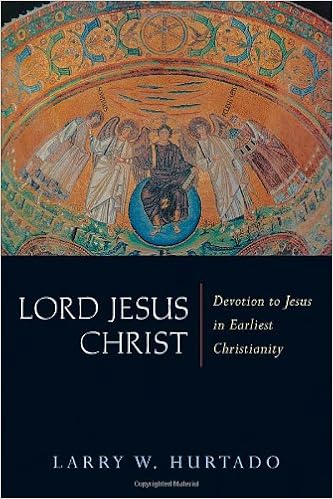
Lord Jesus Christ, S2 Part 5: Did Jesus Pre-exist for Paul?

DID JESUS PRE-EXIST? It's an interesting question to be taken seriously, especially if you happen to believe that the Christian story about his resurrection and cosmic reign of love and justice might actually be true. But a long way away from what you or I might think about this issue, if we believe our beliefs have to be shaped by New Testament positions, then we had better pay good attention to what the apostle Paul wrote on this point, with Hurtado as our ever-faithful guide.

Before we do that, I'd like to recap on the two posts I made regarding Jesus' lordship from LJC. I lost a lot of visits during that double post (sorry, I guess I failed to keep it interesting!) but I think I covered some important ground worth summarising, which I will do now in six short bullets:

  • Kyrios (Lord) was likely used by the earliest followers of Jesus in its Aramaic translation, including in spiritual contexts assimilable to worship (maranatha!).
  • Kyrios in Greek had a wide range of meanings from "sir", to "master" and in some eastern provinces of the Roman empire as a form of greeting the Caeser.
  • Kyrios was used frequently by Paul to describe the God of the Old Testament. He frequently applies the translation standard of the time of removing the definite article "the" in two of the most common cases especially.
  • There are several instances where prophecies of the divine Kyrios of the Old Testament are astonishingly fulfilled in the eyes of Paul (and others) when Kyrios Jesus accomplishes that promise, and the "kyrios-ship" is mapped onto him in these instances perfectly (including the grammar).
  • However, we noted that despite this definite overlap and function of Divine Agent and name bearer, Jesus' Lordship is significantly different and broader to how Jews perceived their god as Kyrios. Jesus is closer and more intimate and is more often than not our Lord, something that was virtually absent from the inherited Jewish worldview. As ever, Jesus shatters our attempted ideas to contain him in this or that predefined concept or ideal! (In some of the referenced posts at the bottom of both the posts on Hurtado's treatment of Jesus as Kyrios in Paul I provided further more technical evidence referring to how the Greek of Jesus' lordship was treated slightly differently to the anarthrous Kyrios of our Old Testaments in linguistically parallel scenarios).
  • I also threw in at the end of the second post (3000 words in!), that the "Kyrios overlap" may have been an important factor in settling the question of quite how much authority and worship should our exalted Lord Jesus receive.
Check out the posts in full here and here

Turning, then, to Hurtado on Paul's belief on a pre-existent Jesus, i.e. before his birth
be that eternally or as some early Christian theology would have it, right back to the dawn of time - not a distinction Hurtado develops here, i.e. to make clear the different types of pre-existence on offer, although he will mention and dismiss one version from James Dunn and later in the section will crucially state that "eschatological entities can be referred to as pre-existent in various ways", p. 124). Another, that Christ might have pre-existed for Paul as an angel is not mentioned. Bart Ehrman has postulated, for example, that for Paul, the structure in Gal 4:14 ὡς ἄγγελον Θεοῦ ἐδέξασθέ με, ὡς Χριστὸν Ἰησοῦν (as an angel of God you received me, as Jesus Christ) is used as a repetitive technique, not a climaxing analogy. Ehrman shows a couple of other instances where these "as" do not contrast but compliment in Paul's usage "ὡς....ὡς....." (1 Corinthians 3:1 and 2 Corinthians 2:17). Regardless of these different types of pre-existence, I suppose the point of this section should be - would belief in a second figure worthy of Jewish divine worship needed to have pre-existed in some sense? That might have tied the section in more nicely to the overall book purpose, even if a wider version does exist: What [do] Paul's letters tell us about the Christ-devotion that characterized Pauline Christianity, and perhaps other and earlier circles as well? (p. 119) and also there are questions about how early this view of Jesus arose, how to account for the belief historically, and what Jesus' pre-existence meant for early Christians

I think the main point really is that we can't say a great deal about this topic in detail, given how brief and fleeting Paul's references are to this supposed pre-existence. Since these references do not attempt to teach recipients anything new about the pre-existence of Christ, we are best left to analyse quite what Pauline churches could be assuming (the idea had already become disseminated among his churches so early that by the time he wrote his epistles he could take it for granted as known - p. 124). And if I could draw in my assumption at this early point, that this lack of need to develop significantly in the early stages may be because certain assumptions have been naturally taken from a graft into Judaism of belief in a divine logos (quite apart from Christianity), which may have already been associated with the Messiah-to-come. This possibility sets us up for what I see as a false dichotomy in Hurtado, as we shall see in a minute.

In his discussion with various scholars, particular Dunn, Hurtado wants to say that this assumption of the pre-existence of Jesus should be greater than some sort of personalised wisdom. Dustin Smith is a great resource for the opposite view, by the way, and can be mined in his co-written book The Son of God: Three Views of the Identity of Jesus (I have written a small series also on this book if you look back to March - April 2016 on this blog). Hurtado also correctly asserts that at some point a real belief in literal pre-existence did emerge, which, with our hermeneutic circle hats firmly back on, should mean that these references and the divine/religious centricity that Jesus takes/is given in other areas were of importance to early interpreters doted, we should note, with greater cultural insight than we have in the twenty-first century. Hurtado also notes that literal pre-existence is more firmly asserted in John 1:1-18 (although Smith still has cards to play in this instance), but Smith et. al still have their work cut out in passages of Paul like Philippians 2:6-8, 1 Corinthians 8:6 (one of those "through whom"s the world was made references), 2 Corinthians 8:9, Galatians 4:4, and a few more. Hurtado maintains that the question should still remain about how "solid" or "imaginary/symbolic" that pre-existence was. Hurtado is on the solid side; his main sparring partner, James Dunn holds "the dissenting view", which tends to focus on the personalised Jewish ideas of (Lady) Wisdom.

Hurtado agrees with Dunn that there is metaphorical language at play, and shouldn't be read woodenly (e.g. 2 Cor. 8:9, Christ "impoverished himself"). The differences lie in what you do with the reality behind the metaphor. Dunn claims that the passage is a "one-stage act of abasement" (Jesus' death). To answer the question more fully, responds Hurtado, we need to look elsewhere in Paul to see what Christ's self-abasement might mean, and goes straight for the jugular of Philippians 2:6-11. As a keen follower of Hurtado's blog, I have noted that his views on this passage have now enlarged slightly. He recognises now that the parallel between the first "god" (anarthrous) is paralleled (also anarthrously) by the first "servant", so it seems that if you want to say that Jesus became "a servant", then you have to be open to the view that Paul's cited poem might have read that although he subsisted as "a god" (see Hurtado's post here). On this Philippian passage, Hurtado sees Dunn's view as too dependent on a pretty absent "Adam Christology", including too much looseness with "made in the image of God" and "subsisting in the form of God". Fform and image, although similar, have distinctions, and if Paul wanted to imply the Adam version, he wouldn't have used "form" here (morphé theou is never used elsewhere in any allusion to Adam p. 122).

As with his recent blog-post, Hurtado demonstrates openness again here in his book when he says on pp. 122-123: In Philippians 2:6, however, "being equal with God" seems to be presented as something already held by Christ or really within Christ's grasp (emphasis mine). The point is that the Greek word used by Paul for "grasp" is very seldom used at this time, but the best I could find when I researched this passage a year or two ago was that "pillaging" seemed to be one of the predominant usages. In which case, openness is definitely the way to go here with this grasping business and is appropriately adopted in the NET translation I believe. The conclusion, nonetheless for the 2003 stage of Hurtado reflection is that this astonishing belief encapsulated in the early Christ poem in Philippians should be seen as the action of a pre-incarnate Christ, thus shedding light on other passages such as the number of stages of abasement in 2 Corinthians 8:9.

But this pre-existence is not a static point - New Testament theology virtually never is. It would feed into the belief that Jesus had really come from God and that the story of Jesus' own involvement in redemption extended back beyond his earthly existence and his crucially redemptive death and resurrection (p. 123). So this pre-existence from a Jewish perspective about this redemptive plan, either alongside or in the Messiah himself, was a firm expectation - the "eschatological agent of redemption". Hurtado says that for the earliest Christians who saw Jesus in this light, sent from God and for this eschatological purpose of salvation, it was "only a small and very natural step to hold that he was also in some way "there" with and in God from before the creation of the world" (p. 125). Hurtado will again later conclude the section that this fulfilment perspective would have also provided a basis for making appeals for Christian behaviour (humility and concern for other in Phil. 2:1-18; generosity in 2 Cor. 8:8-15 (p. 126).

Having returned to 1 Cor 8:6 (One Lord, Jesus Christ, through whom are all things), Hurtado now arrives at the false dichotomy that I referred to earlier: The idea of Jesus' agency in creation and redemption is not driven by speculative interests, and does not respond to philosophical questions about how a transcendent deity could create the material world. Instead, the logic proceeds from profound convictions about the sovereignty of the one God reflected in Jewish apocalyptic tradition, which posit that all of history is subject to God (emphasis mine). Here I see a false dichotomy. This seems to be saying that Christians chose between philosophical categories or Jewish categories. But Philo, in particular, is bona fide proof that those two options had already collided and intertwined. Judaism had already encountered and in some respects embraced hermeneutically philosophical ideas even in the examination and application of her own sacred texts.

Hurtado's own summary of this section


  • The condensed Pauline references imply that notions of Jesus as a pre-existent divine agent had already been appropriated. Paul's not introducing the ideas as new.
  • The pre-existence was active, as an agent in God's creative act.
  • The ideas supporting this pre-existence were Jewish, apocalyptic/eschatological view in which "final things are seen as primal things". 

Tuesday, 11 July 2017

Hermeneutic Circle and asking better "why" questions

I have been making the newbie mistake of calling this circle a hermeneutical circle - sorry about that! The hermeneutic circle is a process of interpreting a text (or an author via his text) as developed in particular by Heidegger and Gadamer. In short, the disappointing news is that where the circle is operative, it is de facto going to bar your access to a text in any objective way.

The text is understood to have two important conditions. It must be terribly important to the reader, and it must be at least in part(s) difficult to comprehend. This difficulty is not necessarily readily apparent, I don't think, but is evidenced through the inevitable gap in "horizons" separating the author and the reader, differing worldviews affected by time in history, geographical location, culture, and so on.


Unfortunately, because hermeneutics was only developed in the last few hundred years, I am not sure how effectively it has been applied to our key question at hand: the emergence of the Triune God around the end of the fourth century, and indeed to other theological matters that "crystallised" in various directions. Even during the first century, I believe that we have the necessary ingredients to see the circle clearly in operation, and that is very significant if we are ever going to be able to move Christian apologetics away from frankly unconvincing anachronistic importations from a later time and yet still hold to some form of sensible first-to-fourth century continuity. If we are to achieve this goal, then hermeneutics is key. Not primarily in the sense of how we bridge the gap to today, our own contexts and our own lives, but to see how earlier gaps might have been bridged by Christians in the past, long before the word "hermeneutic" had ever been dreamed up. First century Judea was not fourth century Constantinople!

But what is this hermeneutic circle? Very simply put and as I understand it, it is the to and fro between the (Christian canonical) text and the reader's conceptual framework of meaning, out of which she is making sense of that text ("WHOLE", below). Each of these crisscrossing "trips" effects both elements (the whole and interpretation of the part), by which I mean the reader's general and multilayered understanding (right up to "their theology") and their interpretation of what the text is saying.


History of Christianity doesn't seem to embrace this concept enough, but perhaps it does attempt it under different guises.

One historian of Christian antiquity whose work I continue to respect is Bart Ehrman. His book How Jesus Became God arrived at a critical time in my deconstruction process in 2014 and the entire journey to which this blog bears witness. But it is his earlier and lesser known academic volume (and it is a sizeable book to be sure) The Orthodox Corruption of Scripture, that I think carries a fantastic example of what I am trying to get at here. This book is of considerable note because it is really Ehrman's original field of expertise, textual criticism - since then it seems that he has strayed a bit into other areas in a (successful) bid to write for a wider audience. In The Orthodox Corruption of Scripture, Ehrman carefully and correctly insists that not all the changes that Christian scribes copying the texts made were accidental. The evidence for that is pretty irrefutable, multifaceted and extensive. Although I felt at times the book development made for some hypothesis-supporting conjecture, i.e. a too-tight association of a deliberate scribal corruption according to a specific heresy, the fundamental point that the scribe is safeguarding against misconstrual (rather than, in the scribe's mind, "corrupting" the text) is vital and all that matters for my purposes here. Ehrman has stacks of examples, but one that is perhaps the most deeply inscribed into my memory is Jesus' added titles. At various points in the codexes, scribes would deliberately add "Christ" and "Lord" at points they considered significant in the new copies they were transcribing. Why? There are other points in Scripture that contain combinations of "Lord Jesus", "Jesus Christ" and even "Lord Jesus Christ", so why add it to the new transcription? Here's Ehrman's reasoning, and it makes sense: some branches away from "orthodox" Christianity would read the Christian texts according to a variant "whole" (see above diagram), which included a "separationist Christology" (incredibly, that is still affirmed by popular Franciscan priest, Richard Rohr: Jesus is sharply and explicitly differentiated from "the Christ", "the Cosmic Christ", etc). According to this "whole", the Holy Spirit scene at Jesus' baptism was construed as the moment when the cosmic Christ entered into Jesus, before leaving him at his death on the cross (by the way, I am not saying that this is the conclusion Rohr makes, I'm sure it isn't). Back in the early Christian centuries, by adding "Christ", scribes certainly did not think they were the ones doing the corrupting. Quite the opposite, actually. By emphasising the inseparability of Jesus Christ (or Jesus from Christ), the scribes would have seen themselves as safeguarding a better interpretation against corruption.

There is always meaning to be found.

So, why would the church perform some almighty U-turn by suddenly switching from a Unitarian God to a Triune God sometime around the Niceno-Constantinopolitan Creed of 381? Put this way, as Biblical Unitarians sometimes infer, it seems impossible, random, unbiblical, and... meaningless. I follow Dale Tuggy's work quite closely on his blog trinities.org (definitely worth checking, loads of great material in there), and I even get to contribute in a couple of very small ways to his show. But the closest I have seen to an answer to this fundamental "why" question, is that Greek mythology was rife with divine triads, and the fourth century was very complicated theologically for the church. But even as Tuggy does an expert job (in my opinion) at unravelling some of that fourth-century complexity, the listener is left with a decidedly bleak impression that these were such chaotic and political times, that there must, therefore, be a degree of randomness there that subverted Orthodox belief away from the Truth, and that this has stuck for a really, really long time.

I no longer buy it. We need to mine these controversies afresh to see what the deeper meaning is behind these debates, from both sides as far as we can understand them. For me, and I have probably mentioned this before, but it does no harm in repeating, there is one particular treasure to be mined in this transitional period, that is the very creed orthodox tradition has since labelled "The Blasphemy", officially: The Second Creed of Sirmium (357). It states: And the whole faith is summed up and secured in this, that the Trinity must always be preserved, as we read in the Gospel, Go ye and baptize all nations in the Name of the Father, and of the Son, and of the Holy Ghost. Complete and perfect is the number of the Trinity.

I've said it before, I'll say it again: they were all Trinitarians, they all believed that since Jesus and the sending of the Holy Spirit, there was a new centre to the faith that emerged from Judaism. So here's the crazy thing: the very creed that is dubbed "The Blasphemy" contains the very goal that united everybody. The problem with Sirmium was the interpretation of Jesus' words: "The Father is greater than I". So if the "Whole" comprises the three in (roughly) equal measure, and you want to push for "greater greatness" in one of the Three, what might be the interpreted outcome? I'll tell you exactly what I think the worry really was. Greatness in religion corresponds, I would argue nearly perfectly, with centricity. And if you make Father, Son or Spirit more central, then it is precisely that preservation of the Trinity that is thrown out of whack.

Look, I am not saying that the Triune God is "biblical", but I am going to give it credit for this: it posed a stable platform and standard from which further theological reflection could be realised without messing about with this important centricity issue, which up until this time lacked vocabulary. Where it had beforehand lacked vocabulary, it had not lacked meaning. So what do I think about the Triune God? It's interpretative. I've been saying that for two years now, but now with the help of the hermeneutic circle, I think we can see the strength of that claim. The Triune God solution is not random - it has purpose and is in line with the perceived threats of that time. It also includes quite a lot of ambiguity, as Tuggy points out, which actually dotes the stability also with flexibility.

I'm really eager to take this discussion soon back to Ricoeur's work, whose ideas about "ontology" (and its pitfalls) speak profoundly to the debates around the Trinity doctrine. Ricoeur also has helped me realise that it is possible that despite their best intentions, Biblical Unitarians might actually be importing some of the fourth-century baggage into their first-century analysis in precisely the ways they lament sloppy Triune-God advocates do, everyone failing to integrate historical hermeneutics into their models. My Triune Hub model must not make that mistake!

As chaotic and turbulent a century as the fourth century was to Christianity, it is vital that we see continuity as well as discontinuity. Sometimes the discontinuity at the time that seems huge to us from our vantage point might have seemed like a minor point of a whole series of adjustments that, just like in Ehrman's textual example, avoided misconstrual of a historically preceding idea, and guess what: it is "terribly important" and "difficult to understand".

Hermeneutics, we welcome you to the first four centuries of Christianity!

Wednesday, 14 December 2016

The Death of Christ


As Christians, we are very excited about the resurrection of our Lord. Sometimes we are in a bit of a hurry to imagine the empty tomb of the first Easter Sunday - perhaps not unlike the resistance of many to talk of Jesus as fully man without quickly rushing on to reassure themselves and their listeners that Jesus is also "fully God".

We need to stop sometimes, and not rush.

It is important to take note of what some scholars have been saying about the death of Jesus in their attempts to reconstruct what really happened that day. It is good not to be in the dark about this because if well known, liberal or simply atheist scholars are allowed to expand credibility of alternative theories, then the faith is undermined. Before I continue, I want to make it plain: I take Jesus' insistance on truth very seriously. Any faith founded on sand not only will be shaken, but should be shaken - the sooner the better. But here - after hearing again Bart Ehrman (atheist scholar) citing John Dominic Crossan (liberal scholar, whose book I am currently reading on the birth of Christianity), I feel a responsibility to respond.

Ehrman cites research - including that of Crossan - which indicates that enemies of the state were not granted decent burials. One of the whole points of crucifixion was that it was as painful and as public as possible - sending the strongest message possible to anyone else thinking they might have it in them to rebel against Roman rule. One argument that is particularly striking (although these two don't seem to make too much of it), is our near-total lack of skeletal evidence for crucifixion in the ancient world: the following image depicts the only known example, whose name is given as Yehohanon ben Hagkol:


It remains, however, something of a mystery as to why we do not have more, given the thousands of people that were crucified for centuries, even if we account for most bodies being left for scavenging animals and dumping in shared graves. Returning to Jesus, however, it is important to account for this evidence. In the Biblical accounts, a certain Joseph of Arimathea requested the dead body of Jesus in order to give it a decent burial. The evidence provided above does not discount this story - it simply provides interesting context for this story repeated in all four of the gospel narratives...

*** part 2 tomorrow! ***

Saturday, 3 September 2016

Another opportunity to push Ehrman on John

Another opportunity has arisen to quiz Bart Ehrman on his confusing presentation of John's Christology. My previous efforts, to which he did not respond, you could read here, but were echoed and encouraged elsewhere. See also another correspondence with him here. You can't help but feel he is dodging the issue a bit. Here's the latest, from his post concerning the plurality of theological perspective in the New Testament, entitled: Different Ways of Describing the Theology of the New Testament (I agree with him that it differs internally more than systematic theologians like to permit, but that's not the point) (sorry, part of his post will not be visible if you are not a subscriber to his blog).

Bart wrote, typically, that for John: "Christ is a divine figure who is equal with God who has come from God to reveal the truth that can bring eternal life". Ehrman likes to contrast John's Christology with a radically different perspective from Mark or Luke, make John's a huge leap toward 4th century doctrinal solutions.

I responded: Dr Ehrman, do you not think it is actually possible that John is addressing a real or potential **misconception** within his community that Christ was equal with God, when he has Jesus saying that he is going to the Father, because he (the Father) is greater than him (Jesus)?

Bart responded: I think instead that it’s very complicated, that John incorporated traditions that emerged at different periods in his community’s history, and these traditions are sometimes at odds, christologically.

I responded: In which case (still thinking about your original statement), would it be more accurate (and wordy) to say that John incorporates a plurality of traditions, some of which affirm Christ’s equality with God and others that refute it? Personally, I would see this as too detached and inconsistent for John whose views I think you would agree are omnipresent.

From my experience, I'd say it is unlikely that he will continue the conversation further. But hopefully you get the point I keep trying to expose. What I meant by this final sentence that is not adequate to retreat back from the initial assertion about John see's Jesus as equal with God (and on previous occasions, Bart has just flat out declared that for John, "Jesus is God", something that even some relatively conservative evangelical scholars are hesitant to express in these terms) with talk of John just incorporating multiple traditions. John is not simply gathering diverse materials about Jesus. Unlike the synoptics that are based on textual sources (or at least Matthew and Luke), John is totally fresh and the content shaped by its strong theological message. Unlike what Ehrman says about the author of John (he knows nothing of the local context and was not at all an eyewitness or connected to any eye-witnesses), I would say some of the specific details in John's gospel show that this is either who it is traditionally connected with (son of Zebedee), or more likely, someone intimately connected with that resulting circle (I actually have a pet theory/speculation that John had recently died at the point of the writing of John's gospel, for the exact and perhaps commissioned purpose of not losing this teaching).

The point is that the author cannot be saying just that Christ is equal with God if he explicitly has Jesus saying that he is not equal with the Father. Logically then it is either

a) Jesus is both equal and not equal (somehow)
or
b) Jesus is not equal.

The author is not writing a compendium of different traditions. He's going for it and even explicitly writes down why it was written down this way John 20:31.

Let's see if Bart does answer though, maybe he can give the further clarification I and others have found he has often lacked on John.

Monday, 25 April 2016

Ehrman complaint and defining God

I am fresh off a slight rant at Bart Ehrman on his blog at http://ehrmanblog.org/the-controversies-about-christ-arius-and-alexander/

Here's what I had to say to him on his ambiguous way of using the G-word :)

Hi all.
Dr Ehrman I believe we already discussed the implications of not defining our terms regarding G-o-d; I suggested that most folk listening to you will not be defining G-o-d as "a divine being". You do this discussing John's christology and I now see you do it with Arius too. That's a confusing tactic, because " a divine being" is **not** how most folk would define, or even understand you saying G-o-d. If you mean "a divine being" then please just say that from the start, consistently. It almost seems like currying some favour with the evangelical crowd regarding John. Since I know that you have some issues with their approach at times and perhaps a certain narrow mindedness, I doubt that is the case, I am just saying it almost seems like that. I would not be so public about this complaint if I had not tried to share it privately first!

My second comment concerns the argument of God becoming a Father requiring the impossible situation that the unchangeable One changed. That seems like a non sequitur. Yhwh can be shown to have had different states with regard to his creation. If creation hasn't always been then he hasn't always been creator. He hasn't perpetually had some kind of mind-state of wrath, but he has definitely, biblically been wrathful.... And then not again. Yhwh sometimes moves about. Most significantly, however, and most probably won't agree with this, I don't think we can say that Yhwh himself has always been God. By this I mean that God is a title, with respect to a **people**. Yhwh is **Israel's** God, etc. Before all time and space, Yhwh wasn't anyone's God. Look forward to any responses :)

Monday, 11 April 2016

Born from above or born again? Both are on the cards.

What does Jesus teach Nicodemus in John 3?


Everyone, or most people in the English-speaking world, has heard of the Christian-lingo "born again" Christians. For many Christians, being a "born-again" Christian is a crucial part of their identity. But is that what the Greek says? Let's look at the English NIV:

John 3:3 Jesus replied, “Very truly I tell you, no one can see the kingdom of God unless they are born again.” 

John 3:6-7 Flesh gives birth to flesh, but the Spirit gives birth to spirit. You should not be surprised at my saying, ‘You must be born again.’

Bart Ehrman frequently likes to make an interesting point about John's gospel here. He actually believes that in Greek this word, anōthen, means both "again" (i.e. born again) and "from above" (i.e. born from above), and that John is placing clever, double-entendre teaching on Jesus' lips via word play in Greek (for a conversation that almost certainly would not have taken place in that language, where the Aramaic translation for "born again" and "born from above" would vary).  But if John was uniquely talking about being born "from above", then there is no good explanation for Nicodemus' confusion about physical re-birth. Meanwhile, being born from above fits the clear flesh-spirit distinctions. So it's probably both. The problem we are left with, I guess, is that saying you are a born-again-this-time-from-above Christian doesn't role nearly quite so well of the tongue :)

Tuesday, 15 December 2015

Bart Ehrman - mistaken on Judas? (2)

I did receive a reply from Bart Ehrman:

I’m not saying that any of htese terms means any one thing; but I am saying that if you want to say “betray” in Greek you use PRODIDOMI, not PARADIDOMI. If you want to pursue this further, you might look at my discussion in my book on Judas. (I’m out of the country now and can’t remember which scholar convinced me on this point. Was it William Klassen???)

Ok so I got caught short there - neither have I read Bart's book on Judas nor do I know William Klassen, but I wasn't about to admit that was I?!

Another lady responded, then I also replied with a post that was probably too long to be read by him, but you never know. To the faithful of this blog I am SURE that won't be a problem, right?!

Mark 3:19 is an example of the verb applied directly to Judas, and as I said there are multiple examples from all four gospels. It seems to me that Bart is saying that this is not a pure form of betrayal. It speaks more of a (simpler? more descriptive?) “handing over”, even when applied to Judas like in Mk 3:19.

Couple of problems in trying to protect the two Greek words from possibilities of overlap or of flexibility (at least on the part of the one we are probing more deeply, paradidomi). Firstly, if Jesus hands *himself* over, therefore not implying deceit, how can we see “the man” by whom the Son of Man will be “handed over” in Mark 14:21/Luke 22:22 as equally guiltless? We can’t, whether or not Paul was familiar with these accounts. Secondly, as you mention, it seems that many of the Greek reference sources agree that betrayal IS one of the shades of meaning of this word.

Regarding the whole issue of “the twelve” – I don’t see why, if I put myself temporarily in Bart’s shoes (big and very respectable shoes that I shouldn’t be toying with probably), then I don’t see why I would be so heavily leaning on a book like Acts and its historicity about precisely when the twelfth member was re-appointed. There are waaaay to many “what ifs” that could come into play to explain Paul saying “the 12”. What if Judas did betray Jesus but Jesus also was known to have appeared to him as one of the 12 before Judas banished himself to another country in perpetual shame (hence discordant death stories)? What if Paul made a mistake (hardly anyone would have remembered the very short period when people went around talking about the “eleven”)? What if the only person who EVER mentioned “the Eleven” like that was Luke telling his story decades later in a Tolkienian fashion to engage his readership (before the Mark long-ending-writer grabbed it from Luke) (Luke IS the only one to mention "The Eleven" in the NT)? What if Luke made a mistake about the timings of the replacement apostle, and would it be the first time he fitted events and stories into a timeline he applies to keep a narrative feel? What if Paul really didn’t know much about what happened in terms of the technicalities of the betrayal/handing-over (like Judas’ name)? What if saying Judas’ name (for some) for a relatively short period of early church history was sooo bad that it was like exposing yourself spiritually to similar betrayal? What if… well I’m not as good as Bart is for the what-if scenarios, but I am sure he and probably many others on this blog could come with a really good list if they really wanted to.

Theology really is quite crazy. I just forgot why this Judas-betrayal question even matters! I guess the familiarity of Paul with the gospels is a big one.
BTW I still loved the “spilling the messianic secret beans” post. Seems more and more plausible each time I think about it, unlike this one, which I think has to remain open. I am grateful for being made to think about it quite deeply and discover more of the nuances here in the Greek.

Final thought on Paul’s remarkable ignorance – I can’t find another mention of him after Acts. So it’s not just Paul who does not focus on this key gospel figure.

Saturday, 12 December 2015

Bart Ehrman - mistaken on Judas?

Bart has done a few posts on the crucifixion. In a recent one he doubts that Paul was aware of the whole betrayal incident by Judas (in fact he even goes so far as to say "It is worth noting that the apostle Paul knows nothing of the tradition that Judas betrayed Jesus or that he killed himself". Before I say why he thinks that and why I am not at all convinced, let me share first something he had already said that was very interesting.


Based on the work of Albert Schweitzer, Bart agrees that maybe what happened was that on a deeper level of betrayal, Judas spilled the beans about the Messianic secret, which tied in closely with being the "Son of God", a messianic title. Bart states: "But what do the Jewish authorities accuse Jesus of?  They accuse him of calling himself the messiah (Mark 14:61-62; note: the “king of Israel” was also called “the son of God” – see 2 Sam. 7:11-14).

And that is the charge Pilate tries him on.  Pilate asks him “Are you the King of the Jews,” and [...] this is the reason he had him crucified."

This makes more sense to me than the simple garden-kissing incident alone.

So that is where I feel Bart sheds some potential light. However, where I am much more sceptical (it's so refreshing being sceptical of a sceptic!) is his take on Paul and Judas. He argues that Paul knew nothing of this betrayal. He bases this on two points (I only take serious issue with the first)

1. The fact that the word the gospel writers use for "betray" can also be used to mean "hand over", and not only that, but Paul never uses the word to mean "betray", According to Bart, this means that when Paul writes PARADIDOMI in 1 Cor. 11:22-24,  “On the night in which he was betrayed”, he is very unlikely to be referring to Judas' betrayal, but more the "handing over" of God. 

2. 1 Cor 15:5-8, Paul recounts eye-testimony to the resurrection:  first he appeared to Cephas, then to the twelve, then he appeared to more than 500... 12 minus 1 = 11! Fair point. They were only restored to the number of 12, according to Acts, after Jesus had ascended to the Father.

This is my response to Bart Ehrman on his blog (I shall post any follow-up correspondence if interesting):

What is not so clear is that PRODIDOMI has to mean betray. In Romans 11:35 it definitely doesn’t. Bart may well be right (that Paul was not referring to Judas but instead to God handing him over), but the assumptions of clear-cut definitions as he puts them here failed to satisfy me today.

Another thing PARADIDOMI doesn’t mean betray?!
Bart does specify that PAUL doesn’t use it this way, but he also does not draw attention to the fact that all four gospel writers use this word EXTENSIVELY to describe Judas and his act. If Paul doesn’t focus on Judas in his writings (or the very few writings that WE have), what other occasion would he have had to use PARADIDOMI in a betrayal sense? Finally, (smaller point) when Paul (and “Peter”) use PARADIDOMI, it is a bit wider than simply God delivering his son; Jesus also gives himself up, people are delivered to their own depravity, it’s quite general and not specifically located in a narrative, unlike this one passage in 1 Cor. 11:22-24. 


Saturday, 3 October 2015

More reflections on Luke's passionless passion...jury is not just out but on holiday!

In my previous post, I outlined my brief exchange with Dr. Bart Ehrman on the question of why Luke might have stripped from Jesus' brutal death the emphases on suffering and agony. I pointed out why the argument for a textual corruption on the drops of blood seems highly probable (for me I am as certain as you can be about these things), but the resulting and obvious question is still begging. Why would Luke do that? Why would he want to portray a suffering-free, calm, collected, reflective Jesus all the way up to his death? Initially I put forward a hypothesis: could it be that Luke was wanting to differentiate Jesus from the Son of Man, who WOULD suffer?

Although I got Ehrman's initial interest on that idea, I proceeded to shoot down my own idea in flames, on the basis that the Lukan text would have had to be subject to a huge conspiracy of corruption to end up with what we have now, because there are many passages that DO associate Jesus with the Son of man.

Ehrman's next response is: It was probably (to give it in its shortest version) to show those suffering that they too did not really need to suffer if God was on their side.  They too could be calm and in control.

But how does this account for Luke's idea that Jesus is the Son of man who must "suffer and die"?

For me this is a mystery indeed that I think I will simply put on hold until I hear a more developed explanation. I do not have one.

Drops of blood

[Translation from recent post in French]

Thanks to a conversation today with a French-speaking friend, who read the blog but gave up because of the language, I propose[d] to do an article in French! Truly I am sorry to have been such an English-lover up until now. One reason for that is that I write better in English - after all, it's my mother tongue. But a second reason is that the sources and references I am examining come for the mostpart from English persons and scholars. However, that is not an excuse, and I hope to do more articles in French, including one this week (on a worship song in the continuation of the series I started on theology in worship).

But my subject for today is the question of the Son of man according to Luke's gospel. This expression THE son of man is radical and innovative. Indeed, this expression (combined with its definite article) is present nowhere else in antiquity, including in the texts of the Old Testament, which contains a hundred or so references to "A son of man" or "sons of man".

Some readers will already have heard of the "historical Jesus". It is a movement that developed in the field of history that applies to Jesus the same criteria of historical research applied to any other historical event or figure. These historians do not apply faith-based or religious criteria, but historical criteria. Some of them are believers, although many are not, and many debates have been held over the issue of the "historical Jesus". One of the most distinguished scholars of our time, who is no longer a believer himself, is Bart Ehrman. No-one seriously undertaking critical Biblical study will be unaware of his contributions to the field. Ehrman is one of those who believes that by applying historical criteria to the data and research we currently hold (for example on the workings of oral transmissions of stories and human memory) that there is a wide variety of historical preciseness in Jesus' recorded words.

Indeed, even some of the more conservative scholars can concede that some stylistic wording can be considered as likely added by the gospel writer, i.e. not exactly word by word what Jesus really said, and this is what interests historians (see Just Bass in his debate with Bart Ehrman on 18 September 2015). Ehrman is in agreement that given the diversity of the multiple and independent sources quoting Jesus talking of "THE son of man" that he really did teach about this a lot, and that it was new. But, what is most surprising, is that if you accept that there can be a difference between the true unfolding of historical events and wording and what is reported by the four gospels Matthew, Mark, Luke and John, and you also accept that Jesus spoke a lot about the Son of man, you are not obligated to take the position of Jesus having historically appropriated the title himself. According to certain verses, it seems totally obvious that Jesus did appropriate this title. However, for some historians, it is just as possible or even probable that it is the gospel writers who at times make Jesus appropriate that title. Let us look at an example that does not at all require such appropriation:

Whoever is ashamed of me and my words, the Son of Man will be ashamed of them when he comes in his glory and in the glory of the Father and of the holy angels. (Luke 9:26)
For historians, this saying might be closer to the actual statement Jesus made than certain other statements recorded by the gospel writers concerning the Son of man.

But why am I telling you all this?

On his blog via several posts, Ehrman has explained why two verses from Luke chapter 22, verses 43-44, we can observe a real corruption of the text ("corruption" in the technical sense, not in the mean-spirited way), that is to say, an insertion. It is the passage that explains how an angel comforted Jesus in the garden of Gethsemane and how Jesus was "in agony":

An angel from heaven appeared to him and strengthened him. And being in anguish, he prayed more earnestly, and his sweat was like drops of blood falling to the ground.

Wow, a very famous passage indeed. But it is an insertion; it was added by a copyist in the second or third century. It is a verifiable fact that the human beings who copied these texts always made small (although occasionally larger) changes. For the vast majority of cases these were accidental and without serious consequence. This is one of the very few larger changes that is neither accidental nor without significant consequence, and can be shown by
  1. its absence from the best and oldest manuscripts
  2. the otherwise symmetrical structure of the paragraph
  3. the context of Jesus' "suffering" in Luke.
We can sometimes have the unfortunate habit of flattening the events of the life, and especially the death and resurrection of Jesus into one single account comprising four sources. This prevents us sometimes from some quite remarkable discoveries. Here's a whopper: if you only read Christ's passion in Luke, you can arrive at the astonishing conclusion that - WITH THE EXCEPTION OF LUKE 22:43-44 - Jesus didn't really have to suffer. Every time that Mark stresses that the situation was heavy and painful for Jesus, Luke, who has access to the Markan text, removes the agony and shows a Jesus who is in control, capable of conversation, reflective, profound exhortations, who does not cry out to God about why he has been forsaken, and so on. Honestly, the arguments for a corruption of this passage are coherent on multiple levels.

But one question remains, and I asked it to Dr. Ehrman: why would Luke have so intentionally described an absence of Jesus in his "passion"? I also made a fated suggestion, that I myself do not really believe but I just want to find an explanation for this reality if I can:

If in other parts of Luke we can indeed observe a connection between the Son of man and suffering, and if Jesus was referring to another, apocalyptic character such as observed in Daniel chapter 7, could not Luke have been avoiding the confusion between Jesus and the Son of man?

Ehrman's first response was "good idea". But the problem with my suggestion was that if Luke was the culprit for making Jesus appropriate the title of The Son of man, why would he seek to remove any trace of the Son of Man's suffering, since the Son of Man, for Luke, IS Jesus? Surely that could not be attributed to scribal corruptions!

Ehrman responded a second time with a brief alternative explanation I can give in the next post...
 

Friday, 21 August 2015

Bloody Sweat

Via a series of blog posts, Bart Ehrman is currently telling the story of how he got into textual criticism of the Bible back in the 1980s. He sets the context very clearly - I already knew that the textus receptus Greek translation upon which the KJV was translated was based on very few and quite young manuscripts. But I did not know that they were all done by one man, a humanist, who updated his own work over time but that was the only improvements provided. I did not know that there was a part of Revelation he literally had no Greek manuscript for whatsoever and borrowed in some latin that he had that has never matched any subsequent Greek manuscript discovered.

In this textus receptus, you get the story of the woman caught in adultery, you get the long ending in Mark 16, you get the verse in 1 John 5 affirming the doctrine of the Trinity.

As the centuries went on, more and more manuscripts were discovered. Hundreds more. Thousands more, many of them older and more reliable than those used to form the textus receptus used for the KJV. Finally in 1881 was released a huge edition of the Greek NT, one version of which included a major contextual analysis of each significant variant in the manuscripts, along with the most likely originals. This was done by Westcott and Hort. On the basis of the evidence of the many small changes (some accidental, some not) made by scribes and their analysis of which way the changes probably went (did the scribe change John 1:18 from the only begotten God to the only begotten son, or was it the other way around, or did he add God or Son to an original "the only begotten [one]"?). In fact they did such a monumental work that there were virtually no changes for a century, or even expectation about how we could get closer to the original Greek, because we were virtually there already!

That's where the bloody sweat kicks in.

It's actually a really popular passage found in Luke's description of Jesus' "passion" building up to his crucifixion. But there is absolutely NOTHING about a text that appears good, profound, inspiring, etc., that makes it true. And while Ehrman would quibble that we are not talking about truth anyway, just the way in which the text was changed, I believe that Christians concerned about truth today should not be putting their faith in a significant textual variant or calling it the word of God. This applies to the above additions (long ending of Mark, Trinity proof text, etc.), but it also applies, I am sad to say, to the bloody sweat.

Ehrman is zooming into this passage, that a lot of Christians will know has some issues if their bibles have footnotes, for a reason. He is keen to show how the field of textual criticism really matters for other areas like theology and exegesis. It had been assumed that the study of textual changes was pretty much devoid of implications for other areas than its own technical field.

So if the bloody sweat verses are an addition, why would it be significant? Most people, like me, would be thinking about size - where most changes concern a single word or article, here is something highly constructed and thought through, like the end of Mark, that has been deliberately appended. Of course that remains a pretty big concern in its own right, there are not many passages like that where the manuscript credentials are very low. But there is a bigger more serious problem.

If you compare Luke's passion with Mark's, and most seem to agree that Luke was using Mark, there is an astonishing systematic removal of Mark's references to Jesus' anguish and suffering, right up to the point that he actually dies. If it weren't for two rather critical verses, then you might read the account thinking that actually Jesus did not really have such a hard time dying after all.

And these are the two verses concerned, from Luke 22:43-44
An angel from heaven appeared to him and strengthened him. And being in anguish, he prayed more earnestly, and his sweat was like drops of blood falling to the ground.

Imagine you are a committed Christian scribe. Maybe a 100 years have gone past since the events in question, maybe more. There are heretical elements threatening the identity of the church regarding just how human Jesus really was (did he just appear human, people asked?) There are other stories circulating about what happened at Gethsemane about Christ's suffering, some quite extreme and explicit.

In my  next post, we will see just how significant and clear this insertion into Luke's account actually is, via a comparison with Mark and a look at the literary structure of the passage into which the verses were later inserted.

Saturday, 20 June 2015

Trinities questions asked (i) and some thoughts from Novatian

I was privileged again a couple of weeks ago to have Dale Tuggy take seriously a question I raised, which he even aired and responded to in a clear, honest and concise way. If I say honest, it is because he does not attempt, as some scholars do in this matter (I am thinking particularly of Bart Ehrman), to have a full explanation that fully explains precisely the route from A to B. Which matter am I referring to? The journey of the church to the tripersonal God. So here's the question and a link to Dale's answer (hurray you get to hear my voice, I was a bit nervous!).

Thanks for your latest posts, really interesting. I look forward very much to hearing more on Clarke. In the meantime, I would like to hassle you a little more on the 325-381 development that you see from homoousios to tripersonal God, as you saw on the comment I left. I even wonder if you feel you are close to identifying the semantic stepping stones (as others have attempted, but rarely in any kind of satisfying way I feel) that take take us all the way through from New Testament to Chalcedon. I sense you might be (or maybe you already have somewhere?).

The reason why I wrote this question back in March was that it had dawned on me for the first time, although this podcast and other sources had already hinted at this, that to say that "God is triune" and "the Son is homoousios [consubstantial, of the same stuff] with the Father" are not synonymous expressions. I love the fact that we can be honest and concede that we are not in a position today to fully grasp what got the church to the "tipping point" as Dale puts it. He refers to a possibility that draws from the notion of Divine Simplicity, but is unsure.

* * *

I then responded on the show notes comments section with the following:

in answering my question about the semantic steps, Dale mentioned that second and third century theologians were sometimes cross-examined about the way in which they called Jesus theos - did that not mean that they worshipped more than one God? The response centred around the uniqueness of the Father, the ultimate, One, True (...) God. Can someone provide some examples of such cross-examinations, if they have them ready to hand? It would be helpful for me to see this distinction played out when it really mattered.

Strangely enough, although no-one has yet answered this favour, I have stumbled over an excellent example from Novatian. Here it is (an excerpt, actually, from the paper I am always harping on about):

Father and corresponding “He” occurrences are in orange and the Son’s “He” occurrences in purple, and there is certainly no mixing.

… but He is of the Father, because He is begotten, whether as being the Word, whether as being the Power, or as being the Wisdom, or as being the Light, or as being the Son; and whatever of these He is, in that He is not from any other source, as we have already said before, than from the Father, owing His origin to His Father, He could not make a disagreement in the divinity by the number of two Gods, since He gathered His beginning by being born of Him who is one God.[1]

Novatian here mentions something absolutely foundational to understanding how trinitarianism might have evolved (and he is only 60 years away from the first Ecumenical Council of Nicaea). In any other religious world-view, the fact that there is more than one divine entity is not an issue, you simply add the “s” to “god”. But that is not something that the Christian faith could allow at any fundamental level – and yet the budding church had to work out some kind of solution based on their scriptures and distinctive faith. What Novatian pinpoints here is a crucial difference between other world-views of multiple gods, and the Christian God and his beloved only begotten Son – those polytheistic traditions have gods of independent origins. Jesus, however, whom the Christians worship and call “god” or "God" can do so because his origin was in the One God who has “no beginning”; he drew the logos out of himself, thus giving him the “matter” of which he is eternally and granting him divine status without multiplying the gods.

Friday, 1 May 2015

Homoousians, homoiousians and homoians


There's three ancient Greek words you do not see every day! They are, however, extremely relevant to understanding what most Christians believe today in our history, and will lead us to a rather key question regarding the belief that prevailed; I will be asking both Stephen Holmes and Bart Ehrman for their points of view on this question (maybe I'll bug Dale Tuggy again too, but I am still waiting for another answer from him, so don't want to bug him too much). But first, let's define.

Homoousian is the belief-set that Jesus is of the same substance or essence as God the father [the one and only divine].

Homoiousian is the belief-set that Jesus is of similar substance or essence as God the father.

Homoian rejects any talk of substance with "its materialistic overtones, inevitably misleading and unhelpful" (Holmes, Quest For the Trinity, p 93), but still keeps the key iota there, that Jesus is like God.

In Holmes' book, the Homoiousian and Homoian distinction is not clearly developed, with Holmes concentrating mainly on the predominant Homoian belief in the fourth century. I am not sure why that is, and Wikipedia, for instance, is able to cite many more Homoiousians than Homoians - I suspect that the distinction is fine and not exclusive. What is fascinating is that in the fourth century, when these first monumental councils and creeds were coming together, it is not the Homoousian view that initially prevailed. Furthermore, the Roman Emperor Constantine who was absolutely pivotal in the 325 Council formation, was baptised several decades later by a Homoian (or Homoiousian) bishop, just before he died! It was by no means a foregone conclusion (Ehrman) that the Homoousians were going to win out, but in the end they did.

And so we get closer to our question - why was that? When I read Holmes' couple of chapters on this key period, and remember that Holmes is a deep and devout believer himself in God's sovereignty in this process, he points to a lack of unity among the Homoians. They were also too busy trying to dismantle the opposing view, without "doing theology" themselves. In the meantime, the Homoousians were very busy doing theology. Somehow, I still do not quite get it.

I am not certain that Ehrman's orthoparadoxes idea quite answers it either - this is Ehrman's idea that what prevailed was where certain "right" (ortho) beliefs of one belief-set were maintained and others rejected from several different 2nd and 3rd century Fathers, none of which were fully orthodox (and some, like Origen, positively condemned later), in order to gain a paradoxically, but ultimately purely orthodox view.

So let's see if I get lucky with some answers...

Saturday, 18 April 2015

Memory and oral traditions

Bart Ehrman is going through a series of posts at the moment on his blog ehrmanblog.org concerning his latest book project. He seems to have decided that he has spent many years - decades even - in the field of textual criticism and it is time to move on, and the field that has gripped him is memory.

That might sound a bit strange, moving from studying manuscripts to a field in psychology - why not just move into surfboard design? Of course, it is much more closely related than that! The reason why memory is such a fascinating topic is because some of our fellow human-beings of the first century, who became "followers of the Way" BEFORE anyone wrote anything down but AFTER Jesus was exalted back to the Father's side, relied on word of mouth for what Jesus said and did. So it is like Ehrman senses the need to push the boundaries of time back even further by looking into the way oral stories are transmitted and circulated from a more sociological perspective.

I am sorry to not hyperlink the exact post, you can only read it fully if you are a paid up member, like I am.

There was something that he said today that struck a chord of truth deep within me, so I decided to leave the following comment on his post today:

One of the most enlightening posts, and I didn’t even agree with it all! The line I think that seems so simple and yet speaks to me most profoundly is this: “you necessarily mould it to the audience you are addressing”.
Man alive, I think that is so obvious now, and yes I did believe the oral tradition myth. I even feel a bit convicted by it, because I even hear MYSELF tweak stories as I tell them according to my own audience!

With regard to the gospel narratives, I think it also goes without saying that a believer who cherishes their view of God’s sovereignty when it comes to communicating good news about his Messiah, could be fully in charge on the macro level of what essentially was to be retained. Right?

When I said "oral tradition myth", I was referring to one part of the post that articulates a point of view that many of us have heard (it is true) and believed because it seems to make sense (it is true) and so we have taught others (not sure I have, but I could have done): BECAUSE they did not have the means to document and record, oral cultures have always been especially careful and accurate in the way the recount significant stories - in our literate cultures we can simply compare two different texts to look for discrepancies, so do not have to be so careful when telling stories orally.

Saturday, 31 January 2015

Simultaneous criteria for textual variants in the New Testament - a possible little breakthrough!


I feel slightly excited, as I consider today's post. Although I enjoy wrestling with theological questions and engaging with people's ideas about Scriptures, their assumptions and opinions, I rarely feel like I have come up with something especially new to contribute myself, until just now. The question is how to explain it clearly!

I have been engaging with textual criticism for a little bit, and the two authors, Bart Ehrman and Daniel Wallace, in particular. Textual criticism is quite scientific actually - it weighs up the various manuscript, historical and archaeological evidence to provide probabilities of textual change direction. This requires us to understand the indisputable claim that there are hundreds of thousands of differences between the extant (existing/found) manuscripts. That is not nearly as bad as it sounds - the slightest difference between any one of the thousands of manuscripts relative to any one other manuscript (e.g. a variant spelling) constitutes a difference.

Actually, of the most significant type of variants in the manuscripts, we can identify a top 7, which include texts like the woman caught in adultery, the long ending of Mark, and an omission in Matthew 24 "nor the son" during the Olivet Discourse and knowledge of the day and hour of the coming of the Son of Man.

It is argued convincingly by Wallace, along with Gordon Fee and Philip Miller and Matthew Morgan and Adam Messer and Tim Ricchuiti and Brian Wright, that Bart Ehrman applies a too systematic and overarching criterion of orthodox corruption of significant variant passages. The person agreeing with Ehrman is basically saying: scribes changed the wording to align it better with the orthodox belief of the time.

As it turns out, Bart Ehrman is so confident of his views, unfortunately, that he does not take the time to properly answer these serious purported flaws in his methodology (see his blog post here).

My basic idea is the following, and is unique, as far as I can tell in their debate, particularly with regard to the variant in Matthew. I believe that it is highly possible for more than one factor to be acting at the same time on a scribe. Whether or not you want to call this multiple causes or multiple factors resulting in a single cause is inconsequential.  What it does do is place this view, and as far as I know, in disagreement with both Wallace and Ehrman (thank goodness I don't know them personally, they would have my guts for garters!) Let me unpack it, as so far I am being vague.

In Revisiting the Corruption of the New Testament, on page 36, Wallace states [his italics]: "One cannot have it both ways; there cannot be wild copying by untrained scribes and a proto-orthodox conspiracy simultaneously producing the same variants. Conspiracy implies control, and wild copying is anything but controlled". I basically disagree with Wallace's thesis, although I need to untangle it first. Wallace is zooming in on an observation that Ehrman makes, that copying seems to be less careful the further back you go (I have not yet come across his use of "wild"). On the surface, Wallace's argument quoted above sounds pretty solid, but unfortunately, he subtly and probably unconsciously uses that premise to draw the reader into a false dichotomy that permeates significant portions of the book. I certainly missed it until I re-read his opening chapter "Lost in Transmission" today, and cross-referencing it with Miller in the subsequent chapter discussing the variant in Hebrews 2:9 (p79) and the discussions surrounding Matthew 24:36.

This verse either states that Jesus' death was by the grace of God, or apart from God. Miller correctly points out, as Ehrman should have noted, the very high similarity between the majuscule of the two words in Greek. He rightly notes that it is plausible that the copyist made a mistake and changed it to "apart" from God. What if Ehrman, though, is right, along with the (admittedly fewer) manuscripts? Can he argue uniquely the existence of the "grace" manuscripts based on orthodox corruption? Given the extreme similarity of the words, the answer has to be "no". Given the definite existence of orthodox corruptions, could we rule out the influence of theological commitments? Again, the answer is "no". The point is that Wallace's textual approach (and possibly Ehrman, although I am not so sure) seems to be based on the need to find a single criterion. What is needed here is to invite in new fields of research, notably psychology.

Some fields of psychology attempt to work on the unconscious parts of our minds, which is generally widely affirmed to highly affect our actions and responses. Sigmund Freud was obviously a classic example. For him, it was the unconscious repressed desires of childhood that governed our behaviour. But the area of unconsciousness is now understood to be much wider and more complex than that. Where this interests us is in the area of theological commitment. We all know that theological commitment is an area people feel so strongly about, and it is because it affects our various social groups and helps define our identity. That is some serious unconscious "welly". So why would a scribe, a human, flawed, theologically committed scribe not be doubly affected, both by his brain confusing two very similar words and also by what he would prefer it to say?

I feel so sure that this is significant, because it seems to me it could help us better explain how orthodox corruption might occur, while doing away with any unnecessary pressure to assume that everything was conscious, thus contributing to a rather untenable position that looks conspiratorial.

To conclude, I critique Wallace's methodology to be underpinned by an unspoken mutual exclusivity of criteria - it is far from obvious that this is necessary. I.e. - In the example of Hebrews 2:9 (although John 1:18 would have been a better example), both Wallace and Ehrman can be correct about their hypotheses of causation. It requires further investigation and particularly bringing in specialist psychological research.

Wallace is clear that more than one simultaneous factor is not possible. I am not so sure for Ehrman, and will attempt to find out on his blog in the forum area.

So how migh Ehrman respond? In order of probability from what I have seen of him thus far:
1. Probably not at all - heck, even Wallace is small fry for him!
2. Very short response, dismissive, sticking to his initial guns: it is all about the orthodoxy... kinda (unfortunately, this response will invite a quote from him about how other considerations need to be examined first)
3. Positive, curious, discussion-opener.

How might Wallace respond?
- I have no idea how to interact with Wallace. He seems like an open-minded kind of guy though, so if I ever do get through, I would expect some careful reconsideration of his exclusive view.

Sunday, 11 January 2015

Bart Ehrman blogs on the back foot to my email

As you may have realised from previous posts, I am going through Daniel Wallace's interesting book Revisiting the Corruption of the New Testament. Actually, the full title is worth noting ...Testament: manuscript, patristic, and apocryphal evidence.


Bart Ehrman is central to every chapter of this book, which is a response to his much earlier work: The Orthodox Corruption of Scripture. If I had to summarise what I understand the basic point of this book to be, it would be that the corruptions that took place need to be weighed without bias between the various criteria available in order to come up with sound hypotheses to the reasons motivating the changes, and placed within a wider context of overall reliability.

I need page references for this so I apologise, but Bart is quoted as recognising that the criterion of orthodoxy needed to be a secondary issue and not a primary one, while seems to be shown to making the orthodoxy criterion not only a primary criterion, but almost like some kind of supreme cause for manuscript miscopying. I already believe this to be an overstatement because when I consider the criterion applied by Bart of "embarrassment", it is difficult to see that as being a strict issue of orthodoxy. That said, the discussions in the book around Matthew 24:36 do indeed seem to reveal some possible bias from Bart.

I do not know Bart Ehrman. I neither like him, nor dislike him. For a very interesting discussion on para-social relationships, I would direct anyone interested to the Liturgists podcast episode 10, which deals effectively with the work-identity separation, which I think Bart should hear because he has taken this the wrong way (i.e. personally), which seems confirmed by the very title of his blog post hyper-linked below. By the way, for reference, I am also a "thin-skinned" individual, and I thought it was good and very open for Bart to acknowledge this aspect of his character.

So in reverse order:

1. Bart Ehrman's response (obviously I cannot prove that it was in response to my email, but I will leave that to you to judge). I leave a comment there and a link to this post. The comment will essentially be a brief reference to the value of dialogue between scholars and the potential for progress in our understanding.

2. My 2nd email:
Wow!

Before I worry too much about which side of the intelligence fence I sit, I think I might put this question out to the members forum for their views to see if I can get a bit more discussion going on this. There's something missing here. 

I also note that this may have been written in the night which may have affected your tone, as I am sure you are not usually so dismissive of Wallace's credentials!

Have a good day.

3. Bart's initial response:
No, I haven’t responded.  I think anyone with intelligence can read what I have to say and what they have to say to figure out who has the better argument!

4. My 1st email: Dear Bart, thanks for all your hard work and commitment to this blog, I do find it informative and have just become a member.

I am wondering if there is somewhere here or perhaps in print that you have responded to Revisiting the Corruption of the New Testament (Wallace and co.), and in particular the allegations of the criterion of orthodoxy?
....[technical issue]
Many thanks,
John


NB I note that I made have also harmed this discussion by using the word "allegations", which was a much too loaded word. Sorry for that, Bart, if you ever read this!

Sunday, 4 January 2015

Ehrman on Mary

Ehrman does a wonderful and, for me, helpful summary here on Mary, which is a topic I now realise we have really misunderstood in the Protestant tradition (see also its bearings on the creeds in an earlier blog post I wrote).
Please note I do not really agree with his analysis of Mark implicitly arguing against the virgin birth: I have read this post also and the argument seems far from sound.
His summary of the summary (click link for his more detailed post):
am now ready to end this thread of posts dealing with the stories of Jesus’ virgin birth – told differently in Matthew and Luke, not at all in John, and seemingly argued against in the Gospel of Mark. Earlier I should have given some terminology so that we could all be on the sam page.There are different terms that are often confused: Immaculate Conception. This doctrine is *not* about Jesus’ mother conceiving as a virgin; it is about Mary’s *own* mother and how she conceived Mary.

Published: 03/01/2015 16:07:32 * Post Link: http://ehrmanblog.org/the-virgin-birth-and-jesus-brothers/ * Feed: Christianity in Antiquity (CIA): The Bart Ehrman Blog (http://ehrmanblog.org/feed/)

Tuesday, 30 December 2014

Quick Christianity jabs

I am so grateful and glad that Daniel Wallace is alive, kicking and writing.

In his latest post on his blog, published yesterday here, Wallace easily deals with the hasty attack on Christianity by Kurt Eichenwald, who, writing for Newsweek, exaggerates the so-called unreliability of the New Testament transmission methods, even overstating Bart Ehrman's case. Just to give you an example of some of the unsubstantiated things Eichenwald says, and Wallace should have mentioned this I think, and this of the 381 Council of Constantinople: "a new agreement was reached—Jesus wasn’t two, he was now three—Father, Son and Holy Ghost." Oh really?!

One of Wallace's key points, however, is to state that we are not talking of a near-perpetual linear series of translations of translations, one of Eichenwald's points. All serious translations of today are working off manuscripts, some of which "go as far back as" the 2nd century.

I am currently reading through Wallace's book at the moment on Revisiting the Corruption of the New Tesetament: Manuscript, Patristic and Apocryphal Evidence. 


My intention, by the way, for anyone who is interested and for my own reference, is to publish chapter summaries. Each subject is distinct and actually written by a different scholar, with the whole lot edited by (and the first chapter written by) Daniel B. Wallace. In this book, one of the key challenges of Ehrman's interpretations is that he does not acknowledge his own biases, in particular the criteria of orthodox corruption. While that is not entirely true, from what I can see, we have another clear case here that works in the opposite direction. So when we see "as far back as the second century" from Wallace, Ehrman would maintain that the second century is still a fair old way off from the first and very fragmentary in what we do have, and even these are probably at least copies of copies of a copy (or of copies). He also would remind us that from the evidence we hold, in manuscript copying errors intensify the further you go back and that we simply "cannot know" what the originals said. 

While I agree with Wallace that Ehrman overstates his case, it is easier for me to see now when presumptions are "smuggled onto the table" (Stephen Holmes' expression), and here "as far back as" implies that this is an incredibly long way back. Challenged, the Wallace crew would be quick to compare to other ancient Greek texts that are much less well attested in terms of manuscript evidence. Ehrman is not in the business of comparing, however, and has no more faith in the copies of manuscripts that we have of Homer, for example, as representative of what was originally penned to parchment. 

But the key issue I think here in Wallace's otherwise solid defence against this weak attack by Eichenwald, is an often-forgotten translation stage. It seems to have been too obvious to mention by everyone, but it is not insignificant: the quotations in the gospels are already translations. We should be aware of that and reminded of that in these sorts of conversations. So in that sense, perhaps unwittingly, Eichenwald had a point he did not realise he was scoring!