Showing posts with label Jesus' prayer. Show all posts

Sunday, 10 September 2017

LJC S2 Part 8: Prayer

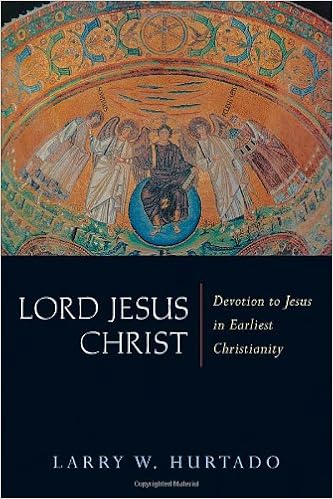
THIS IS WHERE Hurtado's study gets up, close and personal, if we will let it. Why? Because: "Who did they pray to" is just a tiny step from "who do I pray to". Also, in ways surely never glimpsed by the disciples when they asked for assistance on how to pray to Jesus, the issue of how to pray seems complex when there are at least two, closely related potential recipients. So how does Paul handle it?

Paul's prayers seem to primarily aim for God, although as ever, Jesus is never far removed from view. In Romans 1, the prayer is even offered "through" Jesus. However, as Hurtado rightly notes, there are other occasions when both are addressed, such as 1 Thessalonians 3:11-13:

Now may our God and Father himself and our Lord Jesus clear the way for us to come to you. May the Lord make your love increase and overflow for each other and for everyone else, just as ours does for you. May he strengthen your hearts so that you will be blameless and holy in the presence of our God and Father when our Lord Jesus comes with all his holy ones.

There are also petition moments that include Jesus, such as Paul's famous petition to the Lord Jesus for the removal of his "thorn" in 2 Corinthians 12. Fascinatingly, Hurtado also informs us that in the "unsuccessful mutations" of Christianity, direct prayers to Jesus are actually more prominent than in the canonical material, which seems to keep something of a balance. Hurtado concludes:

Overall, we get the impression of a remarkably well-established pattern of prayer in which Jesus features very prominently, either as recipient or as unique agent through whom prayer is offered. Moreover, there is simply no analogy in Roman-era Jewish groups for the characteristic linking of Jesus with God in the prayer practice reflected in Paul's letters. (p. 140)

Notes
You may have noticed that I have been treating God as a uni-personal individual. This is in keeping with Hurtado and, I strongly believe, with Paul. We also are clearly thin on Holy Spirit in this area, certainly as a recipient of prayer. That obviously does not mean that Paul dos not have a great deal to say about the Holy Spirit, and indeed sees the Sprit as interceding/praying for us in Rom 8.


Thursday, 17 August 2017

Proposition de Prière

Le saviez-vous, qu’il est possible que quelqu’un d’autre que Jésus soit à l’origine du « Notre Père » ? Dans la version trouvée en Luc 11, nous lisons une version plus courte de ce qu’on associe à cette prière dans sa version plénière. Le contexte est important :

Jésus priait un jour en un certain lieu. Lorsqu’il eut achevé, un de ses disciples lui dit : Seigneur, enseigne-nous à prier, comme Jean l’a enseigné à ses disciples. Il leur dit : Quand vous priez, dites : « Père ! Que ton nom soit sanctifié ; que ton règne vienne. Donne-nous chaque jour notre pain quotidien ; pardonne-nous nos péchés, car nous aussi nous pardonnons à quiconque nous offense ; et ne nous induis pas en tentation ». Il leur dit encore : Si l’un de vous a un ami, et qu’il aille le trouver au milieu de la nuit pour lui dire : Ami, prête-moi trois pains, car un de mes amis est arrivé de voyage chez moi, et je n’ai rien à lui offrir, et si, de l’intérieur de sa maison cet ami lui répond : ne m’importune pas, la porte est déjà fermée, mes enfants et moi sommes au lit, je ne puis me lever pour te donner des pains, je vous le dis, même s’il ne se levait pas pour les lui donner parce que c’est son ami, il se lèverait à cause de son importunité et lui donnerait tout ce dont il a besoin. Et moi, je vous dis : demandez, et l’on vous donnera ; cherchez, et vous trouverez ; frappez, et l’on vous ouvrira. Car quiconque demande reçoit, celui qui cherche trouve, et l’on ouvre à celui qui frappe. Quel est parmi vous le père qui donnera une pierre à son fils, s’il lui demande du pain ? Ou, s’il demande un poisson, lui donnera-t-il un serpent au lieu d’un poisson ? Ou, s’il demande un œuf, lui donnera-t-il un scorpion ? Si donc, méchants comme vous l’êtes, vous savez donner de bonnes choses à vos enfants, à combien plus forte raison le Père céleste donnera-t-il le Saint-Esprit à ceux qui le lui demandent.

Jean le Baptiste était, je pense, à l’initiative d’une forme primitive de cette prière, mais Jésus va la réinterpréter et fera introduire l’Esprit Saint comme une notion de don qui répond aux besoins les plus fondamentaux de l’homme, plus fondamental encore que le pain, qu’on peut toujours trouver ou demander. Notons bien, il ne dit pas ne pas être reconnaissant envers Dieu pour toute chose, bien sûr, il n’est pas un père méchant comme ça. Mais Jésus veut pour ses disciples, pour nous, le meilleur. Il veut changer l’objectif final de la prière, l’Esprit Saint en nous.


D’un point de vue chrétien, puisque nous comprenons bien que le Christ après sa résurrection était exalté à un point tellement haut qu’il siège maintenant à la droite de Dieu le Père, je propose cette prière trinitaire :

Notre père et notre frère, que votre nom soit sanctifié ; que votre règne vienne.

Père, comme ton fils bien-aimé, Jésus, nous a instruit de faire, donnes-nous aujourd'hui donc l’Esprit Saint pour qu’il ‘fasse le ménage’ chez nous, qu’il ôte toute amertume, méfiance, crainte de rejet et orgueil qu’il est sûr d’y trouver, pour que nous puissions être remplis et assurés de notre identité de fils et filles bien aimés de toi, pour être équipés pour porter le Royaume en nous, pour être une source de bénédiction pour les autres. Donnes-nous aussi ton Esprit pour nous guider sur les chemins à prendre et à éviter, pour percéverer dans la prière et dans l'adoration.

Jésus, c’est à toi maintenant que nous pouvons adresser notre louange, car tu as hérité le Nom qui est au-dessus de tout nom, que chaque langue te confesse comme Seigneur et chaque genou se plie devant toi, à la gloire du Père, tout par l’action de l’Esprit agissant puissamment en nous.

Amen J


Friday, 29 April 2016

Responsibility (2)

Hullo!

This is a small update on my first post about the wonderful discovery of responsibility. While on my retreat, I realised that issues in me that I didn't want to recognise (they really "suck" as Americans would say) held me back from deeper relationships. Fragmented identity is a killer in our modern societies, and more than once I have heard French philosophers wax lyrical about the fatigue and pain of simply being.

At least some of what Christianity understands as "sin" in our lives, makes existing really hard work, simply trying to "hold it all together". As a fragmented person, as soon as I meet someone, I am confronted with complex decisions like: what aspect of who I am should I reveal to that person? Shall I try and impress them falsely to feel better about myself? If there is no real sense of cohesion in my identity, then my relationships will instantly suffer and level out, for the simple reason that folk aren't dupe. We all sense when what you see is NOT what you get. That discrepancy has potential to ruin relationships. Because our potential friends do not seem knowable or trustworthy even to themselves. In the New Testament of the Bible, James says:

Anyone who listens to the word but does not do what it says is like someone who looks at his face in a mirror and, after looking at himself, goes away and immediately forgets what he looks like

In fact the first chapter of James is really hot on deep sincerity, and not just with other people. With ourselves.

Taking responsibility is a wonderful spiritual process that has its place in what Christians call repentance. Taking responsibility is taking ownership of everything you are (the bits you love and the bits you'd hate anyone else to point to you) and all the negative consequences of your existence on others, intentional or otherwise. Most of the time it is otherwise.

Roadworks make you late for your husband, who regularly criticises you. This is a very tough one. But can you imagine a you who has the depths of grace to dig soooo deep down to find the genuine sorry, even though it is not your fault? One of my grievances about the 1st century Palestinian context in which Christ's life and record are indelibly marked, is that some of these "grace notes" of please, thank you, so sorry, and so on have yet to be developed.

This is a good point to address a mistake I made in my previous post, where I overly connected the idea of sin and responsibility. I appended a small comment about this to the post itself to state:
A couple of issues in the relationship between responsibility and sin here ... If God took his responsibility with respect to his oath, Responsibility is not a.k.a. "sin", as I casually asserted .... Responsibility is about truly being in the universe, without any discrepancy between word and deed, word and thought, thought and deed, repressed desire and thought, and so on. Since sinning is affecting me and others in the universe, and I often ignore it, then this is an example of failure to  *be* in the universe and take my responsibility. Taking responsibility creates re-alignment in the chaos, and is truly a most beautiful thing.

What could we say with respect to he who was without sin, Jesus Christ? Jesus' human path of self-realisation is nothing short of extraordinary. It is assumed by some that Jesus actually may have coined the term "hypocrite". For Jesus, this inner cohesion is  E S S E N T I A L  for the holy life of his followers. I think perhaps the best way to understand the spiritually mature Jesus (and apparently he was streets ahead even at age 12!), is to realise that he became totally incorruptible. You could tempt him all you liked, but sin had zero hold on him, because he truly loved his Father God and cultivated his relationship with God. And it was mutual. When you see in John's gospel especially all this Jesus-talk of I depend on the Father for this and I depend on the Father for that, Jesus (theologically and I am certain historically) must have been a grand master of humility (see John 5:19 and 12:49, for example). Amazing. Without the Father, Jesus would have had no source for his abilities, words, wisdom, than himself, and this perspective strapped to a human brain has a highly reliable pride-generating mechanism.

As a slight aside: I'd like to announce plans to launch a website at some point in the next few months dedicated to promoting the love shared between the father and the son in the Christian faith. There will be a subsection about Christian worship too. Regular readers of the blog might already be aware that I am quite concerned by the modalistic tendencies in some churches (the Father, Son and Holy Spirit are so "one" that they are basically the same person, he's called "God", and he loves me), fuelled by a plethora of confusing Christian worship songs. The goal here is not to smash the modalism (that won't change anything), but again to promote what is so precious and at stake by confusing the Father and Son. Love itself.

Monday, 6 October 2014

Stephen Holmes transcript


Trinitarian Action & Inseparable Operations


"One very broad answer in terms of what I think we are doing with the doctrine of the trinity, in terms of exegesis, you know there's this question that Fred touched on this morning, "is this doctrine biblical?", and Fred's answer was "yes it is if we take big enough chunks of the bible... I'm not sure that I fully agree with Fred there, I think in terms of the technically developed doctrine, I am not sure that you can get to certain bits of it just by doing exegesis, rather I think the way you get to it is by facing up to apparent contradictions in the biblical texts and trying to imagine the sorts of things that must be true, particularly about the divine life, in order for those apparent contradictions to not be contradictions for both texts to be true." 

53'00 PRAYER ON JESUS LIPS : "it seems to me that prayer is necessarily a human action, and so when we hear a prayer on Jesus' lips, we have to say well this is a specifically human action. The dyothelite interpretation of those passages which was declared orthodox: The clash of the wills here is not the clash between the Son and the Father because the son and the father have one will. It is the clash of the human will of Jesus with the single divine will. That is not what you get if you said I just want to exegete this text, but i do think it is a reasonable claim to say that if actually we try to make sense of the entire witness of scripture, to the being of the incarnate son, that you are going to need to say something quite like this eventually down the line and do things with that text that are not on the surface, in order to be able to confess its truth alongside the truth of other texts rather rather than picking which texts we believe and which texts we don't.