Showing posts with label John. Show all posts

Friday, 25 August 2017

It all started with **B A P T I S M** (4): The Star Points To Another Who Points To Another

IF ANY FIRST-century historical individual could be credited with the largest pressure on the primitive Jewish Christians to adopt a form of trinitarian thinking, it would be the wilderness apocalyptic preacher known as "John the Baptist". It sounds kind of whacky, but it's true! Let's take a moment to recap our Journey thus far, in this the last of four instalments into John the Baptist, and why I reach this conclusion.
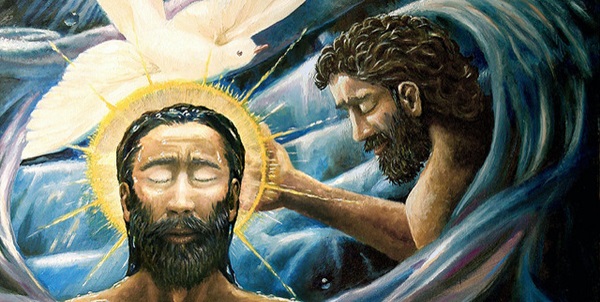

In Part 1, I just wanted to get straight to the point and offered 9 bullets that reconstruct how John's ministry was necessarily contrasted with Jesus' baptism with the Holy Spirit, and concluded: This trinitarian saying [trinitarian baptismal formula] was said over converts by Jewish Christians in the latter half of the first century as a part of their baptism rites, and the confusion was at last resolved. This mutation of Judaism had astarted to vocalise, ritualise and (although they did not know it) immortalise its "Triune Hub".

In Part 2, I wanted to demonstrate how significant John the Baptist was from a non-Christian source, the Jewish historian Josephus. Here John receives as much attention from Josephus as Jesus. He is understood to have had massive influence such that even that God himself would overturn Herod's army in vengeance against the execution of his beloved prophet, John.

In Part 3, I took on the problem of the date of John's death, which is problematic if you cross the gospels' chronology with that of Josephus, but also a good angle from which to look at how the portrayal may have developed over the later stages of the first century. Here I present, gospel author by gospel author, the portrayal of John the Baptist, noting first in Mark the basic events and assumed death of John and Luke's expanded version which includes John's own birth narrative alongside Jesus'. Then we saw that Matthew almost seems to take on the challenge against the Josephus chronology, integrating narrative that explicitly informs Jesus of John's tragic demise. Finally, we saw in John's gospel that the author simply allows Jesus to "steal the show", allowing John to slip from view once he has served his purpose to point to the light.

What I failed to note in looking at Matthew (and regular readers will know I have a special relationship with Matthew!), is the relevance of the date of Antiquities, where Josephus describes John's ministry and death. It was written no later than 94 AD, but possibly earlier. Given all the other late indicators I am seeing for Matthew, I would suggest that this over-emphasis on Jesus' interaction with John's death is a firm contribution to a composition date of Matthew around the 90s close to John. It obviously contributes to the strong consensus that composition by the disciple Matthew is very unlikely.

Another thing we didn't do was look at the passages in Acts that refer to him. We'll not lose too much time on them individually now, as there are actually 9 of them, but they really do consistently echo what we have been saying all along: the contrast between the two main first-century Jewish figures, and that John points to Jesus. For that to mean something big so much decades later, can only mean that John's ministry continued to make a huge splash in Judea and beyond for decades.

Thus, regardless of when John really died, John's memory is dedicated to being that of a star player that nonetheless pointed to the hero and saviour of all, Jesus Christ, the inaugurator of the new Eschatological Age of the Spirit! It is with these ideas in mind that I called this last part: The Star Points To Another Who Points To Another.

Thank you for following the journey, blessings.

For reference, those 9 bullets again, followed by all New Testament references to John.
  • John's impact was really very big indeed and his renown mid-first-century may have been comparable with Jesus', see for example Apollos' of Alexandria's familiarity with his ministry in Acts chapter 18 and Paul's encounter with 12 disciples in Ephesus in the following chapter.
  • A clear historical relationship connects these major first-century Jewish players of John and Jesus; some credible scholars, have Jesus first being John's disciple before starting his own movement.
  • We have no texts of any followers of John.
  • For Jesus followers, Jesus has to be bigger and better than John. If John was great, and Jesus much greater than him. This could only have contributed to his final exalted status.
  • Contrary to popular Christian apologetics, killing a leader does not necessarily kill off the sect he started unless he is resurrected. John is solid proof of that. 
  • John and Jesus are firmly differentiated on the following grounds:
    • the Christ was more successfully understood to have really been raised back to life, unlike the rumours that surrounded a resurrection for John, 
    • John's humility seems genuine and may indeed have heralded the coming Messiah, turning down offers of honour, recognition and prestige (which ironically had the opposite effect), while Jesus combined humility and the messiahship,
    • Jesus baptised with the Holy Spirit; John baptised with water.
  • Since both martyrs were hugely influential baptisers and their ministries overlapped, their baptisms (and order of death) were at times confused.
  • Someone, somewhere, decided: enough is enough and came up with the threefold baptismal formula to clear it up once and for all. This may have been the author of Matthew's gospel, (whom I strongly believe wrote later than Luke and Acts, which bear witness to the confusion), or it may have been the author of the part of the Didache that also contains the baptism formula. Since both those sources are Jewish, that someone was almost certainly a strongly Jewish Christian (leader). 
  • Conclusion: This trinitarian saying was said over converts by Jewish Christians in the latter half of the first century as a part of their baptism rites, and the confusion was at last resolved. This mutation of Judaism had started to vocalise, ritualise and (although they did not know it) immortalise its "Triune Hub".

New Testament References


Saturday, 3 September 2016

Another opportunity to push Ehrman on John

Another opportunity has arisen to quiz Bart Ehrman on his confusing presentation of John's Christology. My previous efforts, to which he did not respond, you could read here, but were echoed and encouraged elsewhere. See also another correspondence with him here. You can't help but feel he is dodging the issue a bit. Here's the latest, from his post concerning the plurality of theological perspective in the New Testament, entitled: Different Ways of Describing the Theology of the New Testament (I agree with him that it differs internally more than systematic theologians like to permit, but that's not the point) (sorry, part of his post will not be visible if you are not a subscriber to his blog).

Bart wrote, typically, that for John: "Christ is a divine figure who is equal with God who has come from God to reveal the truth that can bring eternal life". Ehrman likes to contrast John's Christology with a radically different perspective from Mark or Luke, make John's a huge leap toward 4th century doctrinal solutions.

I responded: Dr Ehrman, do you not think it is actually possible that John is addressing a real or potential **misconception** within his community that Christ was equal with God, when he has Jesus saying that he is going to the Father, because he (the Father) is greater than him (Jesus)?

Bart responded: I think instead that it’s very complicated, that John incorporated traditions that emerged at different periods in his community’s history, and these traditions are sometimes at odds, christologically.

I responded: In which case (still thinking about your original statement), would it be more accurate (and wordy) to say that John incorporates a plurality of traditions, some of which affirm Christ’s equality with God and others that refute it? Personally, I would see this as too detached and inconsistent for John whose views I think you would agree are omnipresent.

From my experience, I'd say it is unlikely that he will continue the conversation further. But hopefully you get the point I keep trying to expose. What I meant by this final sentence that is not adequate to retreat back from the initial assertion about John see's Jesus as equal with God (and on previous occasions, Bart has just flat out declared that for John, "Jesus is God", something that even some relatively conservative evangelical scholars are hesitant to express in these terms) with talk of John just incorporating multiple traditions. John is not simply gathering diverse materials about Jesus. Unlike the synoptics that are based on textual sources (or at least Matthew and Luke), John is totally fresh and the content shaped by its strong theological message. Unlike what Ehrman says about the author of John (he knows nothing of the local context and was not at all an eyewitness or connected to any eye-witnesses), I would say some of the specific details in John's gospel show that this is either who it is traditionally connected with (son of Zebedee), or more likely, someone intimately connected with that resulting circle (I actually have a pet theory/speculation that John had recently died at the point of the writing of John's gospel, for the exact and perhaps commissioned purpose of not losing this teaching).

The point is that the author cannot be saying just that Christ is equal with God if he explicitly has Jesus saying that he is not equal with the Father. Logically then it is either

a) Jesus is both equal and not equal (somehow)
or
b) Jesus is not equal.

The author is not writing a compendium of different traditions. He's going for it and even explicitly writes down why it was written down this way John 20:31.

Let's see if Bart does answer though, maybe he can give the further clarification I and others have found he has often lacked on John.

Tuesday, 12 July 2016

John's gospel: "the Lord"

A crazy-short post today as I'm mega busy. I did procrastinate just long enough to check all the mentions I could find of the English rendering "the Lord" in John's gospel.

Every single one that was specifically referring to Jesus was arthrous. This means that Kyrios, the Greek translation for our word "Lord", is systematically translated with the definite article in John's gospel when referring to Jesus.

This cursory glance is suggestive of different usages of "Kyrios" in the Bible, where Yahweh is often translated "Kyrios", but without the article.

Since these gospel citations are likely emmanating from a later stage of 1st century understanding, given common dating of John's gospel, it seems that this usage is Jesus' earth-ministry title accorded and remembered by his disciples. The name that he inherited as the Son of God (see Hebrews 1:4) is probably a quite different kettle of fish.

Monday, 11 April 2016

Born from above or born again? Both are on the cards.

What does Jesus teach Nicodemus in John 3?


Everyone, or most people in the English-speaking world, has heard of the Christian-lingo "born again" Christians. For many Christians, being a "born-again" Christian is a crucial part of their identity. But is that what the Greek says? Let's look at the English NIV:

John 3:3 Jesus replied, “Very truly I tell you, no one can see the kingdom of God unless they are born again.” 

John 3:6-7 Flesh gives birth to flesh, but the Spirit gives birth to spirit. You should not be surprised at my saying, ‘You must be born again.’

Bart Ehrman frequently likes to make an interesting point about John's gospel here. He actually believes that in Greek this word, anōthen, means both "again" (i.e. born again) and "from above" (i.e. born from above), and that John is placing clever, double-entendre teaching on Jesus' lips via word play in Greek (for a conversation that almost certainly would not have taken place in that language, where the Aramaic translation for "born again" and "born from above" would vary).  But if John was uniquely talking about being born "from above", then there is no good explanation for Nicodemus' confusion about physical re-birth. Meanwhile, being born from above fits the clear flesh-spirit distinctions. So it's probably both. The problem we are left with, I guess, is that saying you are a born-again-this-time-from-above Christian doesn't role nearly quite so well of the tongue :)

Tuesday, 19 January 2016

Throwing Thomas some trinitarian credit... [updated]

Today I am providing the next part of my new sub-chapter into explicit references of Jesus being called "God".

John 20:28 – My Lord and my God!

John 20:28 brings us to what is probably the most explicit attribution to Jesus of the title “God” in the whole New Testament. Furthermore, and unlike in John 1:1, the definite article preceding "God" is also significantly present (ho Theos). The context of this famous declaration is that Jesus has now been raised and most of his disciples had seen him and been “breathed on” by him – but not Thomas. Like some other disciples, Thomas has doubts. Jesus subsequently confronts him and commands him to stop doubting and believe. Thomas’ response is “My Lord and my God” (and to worship – it is not clear if he actually takes up Jesus on his invitation to touch his wounds, but presumably not according to this account).

In this immediate context of doubt about God’s resurrection of Jesus and the disciples’ own empowerment through Jesus’ breathing in v22-23, why might Thomas say “My Lord and my God” to Jesus? Of course it is possible that despite the multiple distinctions within John’s gospel between Jesus and his Father God, that Thomas supernaturally glimpsed something of a totally different level to John, which concerned Jesus’ very nature (or natures). Maybe – because of the explicit wording we have to be open to it, or it might also be argued to work nicely in tandem with the prologue (the God-Word became flesh). However, since good Trinitarian theology is about big-picture reality of the life of God, there are some other contextual considerations that should be integrated into the exegetical analysis before developing theology from such a rare and apparently explicit statement.

The first consideration is to properly account for the author’s perspective. Although Thomas is “speaking” here, John is also speaking throughout. It is not likely therefore that Thomas will have a different insight to Jesus’ identity to that which John now holds 60 years later around A.D. 90. Within this very same chapter, Thomas’ statement is framed by two significant facts. Firstly, when the raised Jesus addresses Mary Magdalene, he freely and inclusively talks to her of his (and your) Father being his (and your) God (20:17) – so here John has another explicit and quite different statement about Jesus, that he and Mary share the same Father and God (see 7.3 God is the God of Jesus/Jesus has a God/Jesus is the servant of God). Secondly, the purpose of the book itself is plainly stated (20:31) so that, concerning Jesus’ identity, John earnestly wants to convince his readers of Jesus’ identity claim. This claim, which is demonstrably not in Cappadocian terms, states simply: the Messiah and the Son of God. For John, the Father is always in view and never confused with the Son. So why on earth might both “Lord” and “God” seemingly be attributed to the one Jesus here in John 20:28?

A minor second consideration is a hidden distinction in the Greek, which emphasises the third point I will develop below. It would have been possible for Thomas to simply state: “the Lord and God of me!” Yet, he does not do that. What he actually says in the Greek is: “the Lord of me and the God of me!”

With this in mind, let us move on to the final and most important consideration of John’s purpose here: spurring disciples to know God the Father in Christ. When we zoom in on just this passage for doctrinal purposes, Thomas’ character (and belief) development within John’s gospel are often sadly lost. For in addition to the primary goal of revealing Jesus’ identity as God’s Messiah and Son, John is also desperate for people to respond to the revelation he is chronicling, and truly believe this dual (and to a less emphasised extent, triple) reality. It seems impossible that this dual reality could be an incredible revelation of Christ’s two natures! The dual reality is seeing both Christ and God-the-Father-in-Christ. Believing (and its antithesis, doubting) are key themes for him, so in encouraging late first century disciples in their belief, tracking Thomas’ spiritual journey would have made a lot of sense. Just look at how Jesus immediately responds to Thomas in the following verse: “blessed are those who have not seen and yet have believed”. So to understand Thomas’ “belief development”, we need to go back six chapters to chapter 14, where both Thomas and Philip question Jesus about belief. Belief is to be in God and in his Son (14:1), you cannot short-circuit Jesus to the Father (14:6), and the Father is present in the Son. If you see the Son then your desire to see the Father is satisfied, not because the Father is the Son, but because the Father is in the Son. You cannot have one without the other. This is the journey that John is so keen to show his disciples and readers later on. Zoom forward three chapters to John 17:3, and Jesus prays this: Now this is eternal life: that they know you, the only true God, and Jesus Christ, whom you have sent. Jesus and the Father are to be known, both of them. For Thomas as-yet without the Holy Spirit, that means knowing (and believing in) the still-present Jesus and, through that Jesus, knowing their common Father.

In light of these three considerations, it therefore seems quite possible to me that in 20:28, Thomas finally understands that the Father, who in first century parlance is the one who is properly called “God” in the genitive sense, that this Father is indeed in the Son (John 14:10). Thomas might well then state “the Lord of me (a title in the possessive form that is never attributed to God in the Bible but always to human authorities[6]) and the God of me” (specifically stating belief of the Father’s presence, truly and astoundingly in Jesus).

It is somewhat ironical that the traditional interpretations, which have pushed for simple divinity interpretations, have frequently failed to identify and develop the deeper trinitarian and Johannine themes here of the Father in the Son. 18th century commentaries such as Matthew Henry (We must believe his deity—that he is God; not a man made God, but God made man, as this evangelist had laid down his thesis at first, ch. 1:1[7]) have provided a normative precedent away from vertical contextualisation in this case. Much later that century, British bishop Brooke F. Westcott, unsurprisingly[8], was more careful with the text, despite his failure to specifically join the dots to the Father’s indwelling presence through his Holy Spirit (my emphasis):

The discipline of self-questioning, followed by the revelation of tender compassion and divine knowledge, enabled St. Thomas to rise to the loftiest view of the Lord given in the Gospels ….

The record of this confession therefore forms the appropriate close to his narrative; and the words which follow show that the Lord accepted the declaration of His divinity as the true expression of faith. He never speaks of Himself directly as God (comp. v. 18), but the aim of His revelation was to lead men to see God in him.[9]

Perhaps Westcott was inspired by Augustine who also is close but strangely un-trinitarian here:
[Thomas] saw and touched the man, and [then] acknowledged the God whom he neither saw nor touched.[10]

Adolf Schlatter, however, was able to make a full connection (my emphasis):
“The Word is God,” 1:1. The knowing of Jesus is then attained when it is seen that “he is in the Father and the Father is in him,” 14:10. Through his single word “my” [Thomas’s] knowledge remains not just knowledge but becomes faith.[11]

In final conclusion on Thomas, while it must obviously be concluded that he does address Jesus as “God”, it is frankly disappointingly and decidedly untrinitarian to isolate this passage from its overarching witness of the Father in his Son, the Christ. Jesus himself states emphatically throughout this same gospel:

But if I do judge, my decisions are true, because I am not alone. I stand with the Father, who sent me. In your own Law it is written that the testimony of two witnesses is true. I am one who testifies for myself; my other witness is the Father, who sent me.”
Then they asked him, “Where is your father?”
“You do not know me or my Father,” Jesus replied. “If you knew me, you would know my Father also.” [12]
“The one who sent me is with me; he has not left me alone”.[13]

And finally, when Philip and Thomas ply Jesus with questions on precisely this topic:
Anyone who has seen me has seen the Father. How can you say, 'Show us the Father'? Jesus said to him, “Have I been with you so long, and you still do not know me, Philip? Whoever has seen me has seen the Father. Don't you believe that I am in the Father, and that the Father is in me? The words I say to you I do not speak on my own authority.[14]


[1] For now I can say this: despite general historical shifts in understanding what is going on with “Word” (logos), “God” (ho theos and theos) and “Become” (egeneto), that Christians having access to this passage or its precursor, have always believed that God’s eternal divine word was incarnated in (or into) Jesus (as a Christian I also have made the choice to believe that). This leaves incarnation Christology still very open as my chapter above on the church fathers demonstrates. It is precisely the interpretative options that I must still articulate and align with John’s overarching themes and goals.
[2] You will recall that there is a penalty system in place for texts where the strength of their suggestiveness or dissuasiveness is weakened according to a number of defined causes (see p. 51). This category is concerned more than any other by the penalty system as we shall now briefly see before we zoom into two of the most crucial of all blue texts in the entire New Testament canon, and which are certainly not to be penalised: John 20:28 and Hebrews 1:8-9.
[3] Of course, we are assuredly not positing a traditional evangelical view of first century Jewish monotheism that excludes other real gods within Yahweh’s divine council (please refer to the Monotheism entry in chapter 2 if needed; also see ).
[4] Titus is harder for me to assume this because I cannot apply the same criterion of consistency to a book that might be the only text we have by its author. If that were true and it were written in a later and more christologically developed situation, then the assumption of distinction is a considerably weaker option. Earliest manuscript is Papyrus 32, dated late 2nd century.
[5] Fortunately, this variation is footnoted by the NIV, which alerts readers to the shakiness of this evidence
[6] James 3:9 does not really present an exception to the rule given its textual variations, which are not always footnoted in modern translations. Given the biblical evidence, the variant “our God and Father” should be preferred.
[7] M. Henry, Exposition of the Old and New Testament, Vol. 3,  p. 707, London: Joseph Ogle Robinson, 1708.
[8] Unsurprising given his biblical and ground-breaking credentials in New Testament textual criticism.
[9] B. F. Westcott, The Gospel According to St. John, p. 297, London: John Murray, 1894.
[10] Augustine, John, 121:5, in Nicene and Post-Nicene Fathers 1 7:438, Philip Schaff, T. & T. Clark, 1896-1900. One could legitimately pose the question of compatibility between Augustine’s statement here and the ecumenical and unshakable doctrinal stance of both Catholic and Orthodox theology, that Mary is the Mother of God (431 Council of Ephesus): if Jesus could only be touched and seen according to his human nature, which is presumably true, then how could Mary be considered to have mothered him according to his divine nature? A staunch defender of Augustinian theology might posit that Augustine was simply stating that Thomas had not previously “seen” the Father in Jesus until this revelatory moment, but then why this tense and not “whom he had neither seen nor touched”? Of course the issue of physical contact with the risen Lord is not entirely resolved, with some early ambiguity around the physical contact may have been heightened through a tradition expressed by Ignatius in the early 2nd century which does categorically affirm this although the source of that tradition is now lost to us. See R. Brown, The Virginal Conception & Bodily Resurrection of Jesus, p. 88 fn.150, Paulist Press, 1973. Brown does not, however, indicate why Matthew 28:9 was not relevant to him.
[11] Adolf Schlatter, Johannes, p. 362, Evangel. Verlag-Anst., 1954, cited by Frederick D. Bruner The Gospel of John: A Commentary, p. 1183, Wm. B. Eerdmans Publishing, 2012 (Bruner cites page 362, which appears to be from a translation, not the original).
[12] John 8:16-19
[13] John 8:29
[14] John 14:9-10, obviously my own emphasis.

Saturday, 2 January 2016

Who wrote Revelation?

The standard response to the question of "Who wrote Revelation?" has been for many centuries (including the 2nd century): John, the apostle, the son of Zebedee. But are we sure of that?

There is a good paper just released on this exact topic written by Hugo Cotro here, in the DavarLogos Spanish theological journal; the article is entitled  Could the Author of Revelation step forward please?

I realised that my research (on this blog, although unfinished) on arche, which has bored most readers of this blog, might actually be of some relevance here, along with a very surprising discovery I made today about John's [otherwise] non-usage of Sophia.

I decided to write to Mr Cotro:

Dear Mr. Cotro.
I hope you don't mind my contacting you following your interesting article on the authorship of Revelation. I enjoyed reading your piece which I found summarised some of the arguments well, encouraging both positions to remain more open than perhaps has been the case. In particular I was impacted by the lack of evidence of an early Johannine circle. 
I wanted to submit to you two small grammatical arguments against same-author-as-fourth-gospel, which I suspect is maybe your preference. It may seem small, but they constitute two small linguistic stones on the it's-not-John-son-of-Zebedee camp (assuming the gospel is indeed that guy) and I don't know if you had them in view:
Firstly, John's gospels and the epistles [bearing his name] apply the anarthrous-yet-definite ARCHE in its many forms. John is the greatest New Testament advocate of this construction, which is also, of course, the LXX method in Genesis 1:1 and elsewhere. However, there are two authors who do not seem  to accept this usage. The main one is Hebrews, unless he is quoting the LXX, which he tends to do very faithfully. The second one is the author of Revelation.
My second linguistic stone is Sophia. I was stunned to discover not only that Logos is related to Sophia (which in itself is not a shocking discovery of course), but that John *never* (unless I am mistaken) uses Sophia... except guess where?
I hear your point about assistance from Ephesus, which is speculative and possible.
Thanks,
John

Tuesday, 22 September 2015

God/Jesus distinctions

In my paper Trinitarian Interpretations, I address some aspects of the God/Jesus distinctions provided by the New Testament authors, although I'd love to look into them more. On Bart Ehrman's blog, someone posted about 24 distinctions that he had found with their references. This was my response:

I was able to find around this number just for the strand: "God raised Jesus" anthem we find in the NT. But don't waste time on Jesus distinctions with "the Father", Trinitarians have a quick and "easy" response to that, unless of course you want to wrestle with the "Father/God" interchangeability.

For the interchangeability, I think the strongest evidence can also be found in John. "The Father sent me". "God sent me", etc. Trinitarians can only claim a one-way relationship between Jesus and God. Jesus is [OF the divine eternal] God [essence]. The confusion arises out of the removal of these square brackets, because if you don't have them, it is not obvious why the opposite cannot be true, i.e. that Jesus and God are not synonymous. That confusion is not present when you read John. For John, Jesus' notion of God is that he is Father, and that this Father, that he has in some sense "discovered", is also God, ho Theos. For John, there IS interchangeability.

Tuesday, 10 March 2015

monogenes


Recently monogenes (only begotten) came to my attention, and I am so glad that it has. For one thing, it opened a new blue sub-category (blue in my study is a colour code that signifies that a passage could be suggestive of something that later could be interpreted according to a Triune-God perspective, from the late fourth century onward), just for these special mentions by John.

Really interesting what came out of the study. I learned the following:
  • Only John uses this only-begotten language of Jesus.
  • Of the other New Testament references, we note
    • It's boys and girls
    • There is always a high risk of death or death has already come to the monogenes.
    • There is a specific reference by the Hebrews writer to Isaac, the monogenes of Abraham (even though there was an older half-brother)
  • In all they number 9.
The problem that Trinitarians must still face is the "of" that is required, at least in English, between "only begotten [son]" and "God": only begotten of God. What would have been really ideal for Trinitarian theology, I think, would have been if the authors had used the preposition "in" - the only begotten son in God. Jurgen Moltmann advocates this solution in a similar problem, The Crucified God. Here Moltmann says that it is more accurate to talk not so much of the death of God as of the death in God.

Returning to monogenes and John, I am now wondering if John, writing later, used this expression specifically with the sacrifice story in Genesis 22 in mind. I was initially a little disappointed to note, I must admit, that the Septuagint (LXX) Greek uses a different expression than monogenes.

"τὸν υἱόν σου τὸν ἀγαπητόν ὃν ἠγάπησας"

But check out what it means: your beloved son you love (the beloved son of you that you love). That's a lot of love! There is nothing here explicitly "mono", but it is carried by singular definite articles and this "love focus". So the idea remains very consistent between monogenes and τὸν υἱόν σου τὸν ἀγαπητόν. We could legitimately wonder, as John taught his church group/disciples, did he discover the strong parallels in the Isaac story, teach that and subsequently adopt this into a working title for Jesus? Or was the monogenes description sufficiently circulated in the story-telling of the Isaac history in first century Judaism and Christianity, as evidenced by Hebrews, to be prepared for John in a similar way to logos (see Philo)? Really interestingly, Philo, who shows scant if any evidence of knowledge of the events of Jesus in Palestine and Jerusalem, already equates God's utterance (logos) with being his first-born son. I'm checking up on this.

In any case, this reflection on the context of death, breaking or abandon of one so unbelievably precious was powerfully reinforced for five of us this evening in a small house group setting. So nice when theology finds its way out into people's lives! We realised that you simply cannot realise how precious something is to you without some kind of knowledge of how terrible it would be to lose it.