Showing posts with label binitarian. Show all posts

Monday, 4 September 2017

LJC S2 Part 7: Paul assumes and does not criticise Christ-worship and Jesus centrality

In Part 6 we tracked the development of the Gentile inclusion process, from Peter addressing Jews from all nations in Acts 2, through understanding (and rejoicing) that non-Jews could be partakers in the great eschatological people via their legitimate receiving of God's great outpouring of his Spirit, to the eventual dawning in Galatians that the scope of Christ's salvation for his People of God was far wider - far greater - than Torah observance of circumcision.
Before advancing in Hurtado's chapter today in Paul, perhaps I could just add in the tension enhanced by Matthew's later addition in Matthew 5:18: "For truly I tell you, until heaven and earth disappear, not the smallest letter, not the least stroke of a pen, will by any means disappear from the Law until everything is accomplished." (NIV). So, hopefully it is starting to become more obvious as we allow Hurtado to immerse us in the first-century world, just what a whopper of an issue male circumcision was to the flourishing Christian movement.

Remember how in Chapter 1 we surveyed Hurtado's general thesis? We looked at his four major reasons that helped shaped Christian worship the way it did, and I praised it for its clarity. We had (the rather epic) Jewish monotheism, Jesus himself, religious experience and the religious environment. Here now Hurtado dips briefly into this model and asserts that for Paul indeed Jesus was this ultimate model for Christian living: "Jesus also functions as the inspiring model of the ethical qualities that are to characterize the present life of the redeemed and of the eschatological outcome of their redemption as well." (p. 134)

The section I want to focus on today is simply entitled "Binitarian Worship". Readers might remember that in the first series I had a post entitled: What does Hurtado mean by "binitarian"? I don't want to re-hash all of that here, but I'd like to give a shout out to blog reader, Richard Wilson, who astutely pointed out in a comment he left on one post that Hurtado has distanced himself over the last decade or more separating us from this important 2003 publication Lord Jesus Christ over this term, preferring to speak these days more of "dyadic worship". This is indeed evidenced over the exchange I had with Hurtado concerning his differences with Dunn here and here, alsoace given to Jesus in Pauline Ch in the first series. Good spot Richard! This problem of quite how we describe this early Christian worship is indeed not satisfactorily solved by calling it "binitarian". Binitarian sounds a lot like trinitarian-minus-one. Trinitarianism itself suffers from a lot of ambiguity, but given its ultimate form of the Triune God, then we could indeed agree that Hurtado's move away from binitarian to be a good one. Our author is certainly not implying that for our first-century founders that God himself is binitarian, otherwise his use of "both" would be entirely redundant: "The christological material we have surveyed here reflects an impressive... place given to Jesus in Pauline Christianity. As Kreitzer and Richardson have shown, in Pauline Christianity we see a remarkable "overlap" in functions between God and Jesus, and also in the honorific rhetoric used to refer to them both." (p. 134)

What I can say in summary and in strong agreement with Hurtado throughout this part is to assert the following: Is it not extraordinary that in all of the Pauline correspondence, despite all the issues that he addresses, that the centrality of Jesus and his overlap in functions with God are never critiqued? Hurtado goes into some detail to attempt to demonstrate that this would have included the earliest, Aramaic-speaking followers of Jesus themselves.

Worship

I am particularly pleased with what follows. I am a bit of a stickler for detail, as my queries on the precise definition of "binitarian" have probably shown. This time, however, on the question of "Christ devotion", which is clearly demonstrated, Hurtado is going to take head on the challenge (particularly from the likes of Dunn) that this should not be overlapped with how we might define "worship". Does the devotion to Christ reflected in Paul's letters really amount to "worship" in the sense of reverence directed to a deity? (p. 137) Here, Hurtado throttles up to full power and unleashes dense summaries of a string of publications he has published over the years that demonstrate the unique and divine status and "programmatic inclusion" of Jesus alongside the one true God of the Israelites. He is able to compellingly sweep aside allusions to occasional alternative intertestamental Jewish figures who had received some honorific recognition, or some sort of emergence of Jesus in the pagan sense of the Roman religious context of the time, highlighting the consistent "constellations" of practices evidenced and assumed by this earliest extant Christian writer, Paul.

In my next  post, we'll see what Hurtado has to say about prayer in particular, which I hope should cause us who believe in Christ and the Father to reflect afresh about how we address them in light of the earliest Christian practice.


Tuesday, 4 July 2017

Lord Jesus Christ, by Larry Hurtado, Part 12: Inside the "furnace"

VISIONS OF THE exalted Christ, prophetic oracles, inspired songs and charismatic exegesis of biblical texts - these comprise perhaps the primary examples of the validating religious experiences of the earliest circles of Christianity.

Yesterday we saw how these experiences would have provided the necessary "furnace" to enable and demand that a serious reconfiguration of the existing Jewish devotional matrix be undertaken. Today, then, we can enumerate these various sorts of religious experience.

1. Visions - I note with interest Hurtado's openness to the centrality of the Spirit via his referencing here of 1 Cor. 14:26, which is most powerfully manifest in a collective setting. Think about it: in these revelations, the Spirit is pivotal to making the resurrected Son central alongside the Father.

2. Prophetic oracles and inspired songs  - again this is not every lone Christian experience, but a feature of the shared experience of the group. Interestingly, we have access to some of the productions of this period through some of Paul's citations of hymns known to his recipients (e.g. Phil. 2:6-11). There was no literary brilliance involved either: These were not the products of trained poets but arose out of the religious exaltation of Christians (p. 73).

3. "Charismatic exegesis" - it is interesting to reflect on the very real possibility that Hurtado provides us that integrating a revisitation of the Old Testament texts (also considered to be inspired by the Holy Spirit) could be part of this communal furnace experience. We can tend to associate analysis of biblical texts as a serious and considered preoccupation that is available to a few from the pulpit and the rest of us at home (in light of that pulpit). Not so the first Christians! In particular, Hurtado shows some legitimate wonder at the usage of the highly monotheistic text of Isaiah 45:23 in Philippians 2:10-11, where Christ gets to be Kyrios in this Old Testament passage!

In addition to these aspects, Hurtado also considers that prayer for divine revelations would have featured, and indeed invigorated fresh inquiry into their Jewish scriptures.

It is this highly experiential life and breath understood through the lens of the Spirit that would have permitted such rapid and intense proportions of Jesus devotion to occur. For me, that might make three, even or perhaps particularly in the context of worship.

Come back tomorrow for Part 13: The Religious Environment, which will see us complete the four factors Hurtado provides for the emergence and shape of Christian devotion to Jesus in the first century. Before I go - ever so grateful to Dr. Hurtado for recommending this series on his own blog, I hope any newcomers from there are enjoying the style and approach I've adopted. We are not too far now from the end of chapter 1, at which point I will provide a summary with Hurtado's chapter structure and my corresponding posts for ease of access.

Monday, 3 July 2017

Lord Jesus Christ, by Larry Hurtado, Part 11: Religious Experience

Christ-devotion quickly amounted to what may be regarded as an unparalleled innovation, a “mutation” or new variant form of exclusivist monotheism in which a second figure (Jesus) was programmatically included with God in the devotional pattern of Christian groups. Outside the Jewish-Christian circles in which this binitarian pattern arose, the characteristic force of exclusivist monotheism seems to have prevented any other figure being treated as rightful recipient of cultic devotion, just as this monotheistic constraint served in early Christian circles to work against any additional figures other than God and Jesus being accorded such reverence. (My emphasis. p. 64)

Despite what we noticed yesterday about the polarising effects of Jesus' words and actions, Hurtado is the first to recognise that this is hardly sufficient explanation for the mutation described above. Rather, it is the combination of the constraint of monotheism, the polarisation and religious experiences with "revelatory validity", as Hurtado aptly puts it, that will cause this initially-Jewish movement to "mutate". Similarly to the caution our author extends to the content of the polarisation Jesus caused, we also should satisfy ourselves not with the content of these experiences per se, rather see that these experiences did indeed validate the solidifying belief structures and devotional practices of the earliest Christian communities. Surely, I thought to myself, as I first read through this section with gusto back in May, we are going to be introduced to the central role of the Holy Spirit for these communities? How will Hurtado articulate that centrality within his "binitarian" model? While that question must be left to hang for the rest of the book, Hurtado obviously must integrate discussion at this stage on the Spirit.

First, he notes that these crucial experiences have tended to be sidelined in many historical studies, which prefer to focus on more theological doctrines. Gunkel, writing way back in 1888, is briefly alluded to as a watershed publication on the Spirit's importance for Paul. A few pages are available of this translated work are available as a sample on the Amazon website and are worth a visit:

It cannot be disputed that even at Paul's position at this point in his teaching [the period of his life when he was writing his epistles] can be properly understood and evaluated only when we first consider the ideas that were first available to the apostle within Christian circles. (p. 9)

We must designate Judaism as the real matrix of the gospel (p. 13)

In the matter of the Spirit's activities, we have to do with an ancient Hebrew or perhaps primitive Semitic conception that had undergone only slight changes in the apostolic age. 

In the eyes of the primitive Christian community [this daily experience of the Holy Spirit] render[s] the presence of the Spirit an undeniable fact. 

If the notion of Spirit in ancient Israel had not been uncommonly vivid, a fact that can often enough be proved with examples, then its origin and persistence throughout many centuries up to the apostolic age would be totally inconceivable.

We are dealing here with an idea that was unusually vital in primitive Christianity. (p. 14)

Impressive. Without having accessed this work yet in full, it seems clear that Gunkel had a similar project to Hurtado and ourselves today, although with respect to the Spirit.

Hurtado also cites again his great sparring partner, Dunn, with a great quote from Jesus and the Spirit:

Dunn insisted that we also have to grant “the creative power of his own religious experience—a furnace which melted many concepts in its fires and poured them forth into new moulds. . . . Nothing should be allowed to obscure that fact.” (LJC p. 66)

This is absolute dynamite. What these experiences provide for then is the veritable "furnace" that we are looking for that would permit such rapid reconfigurations of such slowly-developed religious worldviews as Jewish monotheism - and God's experiential Spirit is at the heart of that.

Hurtado explores some of the ins and outs of the argumentation in the literature that basically concludes that these experiences can be genuinely innovative, even if fuelled by traceable influences.

Time to delve into what those experiences must have been; top of the list is obvious: the resurrected Christ (pp. 71-72), which would have led to the following convictions:

(1) that God had released Jesus from death, so that it really is Jesus, not merely his memory or influence, who lives again; (2) that God has bestowed on Jesus uniquely a glorious new form of existence, immortal and eschatological bodily life; (3) that Jesus has also been exalted to a unique heavenly status, thus presiding by God’s appointment over the redemptive program; and (4) that those who were given these special encounters with the risen Jesus were divinely commissioned to proclaim Jesus’ exalted status and to summon people to recognize in his resurrection/exaltation the signal that the eschatological moment of redemption has arrived. (My emphasis. p. 72 )

My sense is that this commissioning and eschatological status of the Christians' new era were profoundly connected to the marked and experienced empowerment of the Holy Spirit. Thus, we are not describing simply "visions" of the resurrected Jesus, but veritable "experiences" of him that empowered his followers with extraordinary purpose. Let us turn briefly to Gordon Fee's Paul, the Spirit and the People of God (Hodder & Stoughton):

The Spirit as an experienced and empowering reality was for Paul and his churches the key player in all of Christian life, from beginning to end. (xv)

In the case of the Spirit we are dealing with the essential matter of early Christian experience [...which] was how the early believers came to understand themselves as living at the beginning of the end times [...] the Spirit was guarantee that God would conclude what he had begun in Christ (= Paul's eschatological framework).  (emphasis original. pp. 2-3)

The experience of the Holy Spirit and of Christ through the Spirit seem to be central to Gunkel and Fee's perspective of these pre-Pauline communities, but Hurtado keeps his focus on the post-resurrection experience of Jesus. He continues from the previous citation on p. 72:... likely involved an encounter with a figure recognized as Jesus but also exhibiting features that convinced the recipients that he had been clothed with divine-like glory and given a unique heavenly status. This description appears to me reminiscent, although not for Hurtado, of the Daniel 7 depiction of the Son of Man. Regardless, it is this exalted experience of Christ that would lead to the necessity to venerate him accordingly, which as revealed and required by God himself, the mutation is not simply justified but mandatory.

We will pause there for today - in the next post we will look at three example forms that these religious experiences most certainly took.

Sunday, 2 July 2017

Lord Jesus Christ, by Larry Hurtado, Part 10: Jesus, the polarizing figure, just like Marmite...

JESUS IN BOTH life and memory polarized his listeners.

Today, we move away at last from our discussion around monotheism - Larry Hurtado's first of four factors governing the early emergence of first century "binitarian" Christian worship - and move over to his second factor: Jesus himself. In the previous section, we saw that monotheism provided a constraining influence on the practice of devotion to Jesus, we established some of the contours of what appears to be Hurtado's usage of the word "binitarian" and we questioned the effects and meaning of the inclusion of gentile converts (ex-polytheists). On this last point - just to situate anyone joining us at this point - as an advocate for an early Jewish-Christian form of trinitarian faith, I am asking the question of some of Hurtado's key factors of binitarian devotion: might the Holy Spirit also have been pivotal for such an historic development? More of that in the next post.

Back to Jesus. It might sound like an obvious point, but theologians and historians of Christian origins can do a lot of speculating, postulating and theorising around this or that feature of Christianity and somehow avoid the man himself. I've probably been guilty of that too. Hurtado is not, however, although he will also wisely avoid plunging himself too deeply off-track into appraisals of this or that movement to rediscover what "the historical Jesus" might have required in terms of religious veneration. The material to cover is too vast and the primary point that emerges for his own thesis does not depend on a specific reconstruction, because our author will point to the polarizing effects of Jesus on his followers both during his earthly ministry and in his subsequent memory as resurrected and exalted Lord.

Like Marmite is cleverly promoted through its early image of being a spread British consumers either loved or hated (I love it!), Jesus seems to have thrust a radical choice onto his hearers. Either they accept him as God's messiah of a truly biblical, transformational and inclusive humanity, or you reject him (and repeat, on whatever serious subject matter is necessary). What you don't do, says Hurtado, is adopt some unsubstantiated pacifistic Jesus, who was only made into a polarizing force at some later stage (roughly in this camp: Hurtado tackles Geza Vermes, Burton Mack and, most significantly for me, John Dominic Crossan).

Nonetheless, the bridging mechanism between the polarized Jesus of the church and the polarizing Galilean I felt was not very strongly emphasised by Hurtado in response to authors like Mack: there was likely something in Jesus’ own actions and statements that generated, or at least contributed to, this polarization. In response to Crossan, he is stronger: if [Jesus] intended no special role for himself in their religious life, Jesus would have to be seen as spectacularly unsuccessful in communicating his intentions to his followers. [KL 1088] 

Responding to Mack he responds with solid appeals for proof: we do have direct evidence of how Jesus’ sayings were used by a number of Christian circles and none of these circles corresponds to the sort of group that Mack posits. [KL 1134] 

Hurtado is referring to an argument from Mack, which appears to be substantially based on "Q", which we will be discussing this in more depth later in the series (and always including the quotes around "Q"). W, Hurtado is loyal to the "Q" hypothesis, which is indeed backed by a majority of scholars writing on the synoptic problem, but intercepts Mack's inferences - since it contains primarily sayings of Jesus and lacks central Christian doctrines on the death, resurrection and ascension of Christ, Mack claims at the very beginning around when "Q" was written those components weren't yet present in the thinking of Jesus' followers.

All of this said, however, it is still curious to note that Hurtado keeps this mental reserve for some gap between what the impact of Jesus and what Jesus' intentions may have been: "in any case, whether in keeping with his intention or not, people were polarized over Jesus" [KL 1091]. We should understand then that what he is tackling is that there can be any scope for a phase during or after Jesus' earthly life in which the primary response to his words and actions was indifference. Not happenin'.

To close, Hurtado summarizes it best: "the immediate and dominant outcome of Jesus’ career was a sharply divided set of views about him, with some so negative as to justify his crucifixion and some so positive as to form the basis of one or more new religious movements[KL 1162]

Before I sign off, I just wanted to flag that this is the context for the fascinating idea I cited from Hurtado before, right at the start of the series, about dysfunctional or unsuccessful religious mutations. Tracking the christianities that succeeded as mutations from Judaism is, I think, of great interest, especially if we want to claim (like I do) that the Holy Spirit's centrality could not have been a subsequent mutation. With this in mind, and with the glorious benefit of hindsight (!), it is tempting to hold up the mutated triune hub of successful Christianity as the measuring stick of "success" during the first two centuries in particular.

Saturday, 1 July 2017

Lord Jesus Christ, by Larry Hurtado, Part 9: what does Hurtado mean by "binitarian" and monotheism effects on Jesus worship

THIS UNUSUAL “BINITARIAN” devotional pattern certainly requires further analysis and adequate explanation.

These words constitute Hurtado's opening line for this section in which we will see the effects that Jewish monotheism probably had on Christian worship - needless to say, I will have some extra questions regarding quite what the inclusion of Gentiles into this context might have signified - needless to say, however, Hurtado is going to continue to masterfully fill out for us the major contour lines we need.

Before we go any further, however, let's stop a second. Do you see how Hurtado is using this word, "binitarian"? It is a crucial question, and one that this book does not explore specifically (although see expansion below), but we have to ask it. Is he implying that *someone* is binitarian or that *something* is binitarian? It's a thing. That thing is called here a "devotional pattern". Everything hinges on this distinction for my hypothesis, which, just to remind anyone joining the cruise here, agrees that there are most certainly two distinct but joined stages of trinitarian development in the first four centuries of Christianity. In the first century, monotheistic faith came to be reshaped around two additional entities. The faith - not God himself - became trinitarian in its discourse and practice. So do I agree with Hurtado's usage of "binitarian"? Yes and no - although mainly yes. Yes, for the point I just made about it relating to some aspect of faith. My two itty bitty "no" components are to do with the fact that I don't agree that not explicitly making this distinction is completely fine. Some readers - maybe many - who are reading this may gloss over this language, excited to see that Trinitarianism (capital T) starts as early as they hoped. I hope I am just as excited. Only I want to keep my excitement in line with what careful historians are actually piecing together.

Hurtado introduces now a new term, which we need to understand as a direct translation of his previous preference for "mutation": "variant". This is a curious choice for me - apparently, the reason he makes this switch (although he doesn't give up on mutation completely and has a palette of equivalent terms) is twofold. Firstly, since he wrote One God, One Lord, in which "mutation" was used on scores of occasions, mutation language has received some criticism in the academy as somewhat derogatory, although I have no idea by whom. Secondly, he feels like "variant" is an informative illustrative term because, as he knows, and as some of his readership will know, a textual variant has a specific meaning in the field of textual criticism. But that is a highly specialised and less graphic illustration than mutation, and I won't hide constitutes a peculiar choice for me. So this "variant" is, in fact, monotheistic Christianity, and more specifically, the binitarian worship practice within Christianity that still holds to there being precisely one God. This central feature of monotheism in earliest Christianity, we would do well to remember (and I don't think Hurtado feels the need to remind his readership of this, probably assuming prior knowledge), is not something that was defined in quite those terms. Coincidentally, or perhaps not so coincidentally, I believe it is in the context of worship that the word monotheism first arises, as far as we know, with μονόθεον occurring in a Byzantine hymn (see an old post I did on this here). A hymn! I think Hurtado would have liked that.

But we've still not got much further than simply affirming that Christianity represents a mutation of a nonetheless monotheistic Judaism. Hurtado will go on to emphasise the exclusive force of monotheism on Christianity when he states: "Inasmuch as exclusivist monotheism is manifested essentially...in a refusal to offer worship to any figure other than the one God" (my italics). OK, so you might think maybe Hurtado does mean something more by "binitarian" after all! Sometimes it is difficult to track, to be honest, but I think it's an imperfect line out of step with his wording throughout this section. Indeed, I can also say that from reading quite a bit of Hurtado that this line seems odd. Why? Because Christ is another figure (see below) and is consistently referenced by Hurtado as such, albeit with the usual caveats of distinct-yet-joined. One of my favourite lines in Revelation is chapter 12, verse 10, which I think can bring some clarity about how in the first century we might talk of God and Christ together:

Then I heard a loud voice in heaven say:‘Now have come the salvation and the power and the kingdom of our God, and the authority of his Messiah. For the accuser of our brothers and sisters, who accuses them before our God day and night, has been hurled down.

Christ is God's Messiah, according to this passage. Elsewhere we can see co-ownership of the kingdom described through the powerful (presumably) single "throne of God and of the Lamb" in Rev 22:1 and 22:3, and most spectacularly here in 11:15:

Then the seventh angel blew his trumpet, and there were loud voices in heaven saying: "The kingdom of the world has become the kingdom of our Lord and of his Christ, and he will reign for ever and ever." 

Religious priestly activity is also now organised in a binitarian way in Rev 20:6, but look at how it is articulated:

Blessed and holy are those who share in the first resurrection. The second death has no power over them, but they will be priests of God and of Christ and will reign with him for a thousand years.

So this would seem, to me at least, that this sentence of Hurtado's needed some further explanation, that indeed another figure - God's Messiah, the lamb - is indeed in view, albeit in the same devotional snapshot (God would not be able to take a selfie in Revelation without Jesus being in the shot), as my examples seem to demand. Further, the constraints of monotheism must be satisfied from within the Judeo-Christian worldview. This is also an important consideration, as although first century Jewish "converts" to Christianity were able to understand a way in which they were, in fact, being faithful to God's command to worship him and Christ alongside him (or maybe firstly of himself via Christ, his "icon", to adopt Dunn's perspective), that this view was precisely not acceptable to mainstream Judaism, along with other characteristics of the Christian faith.

Hurtado's point, though, for Christianity is that its monotheistic inheritance meant that Jesus could not be deified as a separate deity. That is also crucial, that is the one thing to remember from this section - not my quibbles. We might also add that he could not replace the deity (I wonder if that might be the context behind John remembering Jesus saying "the Father is greater than I", John 14:28, but see also Luke 6:35, 1 Cor 15:27-8). This limitation on Jesus is helpfully termed by Hurtado as "the constraining effect of monotheism".

Turning specifically to how Jesus might be legitimately worshipped now. How was he perceived in this radical new configuration? "[H]is divine significance is characteristically expressed in terms of his relationship to the one God." OK, so we are more comfortably, I would say, back in line with the thrust of the New Testament texts and finding Hurtado's crucial breakthrough of divine endorsement. God knows about this worship, he even desires it and is glorified through it, it's all part of his great Plan. Hurtado has this masterful way of turning back to all those who like me who have pulled their hair out at all those blatant "and"-s separating Jesus and God throughout the New Testament, and saying "you see it but you don't see it"! That is a point I think he also made in an interview somewhere, that it is actually difficult for a New Testament author to speak of God without also speaking of Jesus within a verse or two. The two now function in the first-century mindset together. Hurtado also calls this in the present section "the programmatic inclusion" of Jesus. I quite like this, but programmatic feels slightly too exclusively intentional for me - I don't know what I'd say instead either, but I'd like to appeal also to the organic, natural inclusion of Jesus-worship into Jewish worship practices somehow. Hurtado is also now able to revisit his usage of "binintarian", expanding it slightly: it is still a worship pattern (not a god), around two figures ("God and Jesus", KL 969), operating within a monotheistic framework.

Finally, Hurtado asserts the various ways in which Jesus plays off pre-existent ideas of divine agents developed during second temple times, but also how he has adapted that category in the case of worship - but not in all the other cases. God's accomplishment of salvation for his people through this agent is unprecedented as it has catapulted the people, unexpectedly, into a new era of the Spirit indwelling all peoples. This is my addition, and leads to my question that is not posed in this section: what about the inclusion of Gentiles into this mix? The very fact that they are supposed to be there (although some failure to include is confronted by Paul, as is well known) is also a paradigm-shifting indicator. The first resurrection has happened, of God's messiah, no less. God has operated this inclusive and universal salvation through this Jesus. The presence of monotheistic Jewish Jesus-followers in the meetings is significant, but so is the presence of ex-pagan believers, who have renounced polytheistic practices, accept social discrimination and hardship for not performing the appropriate sacrifices on behalf of their trust in God's open invitation through his son, the Messiah, and the ongoing confirming seal of the Spirit. Thus, this inaugurated age in which all peoples can now come and glorify God is heavily associated by the New Testament authors with the outpouring of his Spirit on "all peoples". So to what extent could we already say that in another sense, this worship practice might, in fact, be "trinitarian", given that "binitarian" didn't have to mean a "binitarian god"? We will be asking questions of the Spirit again when we reach the experiential factors a few posts later.

Next section for tomorrow: how Jesus himself shaped his future worship.

Hope you're enjoying it - any feedback you'd like to leave? Anyone you can think of who might like joining us? Would you please consider forwarding the link to the blog? Thanks so much.

Friday, 30 June 2017

Lord Jesus Christ, by Larry Hurtado, Part 8: the line no-one ever crossed

ANGELS MUST NOT receive worship in either Jewish or Christian texts, says Hurtado, referencing Richard Bauckham's early work on this motif of refusal.

(Today we resume our "Hurtado Cruise", an interactive exchange with the text and even author - see previous post - over his magnum opus 2003 work, Lord Jesus Christ, crucial in building my own case for a first century Judeo-Christian trinity).

In our day and age, angels are seen by many folk as either a symbol for a very kind person or a legendary type of character in the same category as fairies and elves. Even within the church, there can be a sense of mystical or even magical allusion in talking about modern day experiences of them, which is removed from the context in which belief in these agents of God arose. The point is that the belief of such figures was also highly developed by the time that Christianity first flourished into the ready-made Roman empire-located network of synagogues, in such a way that some angels and exalted humans like Moses and Enoch carried huge divine responsibilities and rank. This was even to the point that they could "bear the Name" of God, literally be his representative. But Jesus broke that "rule". Correction, God broke that rule and required worship from Jewish followers of Jesus, to his own ultimate glory. Not only that, but Hurtado notes that the angel-refusal texts like in Revelation are the same texts that require worship of Jesus, which makes the contrast all the more striking.

My only critique of Hurtado, as I have already mentioned in my presentation of my exchange with the author, in no way downplays the striking nature of how God has Jesus 'cross the line' that must never be crossed. Like any established author, he has developed his own favoured linguistic resources, and "alongside God" is one of them, which dovetail well with other expressions like 'binitarian worship practices', one receives the worship alongside the other. Of course he will in his Paul chapter go into some depth on Philippians 2, and we too will make a port of call there on our own cruise of his work, but I felt this would have been a good time to develop how mediation and God's use of agents worked in a from God direction and in a to God direction. The latter description would have benefitted in particular from a description of how the priestly function facilitated worship to God without being through the priest. The key conclusion here is that Jesus is still made to cross the line but in a particular sense of mediation. Never before had an agent of God mediated worship back to God. This might however require a more Dunn-like distinction that I think Hurtado doesn't want to permit.

Back to Chapter 1: Forces and Factors - Hurtado now checks that monotheism is indeed functioning within the Christian New Testament and affirms it is, even in those contexts which extol Christ. Time for a quote:

[W]e have no analogous accommodation of a second figure along with God as recipient of such devotion in the Jewish tradition of the time, making it very difficult to fit this inclusion of Christ as recipient of devotion into any known devotional pattern attested among Jewish groups of the Roman period. [KL 919, my emphasis]

So how did monotheism affect Christ devotion? That's the subject of the next post!

Tuesday, 27 June 2017

Lord Jesus Christ, by Larry Hurtado, Part 7: Response from Dr Hurtado

OVER THE LAST couple of years, I have been amazed at both the opportunities created through the digital age to interact with scholars - regardless of credentials (I have virtually none in the field) - and the openness of some Christian scholars to discuss.

I have previously had some interaction and interest with Dr. Hurtado over my work on the LXX's translation tendency to remove the article to Kyrios as a pre-Christian translation of the Hebrew divine name for God, Yahweh. (That work is currently on hold, but I do intend to continue it).

On this occasion, Dr. Hurtado responded to my previous post in this series on the disagreement with James Dunn - you can consult that post here.

In that post, we were exploring a section on Hurtado's review of monotheism as a factor contributing to Christian "binitarian worship" of Jesus and the Father. His interaction with James Dunn there was fascinating. For Dunn, that kind of worship was progressive: through the humble pre-Pauline beginnings to the full-blown binitarian worship of Jesus "alongside" the Father, to use Hurtado's term, an event that was perceived by the Jewish establishment to finally break their monotheistic requirements of worship to Yahweh alone. Hurtado wants to disagree: all of the first-century expressions of "successfully mutated" Christianity from its Jewish heritage (please see here for what is meant here by "successful", it was an important post in developing my view) were properly binitarian in their worship practices.

At this point, my Ricoeurian viewpoint kicked in. How can both be true? My viewpoint is that it is both useful and important to remember that hermeneutics does not begin after the close of the Christian canon. The New Testament authors were interpreting one another, along with their own theological and practical settings, and of course in line with their own revelation (a question for another day: is there really a fundamental difference between divine inspiration and divine interpretation?) That is the case of Luke with respect to Mark, and of Matthew with respect to both of them, plus their other aforementioned concerns. John, a representative of a late first-century Christian practice, may not have any literary dependence on the Synoptics, which is significant for discussions on its authorship (I'm back on board with the apostle), but ignorance of Pauline and earlier Christianity and worship practices is obviously absurd. I then attempted to present the two Dunnian views diagrammatically, in order to attempt to highlight the potential for deeper convergence of views despite the surface-level disagreement between our two scholars.

It is both possible that my subsequent explanations were insufficient, and that due to his time restraints Dr. Hurtado read it en diagonal. Although maybe not: I had said:

The break-through nuance of (1) is that whereas second temple Judaism knew some striking examples of divine agents, acting in the Name of Yahweh (or Name of LORD), this is the first time that an agent can mediate a hitherto divinely reserved right back to God. That, combined with exclusion from the Jewish synagogues and Jewish communities, and the image of Christ reigning and God's right hand, may have led later Christian communities to interpret the earlier nuance in a new, more "alongside" fashion...

Dr. Hurtado perceived my presentation of the Johannine worship as dualistic. He reminded me to be cautious with John's gospel: 

... [it] is a tricky text:  It both presents a highly exalted picture of Jesus and also emphatically makes him the unique Son/agent of the one God.  And even where the text asserts that Jesus is to be reverenced "just as the Father" (5:24-25), it makes it clear that this was the Father's fiat for this to be so.

Needless to say, I felt a little humbled and wondered if I had overstepped. But if I look back to my presentation, it really is not a defence of Dunn's development, and I don't think I ever intended Dunn to imply that, and certainly not that I was implying that. If that had been the case, then the undoubtedly oversimplified diagram of the Johannine picture would not have commenced with a single arrow that split to the Father and the Son, but simply two arrows.

Dr. Hurtado's other comments regarding Paul simply seemed on the one hand to confirm the "through" aspect I was highlighting of worship to Jesus, who would naturally mediate that back to the Father, although on the other hand provided me with fresh fodder for the "alongside" development/interpretation idea with Paul's consistent joint grace/peace greetings from God and Jesus.

Finally, a couple of comments on a 2013 paper Dr. Hurtado very kindly shared with me, which highlights the dangers of adopting "trajectory" development models of early Christianity. The scholars who have advocated this in the past and whose work Hurtado is critiquing, I haven't yet read so can't comment specifically. But this paper is much more than a critique, it is a proposal for a model that integrates both interaction and diversity of the early Christian movement. As I read this paper, I was reminded of my early concerns of Ricoeur that I shared with my friend, Barney Aspray. I was worried that the ideas he was sharing with me (absolutely new to me) could not integrate precisely these same two central characteristics of diversity and interaction that prompted Dr. Hurtado to also share with me his paper, that it was too linear.

But I think that is not at all characteristic of the Ricoeurian model - Ricoeur is defiantly opposed to a simplistic ontological understanding of the world, including biblical texts. There are no shortcuts to his voie longue, which questions our relationship to the matter at hand, asking lots of tricky why questions. Like why am I interested in Christian origins? Why am I writing a blog, and why are you reading it? I am still on the lookout for an explicit rejection of linearity with Heidegger's hermeneutical circle as I slowly plough through Ricoeur's Le Conflit des Interprétations, but perhaps the point is that a line must always be traced between you and your interpretation of events. It sounds kinda like philosophical mumbo jumbo, but interpretation would be said to reside within your sense of being. This prods us to humbly realise that we are probably unable to have a direct access to truth, one that bypasses this process. 

So my response is again to highlight that I am neither siding with Dunn or Hurtado in this matter - I am trying to ask how we might perceive the hermeneutical circle functioning between these perspectives highlighted of Paul and John, which indeed embraces the interaction and diversity between the two and the communities they represent. If John is more "alongside" in worship practice and Paul more "through", neither (as I already emphasised in the post in question) would need to be positionning Christ less centrally, and neither would need to be devoid of the other emphasis. Both interpret according to what precedes them, which, I wholeheartedly agree, is the extraordinary resurrection-ascension event of the Messiah to the right hand of God.

My thanks once again to Dr. Hurtado for such a stimulating conversation!

Monday, 19 June 2017

Block, technical issues, faith kick [+ mise à jour]

[MISE A JOUR 26/06/17 - Un commentaire important en français en bas de cet article ajouté, suite à une question d'un lecteur français]

Hi. Apologies for the slow-down on the journey into Hurtado first century Christian binitarian worship territory. I felt like I was on a real charge doing a post every day or every other day, then a few things happened.


Like anyone, I sometimes experience "block": just that inability to engage my mind with the same clarity I enjoy at other times. I am also going through a period in my life when my mind actually totally saturates as well, which increases this effect when it occurs. This effect was either caused or worsened by learning that although SPCK found my book proposal interesting (it definitely sounded from their personalised response that it had been discussed between several members of their editorial staff), they weren't going to be able to pursue it further. So that was a downer.

Then, I had this really weird technical issue with Kindle notes. I don't know if you have tried it, but kindle notes and highlights are a great way of interacting with a book. Kindle have recently decided to revamp their online interface and call this new area simply "notebook", with a nice thumbnail of the cover of each book to hit to see your highlights and notes. For some devilish reason, all my Hurtado notes and highlights on which I was relying for this first century blog cruise we're on are present on their old system and totally absent on the new one. With my wife we probably have a couple of hundred of books on Kindle, and Hurtado's Lord Jesus Christ is the only book that this glitch is affecting. And to make matters worse, the old site where all the content is intact will die on July 3rd. Oh, and I'm getting nowhere with Amazon.

Urggh. This all leads to feeling a bit down about it to be honest, and in a world and market which frankly is just not as interested in trinitarian theology as I have been, I'm beginning to wonder if it's worth carrying on.

Sorry for such a depressing post - I'll also share one more thing about faith. From time to time I read or hear something that makes me really question my faith. I'm delighted about that because it means I am engaging with the criticisms out there and have usually bounced back. My research into first century expressions of proto-trinitarianism led me at various points to the Gospel according to Matthew, which time and again seemed late to me, by which I mean late first century. This actually is another small series of blog posts I need to write, and very important with respect to Matthew's relationship to baptism and John the Baptist in particular. Suffice it to say that there are others that share this view, and that Matthew had access to Luke (it's sometimes called the Matthean posteriority hypothesis, MPH) - one of these proponents made some analyses on this basis about the synoptic burial narratives that stung me. So that hasn't helped either.

Looking forward to a more upbeat post soon, and especially a solution to resume the Hurtado cruise.


Tuesday, 30 May 2017

Lord Jesus Christ, by Larry Hurtado - Part 2: Introduction

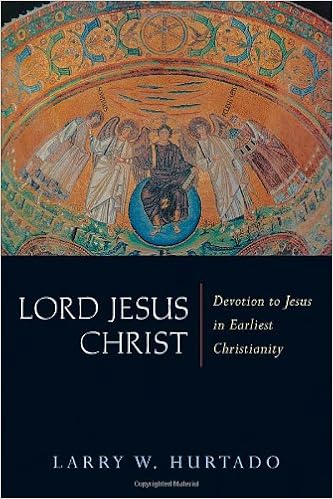
I am now going to more systematically post on the book Lord Jesus Christ: Devotion to Jesus in Earliest Christianity. 

Why Part 2? This is not actually the first response - I posted an insight inspired from my initial "unwrapping" of this wonderful gift a few posts back, where I had hit on an absolute nugget, around the idea of unsuccessful mutations. Please check that out - it is going to be key for what I end up proposing as a theory for the development of the late fourth-century doctrine of the Triune God, and I will certainly be referring back to that idea sparked by Hurtado.

That's a great queue for what I would like to say for the book as a whole: it's sparky. As I read through it with my usual critical approach I am finding whole new areas relevant to the development of the church and its theological, christological and pneumatological categories rise up and take up three-dimensional space in my mind. Read with a mind already initiated to some historical factors behind the rise of Christianity, and you cannot help but find yourself interacting with Hurtado's perspectives - probably endorsing many, questioning some others and perhaps disagreeing with a few too. Before I read it (and I'm not done yet), I didn't really have much of a view about "the Son of Man", or the "Q Source" (theoretical document used to explain the material common to Matthew and Luke but absent from Mark), or Jesus-worship in Pauline churches and Jesus-worship in Johannine churches, or the Greco-Roman bios writing genre adopted and adapted by the canonical gospel writers, or how radical it would have been for monotheistic Jews to give cultic devotion to Jesus alongside God and what could have enabled that, and on and on. But that's the point of thinking. Once you do think about something, you are changed by that thought (this could even be true of the thorny issue of slavery in the Bible - once the church did think about slavery, it was forced to have an opinion about it)

So this really is such a great book in the way it draws you in, but on so many other levels as well; overall, I think it's the combination here that I feel I so particularly stimulating: the way in which the ideas and first century data draws you into having your own critical viewpoint, the careful review of the scholarly work already done in the field Hurtado is covering, non-simplistic (interactive) coverage of the time periods examined and smooth integration of the ancient and modern sources. It's academic in style, but not at all inaccessible to lay readers like me (and maybe readers of this blog) and very clear. In fact, it is this clarity of presentation, I think, that also fuels the analyses and ideas being sparked off in the reader's mind. In reading it, you should still find some extra mental resources available for questioning, comparing, developing etc., instead of scratching your head and searching in vain for a sentence from where you think you can jump back on the train of thought. It's never like that.

Before I go, a couple of words of reminder about why I am covering this book and how I will cover this book. I initially wanted to hold off until I had read the whole thing - but it is Hurtado's life work, weighing in at over 700 pages. Despite its extremely accessible style and structure, the sheer size of the "package" got to a critical mass when I reached chapter 4, at which point I realised I was going to have to do some critical summaries to consolidate my learning as I went along. Now, this book is fascinating enough in its own right. But I'm not just reading it because I am so interested in first century Christianity, or even first-to-fourth century Christian developments, but because I am researching for the second part of my book/manuscript, the working title of which is Mutated Faith & the Triune Hub. That gives me a purpose as I read, I am zooming in on this critical read on any material that helps account for Trinity development really. Since this book is so committed to "binitarian" (two) worship practice, I am predisposed to require Hurtado to more fully account for the Holy Spirit in his model. Sometimes the Spirit seems accounted for, sometimes less so. You can look out also for a request by me to more carefully distinguish the Pauline from the Johannine worship practices, in which Hurtado certainly makes an impressive start and even provides most of the material needed without fuelling stating the conclusions I would see them serving.

All in all, the thesis of this book is a huge asset to the idea of a refashioned, reshaped, mutated Jewish-Christian hub. I had initially hoped to compress my findings into a single chapter, but from what I'm seeing so far that is going to be a hard ask! Anyway, these posts shall hopefully provide the groundwork for that/those chapter(s).