Showing posts with label agency. Show all posts

Thursday, 8 June 2017

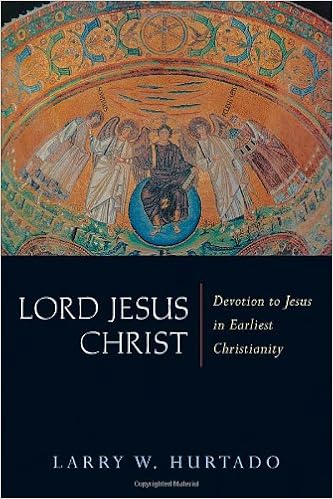
Lord Jesus Christ, by Larry Hurtado, Part 6: mid-first century and late-first century Christian worship perspectives

MONOTHEISM IS NOT a dry, crusty constraint, some sort of doctrinal binding placed on a particular religious group. Of course, nothing prevents it from becoming that in a spiritually dead context, but the point for first century Judaism in the Roman period is that Jewish faith and practice were holistically fused into not just a cerebral understanding of Israel's God being the One True God, but that he was the one to whom worship was due, and to him alone. It is what Torah requires. Torah - roughly the first five books of the Old Testament - is so clear about this point, especially in Deuteronomy: stay true.

That is a key point for Hurtado as he now develops what he means by monotheism, because although he has answered some critics of his position on Jewish monotheism (see previous post), he also senses the need to redefine what monotheism means for those who have seen it is a pure constraint for second temple Jews. Either monotheism is "in force" or it is "broken"; cultic practice is not sufficiently taken into account. The three scholars Hurtado particular wants to refute here are Harvey, Casey and Dunn, but it is Hurtado's interaction with Dunn that I particularly want to focus on today.

James Dunn argues for a later Christological development than Hurtado, and particularly distinguishes Pauline church faith and practice from Johannine church faith and practice:

It seems very important to Dunn to attribute a mental monotheistic “reserve” to Paul that was “soon lost to sight” in Johannine Christianity. (KL 860), and: Dunn has not sufficiently appreciated the import of the devotional pattern that is already attested in Paul’s writings. (KL 863)

Here I would like to add a point that Hurtado does not make, which is not surprising since it appeals to a philosophical framework that is insufficiently utilised by this kind of historical-biblical inquiry. So while Hurtado may be correct that Dunn has not looked enough at the "binitarian" devotional pattern in Pauline Christianity, neither Dunn nor Hurtado seem able to recognise how Johannine material might be interpreting the Pauline corpus (along with other first century beliefs, practices and texts no longer extant) or earlier Christianity more generally. The hermeneutical question asks: what must we do in today's context in order to preserve what was taught before? That question will become critical in exploring why God became Triune, and it will become important at seeing why baptism became trinitarian toward the close of the first century. It is what Paul Ricoeur means when he says: Interpretation, let us say, is the work of our thought that consists in decoding the hidden meaning within the apparent meaning, and lay out the various layers of meaning implicated within the literal meaning (my translation, from Le Conflit des Interprétations: Essais d'herméneutique, Ed. du Seuil, 2013, p. 35: l'interprétation, dirons-nous, est le travail de pensée qui consiste à déchiffrer le sens caché dans le sens apparent, à déployer les niveaux de signification implliquées dans la signification littérale).

In Hurtado's case, although he issues in a good number of statements that he wants to avoid linear developments and simplistic analysis, he nonetheless would advocate a binitarian worship pattern that is consistent across the New Testament. In Dunn's case, he would see Jesus worship kicking Christianity out of Judaism when it later came to threaten Jewish monotheism in John's writing era (end first century), something which was not the case in Paul's era.

Biblical interpretation is often seen as a preservation of the initial model meaningfully into a new context, but it has not yet been (as far as I can tell) sufficiently within the canon itself. In a bid to make uniform the fundamental first century worship dynamic, as I fear Hurtado may be doing here, is to risk ignoring the interpretive work of the Johannine communities as our models par excellence on how to do hermeneutics. To overly separate the Pauline from the Johannine, as I fear Dunn does, is to fail to see the early emergence of an all-new worship practice in even pre-Pauline Christianity.

Let's lay out simplistically, then, how the two first century perspectives may, in fact, have differed and attempt to define quite what "binitarian" might mean between the two.


These two structures are indeed different. However, they do satisfy Hurtado's framework in that Johannine devotion remains "binitarian", if we are to define binitarianism loosely as two recipients of a single worship practice. I actually think that this might be what Hurtado has in mind, although he does use the term "alongside" without necessarily connecting his referred instance to one configuration or the other since, since he may view them as fundamentally *the same*. I say that because for me, when Hurtado talks of Christ receiving religious devotion alongside God, that language speaks more of this Johannine model. If I were the sort of interlocutor that Hurtado would answer, then he might reply to assert that Christ being seated (or stood) at the right hand of God goes back a lot earlier in the first century than the Johannine window in question. To that, I would wholeheartedly concur, pointing out that this is precisely why the worship practice might have evolved away from the nuanced earlier practice in (1) above, exemplified famously in Philippians 2, if indeed it did. In this very early text cited in Philippians 2, Jesus receives divine worship, but it is to the glory of God the Father, i.e. not ultimately for his own glorification. That is perhaps why humility is such an important factor of Jesus' character for the early church, in order that such a religious intensity of worship would not "go to his head", so to speak. To receive that quantity and intensity of worship would surely need an equivalent depth of humility to pass it all on to his God and Father.

The break-through nuance of (1) is that whereas second temple Judaism knew some striking examples of divine agents, acting in the Name of Yahweh (or Name of LORD), this is the first time that an agent can mediate a hitherto divinely reserved right back to God. That, combined with exclusion from the Jewish synagogues and Jewish communities, and the image of Christ reigning and God's right hand, may have led later Christian communities to interpret the earlier nuance in a new, more "alongside" fashion, while carefully (at that time) ensuring that God still remain the greater of the two (which I failed to encapsulate in the diagramme). Ensuring ultimacy to the Father was by no means a "given" in the context of the new emergent worship practice.

That, I think, is more than enough for today. Suffice it to say I think this disagreement between Hurtado and Dunn provides a perfect illustration of how Ricoeur's Conflit des Interprétations can provide fresh insights for our historical analysis.

Tuesday, 6 June 2017

Lord Jesus Christ, by Larry Hurtado, Part 5: Forces and Factors: "the decisive criterion"

"THE REAL CHALLENGE in historical understanding is to figure out not only what happened, but also how it happened and why." (p. 27)

If you were only to read one chapter of this book (comprising in all ten chapters), this would be the one to read. It's not that the book is anticlimatic or anything, it's simply that the subsequent chapters will be trauling through carefully demarked parcels of historical data to validate the hypothesis laid out here in chapter one. What a fantastic quest: it's not trying merely to say whether or not Jesus-worship took place in Jewish circles, it is, as Hurtado points out in the epigraph to today's post, to see how and why Christ devotion developed so early, so powerfully and in such a monotheistic context.

Before I outline the key parts of this chapter, I realised I have forgotten to mention up until now that in terms of chapter summaries, Hurtado himself usefully provides these at the close of each chapter. Because I am not on a general fact-finding mission but rather zeroing in on data useful to my own research project on first century trinitarianism including (thanks perhaps in part to Hurtado's own goals) the how and why of such an early Father-Son-Spirit emergence, I may not need to read the whole text. (By the way, I have, I think, stumbled over some exciting new ideas about this! I can't wait to share them on the blog, but am allowing some mulling and critical analysis time before airing them.)

Chapter "Forces and Factors" outline

  1. Jewish Monotheism (later we will see in worship, prayer
  2. Jesus (the polarising figure, just like Marmite...)
  3. Religious Experience (see also Religious Experience: Inside the "furnace")
  4. The Religious Environment
  5. Summary

1. Jewish Monotheism

Look at the context in which Christianity arose, says Hurtado: Roman-period post-exilic Judaism. In refererence to pp. 17-39 of One God, One Lord, he advocates again as he did thirty years previously that this period of Judaism represented a "defiantly monotheistic stance" - surprisingly, this is not a unanimous scholarly position. Some, like Heiser (mentioned before on this blog), Fossum (to whose work Hurtado responds in One God, One Lord), Peter Hayman, Margaret Barker and several more (whom Hurtado will tackle in the current chapter) maintain that some aspects of Jewish religious perspective on divine agency anticipated binitarian faith, via the Angel of the LORD or the hypostasized Name (of Yahweh). Hurtado doesn't buy into it ("I am not persuaded that a postexilic Jewish binitarianism has been demonstrated", One God, One Lord, p. 39). 

But weren't Jews spread out across the Roman world? Wasn't pagan Roman culture infused with worship to scores of deities? Surely Jewish belief in the pagan world must have been affected, right? Wrong - that is not where the evidence points. Hurtado, citing Lester Grabbe, "Language, dress, dining practices, intellectual categories and themes, sports, and many other things were widely adopted, but there could be no negotiating away the monotheistic posture of Jewish religion. As Lester Grabbe put it, “For the vast majority, this was the final barrier that could not be crossed; we know from antiquity of only a handful of examples of Jews who abandoned their Judaism", p. 30 (my emphasis). So, precisely where the roman world did not make firm distinctions between their culture and religion, hellenized Jews did, as inheritors of a tradition of the "jealous God" who covets the exclusive worship of his people.

So how on earth does Christ fit into this picture? There is no precedent. As Hurtado puts it: "In short, the incorporation of Christ into the devotional pattern of early Christian groups has no real analogy in the Jewish tradition of the period." p. 31.

Here ensues Hurtado's maintained position of defiant Jewish monotheism in the Roman period against Hayan and Barker. Against Barker, Hurtado points to a failed recognition on her part that something genuinely new emerged in Christian devotion to Jesus, stating at Kindle Location (KL) 666: "[significant and creative development of reconfigurations or variant forms of the religious tradition] is what I argue happened in the emergence and development of Christ-devotion in early Christianity: the reconfiguring of Jewish monotheistic practice and thought to accommodate Jesus with God as rightful recipient of worship under the impact of a set of factors". I note here that all this "reconfiguration" and "variant" talk here is directly equivalent to "mutation" language, as Hurtado himself concedes (refer back here; by the way, in One God, One Lord, Hurtado feels considerably freer with the use of the term prior to its criticisms, using it up to 62 times and often without the quotes). Here Hurtado is setting out why this is such a startling mutation in light of the strict monotheism he reports from the Roman Jewish worldview. In fact, it's a double Jewish refusal, since it not only refuses incorporation of outside deities from the pagan world into the Jewish matrix, but it also shuts shop to internal Jewish figures that rose greatly in prominence during the post-exilic period (Enoch, Moses, Yahoel, etc.), which is where Hayman had wanted to argue from. In neither case can there be found suitable recipients of cultic reverence. In Hurtado's most recent book Destroyer of the gods (2016), I believe he attempts to explain why the Jews were not subjecto the same pressures as the early Christians with regards to their refusal to comply with pagan worship rites.

A good final quote, actually, I think it's great, comes from KL 723: The evidence . . . shows that it is in fact in the area of worship that we find “the decisive criterion” by which Jews maintained the uniqueness of God over against both idols and God’s own deputies. . . even to the point of martyrdom, seems to me to reflect a fairly “strict monotheism” (my emphasis). Don't you just love Hurtado's understated style?! But he is correct - see Jan Assmann on a cultural understanding of Maccabean Jewish martyrs as the first example of any religious martyrdom as the fulfilment of a distinctively (and "intolerantly") monotheistic faith, Monotheism and its Political Consequences, 2005,  p145-146.

In the next post we will finish off Hurtado's assessment and defense of Jewish and Christian monotheism while introducing a couple of criticisms of my own. I also need to find a simple way to insert some simple diagrammes... Back soon!