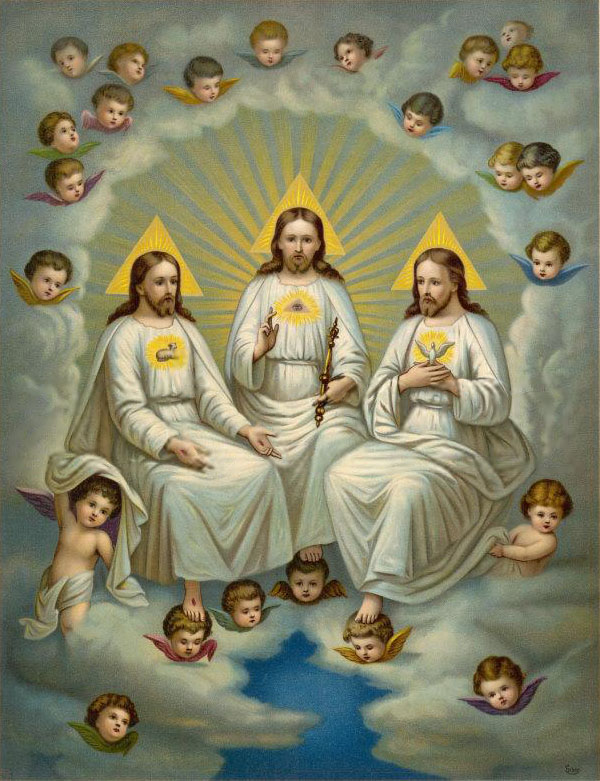
Actually, I don't care too much for the word "divinity" because of its ambiguity, but I thought it would be more likely to tempt you to read this addition to my paper Trinitarian Interpretations than the true sub-chapter title, which reads: 6.4 Jesus is called “God” directly or possibly referred to as such indirectly. (The chapter title reads: 6. Four Types of “Blue” Suggestive New Testament Writing Traditions)
Before I provide you the draft section, perhaps a couple of words for those who have not already seen the paper for context. In the summer of 2015 I wrote a paper that suggested that forced endorsement of a full Trinitarian creed (such as the Niceno-Constantinoplitan Creed) should not be mandatory for followers of Christ who hold to the Bible as superior, more inspired and of greater normative value to all prior and subsequent theological ideas. My three main arguments against this necessity are not equally weighted or explored, but basically:
1. The terminology is so hotly contested and variously interpreted today that it is somewhat meaningless or superficial to require "allegiance" to the words if the words are not understood the same way or even a close way.
2. In the three hundred years separating the first church and the great ecumenical council period, mainstream Christian theology did not especially hold to Divine Essence/Substance theories or One God in Three Persons ideas, and even later had to U-turn on some early "anathemas".
3. The New Testament itself leaves justifiable doubt as to the necessity of stating trinitarianism in any of these ways.
So while I consider all three of these arguments quite compelling (the power of 3 in 1!), the third argument is the one to which most people can relate to, albeit through diverse contemporary lenses. As I re-read through the New Testament myself and also read what various theologians have argued over the centuries, I attempted to categorise all Christological passages into several dozen "suggestive" or "dissuasive" sub-categories. After describing the results in chapter 5, I offer a few sub-chapters on each side of the "suggestive/dissuasive" fence in chapter 6, each one looking at a different sub-category. In the original paper, on the suggestive side, I looked at:
John 1:18 is an example of what textual scholars
sometimes call “conflations”. What happened in the scribal transmissions over
this verse is difficult to fully explain, as this example has already
highlighted earlier (I used this verse to illustrate the relevance and
importance of textual criticism in the second chapter). Some of the scribal changes
in this verse concern inclusion or removal of definite articles, others either
changed huios (son) to theos (God) or the other way around, while others removed
both (to leave simply “the only begotten”). When scribes of antiquity were
aware of more than one version of the text they were copying, they would on
occasion conflate their sources – that is to say, out of reverence and a desire
to ensure that the original text not be lost, they attempted to remove that
risk by combining variants. So instead of choosing variant A, B OR C, the scribe
wrote A and B and C (or some such combination). Since this also then forms an
ancient manuscript and manuscript tradition upon which modern translations can
lean, and since modern translation committees also share the goal of the ancient conflating scribe, the conflated text
is the manuscript of choice for NIV and others, resulting in: “who is himself
God”[4].
The textual uncertainty of the original wording – which in my view probably read
“only begotten son” as everywhere else in John’s gospel – means that
Trinitarians should not (and tend to not) devote too much time to this verse in
developing their more weighty evidence for suggestiveness of Trinitarian
doctrines.
Before I provide you the draft section, perhaps a couple of words for those who have not already seen the paper for context. In the summer of 2015 I wrote a paper that suggested that forced endorsement of a full Trinitarian creed (such as the Niceno-Constantinoplitan Creed) should not be mandatory for followers of Christ who hold to the Bible as superior, more inspired and of greater normative value to all prior and subsequent theological ideas. My three main arguments against this necessity are not equally weighted or explored, but basically:
1. The terminology is so hotly contested and variously interpreted today that it is somewhat meaningless or superficial to require "allegiance" to the words if the words are not understood the same way or even a close way.
2. In the three hundred years separating the first church and the great ecumenical council period, mainstream Christian theology did not especially hold to Divine Essence/Substance theories or One God in Three Persons ideas, and even later had to U-turn on some early "anathemas".
3. The New Testament itself leaves justifiable doubt as to the necessity of stating trinitarianism in any of these ways.
So while I consider all three of these arguments quite compelling (the power of 3 in 1!), the third argument is the one to which most people can relate to, albeit through diverse contemporary lenses. As I re-read through the New Testament myself and also read what various theologians have argued over the centuries, I attempted to categorise all Christological passages into several dozen "suggestive" or "dissuasive" sub-categories. After describing the results in chapter 5, I offer a few sub-chapters on each side of the "suggestive/dissuasive" fence in chapter 6, each one looking at a different sub-category. In the original paper, on the suggestive side, I looked at:
- 6.1 Triadic formulae
- 6.2 Jesus and the Father are "one"
- 6.3 Jesus inciting outrage for blasphemous association with God: the power of rhetoric
Here then, split over three posts, is a draft of:
- 6.4 Jesus is called “God” directly or possibly referred to as such indirectly
References: Mark 10:18 Luke
18:19 John 1:18 John 20:28 Romans 9:5 Titus
2:10&13 Hebrews 1:8-9 2 Peter 1:1
Finally – now he has to
admit it, the Bible says that Jesus is “God” and that therefore the Trinity (or
one of the definitions of the Trinity) has to be correct! I really wish it were
that simple. Before we zoom in on this blue category, I should mention why John
1:1 is not listed here (In the beginning
was the Word and the Word was with God and the word was fully God, NET).
According to the categorisation system I have applied, this belongs to a
different set of suggestive New Testament texts: “Jesus seems eternal, or seems
to have existed prior to incarnation”. I hope to discuss this category and its
associated texts in a future edition[1].
So let us jump straight
in with these texts that seem to call Jesus, “God”[2].
As far as I can tell, the
only clear texts potentially suggestive within the synoptic gospels of a
Trinitarian position regarding Jesus (possibly) being called “God” Himself, are
Mark 10:18 and Luke 18:19. In the previous sub-chapter I developed how rhetoric
functions and was utilised by Jesus as attested by all four gospel writers. So
it is difficult to build too much on these verses if it requires the rhetoric
to work in a diametrically opposed way to how Jesus generally applied rhetoric.
Romans 9:5, Titus 2:10 &
13 and 2 Peter 1:1 are all Greek constructions that could work either way –
either they do state that Jesus is God, or there is an implied distinction there
between Christ and God, thus restoring the Father back into the picture.
Scholars have of course debated these passages at great length, and these
debates are often reflected in the footnotes of the better modern bible translations.
I am relatively convinced of unfair bias toward the theos title attribution to
Jesus in at least the Romans and 2 Peter examples based on assumptions of
author consistency and the ambiguity of the Greek. I remain less sure of Titus [3].
[1] For
now I can say this: despite general historical shifts in understanding what is
going on with “Word” (logos), “God” (ho
theos and theos) and “Become” (egeneto), that Christians having access
to this passage or its precursor, have always believed that God’s eternal divine
word was incarnated in (or into) Jesus (as a Christian I also have made the
choice to believe that). This leaves incarnation Christology still very open as
my chapter above on the church fathers demonstrates. It is precisely the interpretative
options that I must still articulate and align with John’s overarching themes
and goals.
[2]
You will recall that there is a penalty system in place for texts where the
strength of their suggestiveness or dissuasiveness is weakened according to a
number of defined causes (see p. 51).
This category is concerned more than any other by the penalty system as we
shall now briefly see before we zoom into one of the most crucial of all blue
texts in the entire New Testament canon which is certainly not penalised:
Hebrews 1:8-9
[3]
Titus is harder for me to assume this because I cannot apply the same criterion
of consistency to a book that might
be the only text we have by its author. If that were true and it were written
in a later and more christologically developed situation, then the assumption
of distinction is a considerably weaker option. Earliest manuscript is Papyrus
32, dated late 2nd century.
[4]
Fortunately, this variation is footnoted by the NIV, which alerts readers to
the shakiness of this evidence