Showing posts with label Paul Ricœur. Show all posts

Saturday, 4 November 2017

John’s third impacting figure: Dr Dale Tuggy

Fatscript Episode 7 show notes, John’s third impacting figure: Dr Dale Tuggy


Wednesday, 13 September 2017

Big T Little t: It's time to call in the A-Team!


Remember The A Team? What a great show!

One of the great characters from that 90s classic was Mister T. You don't mess with Mister T!
Today I want to reflect again on Tuggy's dichotomy between little-t big-T, which continues to bug me. I have already blogged on the Jewish Roots of the Trinity and especially in my Responding to Dale Tuggy on Trinitarian Conceptualisation. Dale's amazing at showing distinction where there appears to be just mud. He's a trained analytic philosopher, he's just doing his job and doing it well. But there are problems in applying dichotomies across time and culture, especially with regards to this multi-personal God issue that has provoked so much inquiry in his own life and also in my own.

I've hinted at this before, but I'm going to emphasise it again now. Biblical Unitarians - to whom I owe so much and whom I love, at least those that I have had the privilege of meeting - are fully capable of accepting quite unaware the very fourth-century categories they so firmly oppose. Let me give you an illustration of what I mean. Not so long ago, I blogged quite a successful blog summary (What On Earth Has John Been Up To?) in which I included some of my next goals (one of those was a study on John the Baptist, which is already completed, hurrah). Believe it or not, my intuition about the Restitutio interview seems to have been pretty well dialled in - presenter Pastor Sean Finnegan read my blog summary hyperlinked above and has expressed interest in doing an interview. So, that plug aside (watch this space!), my point is that in preparing to speak to Sean I looked up a debate he did on Youtube way back in 2008ish, up against a Trinitarian. I didn't make it all the way through. It was the sort of debate that just makes you think how do those people even think that fast?! One sentence caught my attention, however, where Sean said something along the lines of: "no, I do not believe that Jesus is of the same essence as the Father". The same essence?

I should be careful here! Sean, you might even be reading this, so in maximum warp-speed 10 respect, please hear me right. I'm just trying to point out that it is very easy for any of us to take our opponents' categories for granted. Perhaps Sean wouldn't say that nine years later, either way, it doesn't matter for the purpose of this example. Back to Small T vs Big T.

Dale Tuggy's point is that "small-t" trinitarian refers to a triad. All "small-t" trinitarians are in fact, according to Dale's tightly defined definitions, biblical Unitarians. That is to say that God himself, remains one individual, no matter how much he and his actions are bound to his Son and his Spirit. Over the past year or so, I have come from a point of curiosity, through scepticism now to rejection on the possibility of some almighty conceptual switch. As I have understood the dichotomy thus far, the radical switch from Point A (God Is A Single Person Deity) to Point C (God Is A Three-Person Deity) shift is too great. As I stressed in my response to Dale, to which his response is still due at some point I hope, there has to be a Point B. That Point B is not adequately described as "biblical Unitarian". I'm sorry, but I find that almost as guilty as the back-projecting as some Trinitarians are in their own apologetics.

In my view, the whole perspective is upside down. It wants to start with ontology, which is precisely where Paul Ricoeur has warned us not to begin. If we begin there and disregard the goals, loyalties, injuries, politics, history and other stakes then we can miss important data - this data is so much more complex and nuanced its complexity and nuance require a more hermeneutic approach. It is this hermeneutic approach that says: how do we perceive? How do we conceptualise the seen realm and the unseen realm? If we do that, and we are able to factor in the historical probability of the first-century Christian mutation of Judaism having started to vocalise, ritualise and (although they did not know it) immortalise its "Triune Hub" via the baptismal rites, then we are released into realising that it is, in fact, the Triune God version of the Trinity that should receive the "small T", since it is interpretative of that which precedes it. It is, therefore, the earlier, Jewish-Christian expression and understanding from which it is developed is that which should truly bear the "Mister T" belt.

According to my own definitions, then, I think that makes me a Capital-T Trinitarian! It might frustrate, however, to realise that it is not in any way an outcome of a one-self or three-self decoding process of the ontology of God, since it begins with the social human psyche.

Tuesday, 1 August 2017

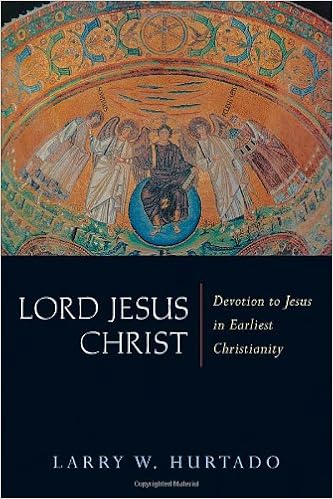
Lord Jesus Christ, S2 Part 2: Jesus' divine sonship

Hurtado will now move through sections of Paul's Jewishness, Paul the Convert, The Gentile Mission, Christological language and Themes, Jesus as "Christ", to Jesus' Divine Sonship. I propose to pick up again here (don't worry, any important elements fast-forwarded here will be recalled during the chapter summary), Jesus' divine Sonship. Here Hurtado is weighing the various arguments for the source of this idea of divine sonship. Was it from the Roman pagan world (where indeed divine sonship did exist)? Or was it from within the Jewish Bible? 

Hurtado cites serious scholars Nock and Hengel as both having shown how difficult it is to demonstrate that it is the application of pagan mythology onto Christ in Paul's writings that permits him to apply divine Sonship, Nock even concluding "[T]he attempts which have been made to explain it from the larger Hellenistic world will fail." (p. 103) (My emphasis. A. D. Nock, Early Christianity and its Hellenistic Background (New York: Harper and Row, 1964, p. 45). So if the divine sonship motif comes from within Judaism, how did that work? What did that mean? Paul's most exalted term for Jesus actually isn't "son of God", and in particular, it is absent at times when we might have seen it fitting to have used it (1 Corinthians chapters 8-10). 

What is important to say from the first-century Roman era of Judaism is that the diversity of translations available to the Jewish communities of their Holy Scriptures would most certainly have included ideas of "sons of God", in particular with reference to the heavenly realm's population. But given the "failure" of this as the predominant ignition for the idea of Jesus' divine sonship, we need to look into Israel's sacred past. The most significant association, then, would most likely have been the ways in which God's anointed king of Israel (see esp. 2 Sam 7:14), other righteous individuals (some extra-biblical literature usage would have been well known) and Israel collectively (e.g., Exod. 4:22; Deut. 14:1; Isa. 1:2; Jer. 3:22; Hos. 1:10; 11:1; Wisd. of Sol. 12:21; 16:10, 26; 18:4, 13) as son(s) and "firstborn" of God. (p. 103). Given Paul's preference for other titles of Jesus with regards to the level of his exaltation, i.e. Kyrios (Lord), I think the most important allusion we should make here is that shared with the leading theme of the second gospel, Mark. The Jesus-God relationship represents the relationship God had always intended to maintain with his people collectively. Jesus powerfully represents "his" people. Whose people? It's now a double "his". God's people are now entrusted to their rightful king, the Messiah Jesus. In which case, although this is not a developed biblical speculation, there is also a double "son", the restored people of God as restored sons of God and Jesus as the archetypical Son.

Whatever the Pauline nuance usage behind his usage of the expression, I think the context shows that it was fairly far removed from the ways in which we can often hear it used today. As Hurtado himself points out (in agreement): In this messianic usage, divine sonship did not function to connote divinity, but it certainly indicated a special status and relationship to God.

We do not need to go through the various Pauline examples takes here, but as I went through it I wondered if there was something that could have been said about uniqueness. Hurtado says on pp. 107-108 "If, as is likely, in his preconversion oppostion Paul rejected early Jewish Christian claims that Jesus was God's unique Son.... this would help explain the importance that Jesus' divine sonship seems to have had in Paul's postconversion religious life." It could explain a lot more besides. If Jesus' first followers whom he had persecuted claimed that he embodied "true Israel" as the true son of God, as a uniquely chosen people (or son), then we also have a backdrop for deep Pauline reflection on the grafting in of other nations into God's special unique people/family.

So in summary: the divine sonship was a Jewish idea and Paul's occasional use of it in relationship to Jesus does not express his inherent divinity, but rather his unique standing and intimacy with God, and his involvement in God's redemptive work. (see p. 104) Regarding the fact that this took place in a social context where divine sonship meant something else, we can perhaps expect that this may have had an underscoring effect on the full ontological divination of Jesus as the serious theologizing and apologetics began to get into full swing in the subsequent centuries - part of a wider process I am calling triunification of God.

Monday, 31 July 2017

Lord Jesus Christ, S2 Part 1: CHAPTER 2! Paul's material takes us as far back as we can go and takes us forward

YES AT LAST we will attempt to respond to Hurtado's second chapter of his great book Lord Jesus Christ: Devotion to Jesus in Earliest Christianity (LJC). For anyone new to this series, a recommendation from the author himself is available here and a summary of material covered thus-far is available here.

To avoid the burdensome feel of a huge series, I have decided to reset the counter. Instead of stating "Part 16", I have entitled it S2 Part 1; the S standing for Series 2, these series roughly corresponding to the 10 chapters of LJC. Note that since not all are necessary in the depth I am giving here for the research purposes of my own work around Mutated Faith and the Triune Hub, it is unlikely that I will be covering all 10 in this fashion. 

A final word of introduction is necessary to point out that I am in the midst of a couple of other things on the blog, not least of which is an exchange with author Dr Dale Tuggy, where our dialogue can be traced Dialogue with Dr Dale Tuggy: herehere and here. It's his turn to respond, and I am expecting it to be a corker (at least I threw everything I had at my last contribution). Furthermore, I also had intended to share on the blog some more of the insights of French philosopher, Paul Ricoeur, into our quest, but I'll hold onto to that i think until the relevant time. His approach to phenomenology will be crucial to helping us understand how a religion could shift from a binitarian/trinitarian something to a binitarian/trinitarian God.

Also, in the current chapter but also elsewhere, other interruptions to LJC have been planned for a while, when for instance our author will turn to Q, John the Baptist and the "Son of Man" literature. At these points, we will see read up on some other literature that will not necessarily support the positions taken by Hurtado in LJC. But God willing, we will try to see the book through despite these inevitable interruptions (better to consider them interactions). 

So let's open Chapter 2. Hurtado wants to start testing his thesis he laid out in Chapter 1 chronologically, beginning with Paul. Although Paul is not considered representative of the first "wave" of Christianity as his writings date typically from the 50s-60s, they are the earliest direct and undisputed source we have to the form of earliest Christianity. He nonetheless affirms with the majority of scholars I have read on the period that: the emergent Christian movement were made up of Jewish adherents in Jerusalem and elsewhere in Roman Judea (Palestine) pp. 79-80. Hurtado also points out the importance of these epistles in their efforts to maintain the bridge between the gentile converts and the Jewish roots of the church with which he is still in close relationship and from within which he is at pains to remind people that his own dramatic conversion experience took place. It is important for proponents of "mutation" metaphors like myself to make abundantly clear that personal conversion to Christ is not at all equivalent to "converting from Judaism to Christianity". It was perfectly acceptable, like for Jesus himself, to be a true follower of God as a Jew. The big question for the early church was now how to interpret that huge body of holy literature around the events of Christ and the Holy Spirit's outpouring.

Since the Triune Hub presentation will be taking the writings of John Dominic Crossan very seriously on the specific mutation of the collaborative kingdom (as opposed to interventionist), I need to be particularly attentive as to when he and Hurtado disagree on other matters (see p. 82). but the issue is more methodological - Crossan wants to "bracket out" Paul in order to focus on this earlier stage of Christianity, something which Hurtado considers pretty impossible. Furthermore, Paul's deep personal association with the early Christian movement during those formative years alluded to in some of his brief biographical sections in his epistles can provide us further insights into that period. His reasons for starting with Paul in bullet form then (with my emphasis):
  1. Pauline Christianity is the earliest form of the Christian movement to which we have direct access from undisputed firsthand sources.
  2. Paul's letters... also incorporate and reflect emergent Christian traditions of belief and religious practice from still earlier years.
  3. Paul's own associations with Christian circles, which include important Jewish Christian figures such as Peter, James the brother of Jesus, Barnabas, and others, go back to this conversion, which is to be dated approximately 32-34, and so his acquaintance with beliefs and practices of Christian circles is both wide and extremely early.
  4. Several of Paul's letters reflect disagreements between him and other Christians, in particular, some Jewish Christians with different views of the terms for full acceptance of Gentile converts, making Paul's writings our earliest and most unambiguous evidence that there was a certain diversity of beliefs and groups in the earliest decades of Christianity, and also our best indication of the nature of this diversity and whatever commonality linked the groups.
  5. The Christ-devotion attested in Paul's letters amounts to a notable development in the history of religions, especially when set in the context of the Jewish religious tradition and the larger Roman-era religious environment, and his letters exhibit this development as having already taken place at a remarkably early point
  6. Finally, the place of Christ in the Pauline letters also anticipates, represents, and likely helped to promote the Christological beliefs and devotional practices that came to be widely characteristic in Christian groups after Paul. (p. 85-86)
Makes sense to me. 

Saturday, 29 July 2017

Some more thoughts on the interpretative process around The Father Is Greater Than I

LAST TIME RICOEUR was examined here on this blog we established three fundamentals:
  1. Hermeneutic task of discerning the apparent and hidden meanings
  2. Group persons are real agents, with memory, desires, goals, moral responsibility, etc. Personality is like a culture and vice versa.
  3. Hermeneutic understanding of oneself via understanding of other. On this third point I am reminded of the "wildly divergent" (Holmes) attempts of certain Trinitarian theorists to see their own vision of the Trinity as a blueprint for the church. Take John Zizioulas, for instance. He sees the Trinity this way, and yet sees the connections between the Members as fundamentally relational not ontological. What would Ricoeur suggest this reflects about him and his relationships between churches or within churches? Leonardo Boff is adamant: Zizioulas' proposals are far from relational, they are heavy and political:


[T]he trinitarian vision produces a vision of a church that is more communion than hierarchy, more service than power, more circular than pyramidal, more loving embrace than bending the knee before authority. 
(L. Boff, Trinity and Society, (Liberation and Theology, vol. 2), Tunbridge Wells: Burns & Oates, 1998, p154.)


The similarity in the goals between these two Trinitarian theologians seems to illustrate the point well. It would seem that the perception of the church and of God are indeed tightly bound up with who we are as persons and our personal history.


Moving onward today to p. 42 in Conflit des Interprétations, Ricoeur points out a certain insufficiency of the Cartesian "I think therefore I am". What's wrong with it? You have to start somewhere, don't you? The issue, for Ricoeur, is that you don't only start there, you stop there too. It is a deposited truth claim that can neither be verified or deduced: The cogito is not only a truth as vain as it is invincible; we must add, as well, it is like an empty space which has, from all time, been occupied by a false cogito. We have indeed learned from all the exegetic disciplines and from psychoanalysis in particular, that so-called immediate consciousness is first of all "false consciousness"... a philosophy of reflection must be just the opposite of a philosophy of a philosophy of consciousness...textual exegesis of consciousness collides with the initial "misinterpretation" of false consciousness. Moreover, since Schleiermacher, we know that hermeneutics is found wherever there was first misinterpretation


This is a long quote, but you'll see why we need all of it, please keep reading:

Thus reflection must be doubly indirect: first, because existence is evinced only in the documents of life, but also because consciousness is first false consciousness, and it is always necessary to rise by means of a corrective critique from misunderstanding to understanding.


Yes, you may have noticed that the translations are pretty good today - I have found an officially translated version of Conflits available here, p. 18, trans. Kathleen Mclaughlin).


I'm hoping readers are beginning to get the picture. Lots has been said in hermeneutics about how readers today might interpret a text (or misinterpret a text), how that interpreted meaning spirals back into a larger conceptual whole that is an integrated part of our being, modifying it, affirming it and preparing the person for the next interaction with that text. But since hermeneutics is associated with the contemporary task of interpreting important texts such as the Bible or the State Laws, it seems to have slipped our notice that this might well be a vital historical phenomenon as well. In fact, from all that we have seen of Ricoeur thus far, I would say it utterly confirms it, especially when we accept with List and Pettit (2011, 162-163) and Copp (1979) that we can correctly deduce "joint control" in a group via a mechanism of "multi-level causality", that the ecumenical decisions made were groupal and in response to opposing groupal misinterpretations.


So what you would do if you were an intelligent-but-stranded Amazonian who dug up an English Bible, somehow taught herself to read through it and read "the Father is greater than I", what a Unitarian might read when she reads "the Father is greater than I", and what a Trinitarian (Triune God Advocate) might read when she reads "the Father is greater than I" are three quite different processes, all of which contain groupal and multi-level components.

Let's take the Amazonian first. She has spent months, maybe years, trying to cypher this enormous book - not because she wants to waste her time, she has plenty of other tasks she would normally be doing to help maintain her tribe as specialised in fishing and preparing the tar needed to make fishing vessels. But time has been thrust upon her, and she is reading out of curiosity that is fed by the dream that she might one day be rescued and returned to her tribe to share her knowledge with her kinfolk. The fact that this extraordinary Jesus character even could have been considered as great as the creator god may simply add to her marvel of this historic man, and she may not gloss over it so quickly.

The Biblical Unitarian's core tenet, please excuse me Biblical Unitarians reading this and please feel free to correct me below, is that Jesus is not God since only the Father is God, and so when a member of this "tribe" comes across this Jesus statement, the thought flashes through her mind: What more evidence do you need?! She certainly is less likely to gloss over it, it will be actively affirming and feeding the self-knowledge of the reader in a profound way in preparation for subsequent readings. This is a particularly important process of integration of interpretation for the Biblical Unitarian, since, like with many small denominations, they represent a small minority, that sense of identity needs to be more carefully and intentionally hewn. Someone deciding to become a Catholic hardly need consider themselves too deeply with theology or church practice, but a thinly-spread minority group with a non-mainstream reading of the Christian texts, needs to have well-affirmed readers. Notice the potential for emotional reaction. That reaction is in line with the group's marginal status and potential for rejection. It is also a development within the Biblical Unitarian's interpretative matrix precisely because there exists a perceived misinterpretation (or "false consciousness"). Readers do well at this point to remember that we all belong to groups and that we as individuals are simply unable to fully bear the loads of our predecessors.

What about the Trinitarian coming to this passage? Well, I used to be a Triune-God advocate myself, as most readers know, and I also for a short time considered myself a Biblical Unitarian. Now I have run out of theological carparks to park my car, although I hope the Trinitarians might still find some space for me in their basement. My feeling is that Trinitarians probably read the text in the widest variety of ways. As Christians, we are free to read the text slowly, fast, for facts, for deep meditation, reading plans around a topic for a "biblical understanding" on a topic. We might put it to music or commit it to memory. As such, a single text to the human mind becomes a veritable plethora of meaning that cannot be reduced to any simple layer of meaning. It truly does dance and shape our sense of self. But what happens when the Triune God Advocate reads "The Father is Greater than I"? Such an apparently contravening statement to the idea of co-equality in the godhead might seem shocking, but as my exchange here with Sam Fornecker illustrates, there is no "feeling of tension" generated by this text that you might for Triune God Advocates - literally, none (I am still waiting for Sam to pick up the conversation there, I think he has left some of my questions in an unsatisfactory state of suspense). No feeling of tension in the face of such a "clear" text might leave the Unitarian at something of a loss for words. But the bigger interpretation is too deep, too historical, too liturgical, much brought forth in prayer and worship to be swept aside by a verse putting co-equality into question, as if for the first time. Generally speaking, the careful Trinitarian reader will simply keep reading. For any "difficult text", the general advice is almost invariably to "step back" from the text and try to get the bigger picture of what is going on here. However, and I mean no disrespect here, the majority of readers are not highly nuanced "Triune God Advocates". They are simply Christians reading through the popular gospel of John and looking for ways to deepen their faith and sense of connection with God. They may quite simply just keep reading, drinking in the depth of the outplaying of this threefold relationship of Father, Son and Holy Spirit. They may be imploring the Holy Spirit to now come powerfully into situation X, Y or Z in this amazing way that Jesus said we would do things, even more, with even more "greatness" than he did.

The Christian apologist, however, has a quite different reading process in mind. Like a great chess-player, he is trying to foresee his imaginary opponents' next moves and is not really in a deep interaction process of his own. Rather he or she is going through his armoury, checking the ammo stores are full, the key citation grenades pins are primed and the lie-guided missiles fully online... that's right, he's a warrior! A great fighter for the Church! I don't even want to probe his or her next steps on this verse. I tend to find some of their efforts a little sickening.

Notice not only the variety of these examples but their huge limitation. There are many, many more contemporary possibilities and nuances today, both individual and denominational (or groupal). Even if such an in-depth study were possible, it would be representative of the interpretative ranges operative today. That is why it is important for us to study the church fathers - and I intend to do some longer excursions on this blog in the future - in order to see how interpretation was operated in both "victorious" (orthodox) groups and, as far as it is possible to ascertain, the "unvictorious" groups.

To return, then, to the insufficiency of cogito, we see a disenfranchised uni-layered reading as both a non-starter and a non-finisher. It is nothing. But interpretation rises or rather arises out of a corrective movement by a victorious group of interpreters over misinterpreting opponents. What gives rise to that "victory"? That's a huge question I shan't attempt here, I simply mention it as it seems to a necessary one to ask in light of today's steps. Nonetheless, it is probably worth noting that the Triune Hub hypothesis suggests that in order for a stable religious bedrock to establish itself, it became increasingly clear as each off-kilter wave of teaching was refuted that this stability required co-centricity of Father, Son and Holy Spirit, perhaps even more than the New Testament texts, in order to hold the New Testament texts. Every time the church went through a process of refutation, via apologists such as Irenaeus or Justin Marty, by ensuring the co-centricity of the Father, Son and Spirit, the church herself was constructing her own stability, her own "being" as the hermeneutic circle continued to turn, and so did the "WHOLE".

See also my post: https://faithandscripture.blogspot.fr/2017/07/hermeneutic-circle-and-asking-better.html

Tuesday, 18 July 2017

How does your interpretation help you understand yourself more?

Yesterday we began to draw some of the connections between Paul Ricoeur's work and the methodologies underlying some of the historical quests for the Trinity. I attempted this in both English and French, which was a big effort at over 2300 words in total, something I won't be able to maintain. It was also one of my least visited posts recently - possibly a coincidence, possibly English readers hadn't realised that the post was also in English, I don't know. Anyway, today I will keep it mainly in English with a couple of French summaries, using the same colour codings as yesterday. Citations will continue in both languages, the English being my own translation.

Aujourd'hui je me contenterai de faire la plupart de l'article en anglais, avec quelques remarques et citations en français.

Yesterday we saw Ricoeur distinguish two types of ontological inquiry: the short route, which I translated as "ontological comprehension", is very black and white. The longer route is more arduous and involves semantics. It does not attempt what I coined as "historical surgery", is more nuanced, personal, intentional and multi-faceted. I'm going to fast-forward a few pages now to arrive at a key citation that brings in the concept of symbolism, which is important when insisting, as I do, that the fourth-century discussions around the doctrine of God, despite the ontological packaging, were also deeply symbolic. Here's Ricoeur on p. 35:

I am calling a symbol any structure of meaning where a direct, primary, literal meaning also provides an indirect, secondary, figurative meaning behind it that can only be apprehended via the first. These two-layered structures constitute the hermeneutic scope ... I suggest we afford [the concept of interpretation] the possibility of the same layering as the symbol. Thus let us assert that interpretation is the mental task in which the hidden meaning is distilled from the apparent meaning and to deploy the various layers of meaning implied in the literal meaning.

J'appelle symbole toute structure de signification où un sens direct, primaire, littéral, désigne par surcroît un autre sens indirect, secondaire, figuré, qui ne peut être appréhendé qu'à travers le premier. Cette cironscription des expressions à double sens constitue proprement le champ herméneutique. Je propose de donner [au concept d'interprétation] même extension qu'au symbole; l'interprétation, dirons-nous, est le travail de pensée qui consiste à déchiffrer le sens caché dans le sens apparent, à déployer les niveaux de signification impliqués dans la signification littérale.

More dynamite! I've been saying this for a while, but the more we look at the Triune-God process - let's call it the "triunification", the intelligent minds that were involved in that process, the more improbable it gets that this was an illogical, unbiblical or crazed invention. Something I breezed over to get to this crucial quote was a very brief treatment of Edmund Husserl, factoring in personal intention. Husserl is focussed on phenomenology, which is this curious sub-world in philosophy that attempts to look at human experiences experientially without reference to metaphysics and theories. All this is very interesting, but where we still need to join some dots is by asking the following the question: can we consider an institution to be a person with intentionality? Chad McIntosh argues compellingly that we can as "corporate personalities", provided we designate them as functional persons and not "intrinsicist" persons. Like most intrinsic persons, these corporate personalities meet the conditions first of agency....:

An agent is anything that has representational states about how reality is, motivational states
about how it wants reality to be, and the ability to rationally process and act on those states so as
to attempt to get reality to fit its desires. Insects, animals, men and even robots may all qualify as
agents on this account. Houseplants, rocks, stuffed animals, and screwdrivers do not.
That groups, too, can be agents in this sense is standard fare among many philosophers.
...
Once it is recognised that groups can meet conditions of agency, it is natural to consider next
whether they might meet conditions sufficient for personhood, such as being morally
responsible, having free will, and having a first-person perspective. The most travelled route from
group agency to group personhood is via the first of these, moral responsibility.
(CA McIntosh, God of the Groups, p. 2)

Je fais le lien entre Ricoeur et McIntosh, puisque cela me permet de proposer que les collectivités d'évêques qui sont représentées par les documents historiques des concils écuméniques sont, à mon sens, dotées des conditions nécessaires pour l'herméneutique dans le sens où il y a une signification apparente et aussi des significations cachées à en déchiffrer. 

And McIntosh will indeed conclude that such an "adoption" into personhood is not only possible but full, along with some notable philosophical support. All that is relevant to establish a development that I want to make from Ricoeur's insistence that hermeneutics is about teasing out the hidden layers of meaning behind the more literal or apparent meaning. Since we are such social creatures, preprogrammed to work in social structures, we have to step beyond a simple individual's examination of an ancient-yet-meaningful text. The individual's focus and drive are part of a wider-held concern (or lack thereof as perceived by the individual), but so also are the Biblical texts themselves and the later great ecumenical councils, which especially need to be seen as interpretative in the sense brought to us by Ricoeur, and as a collective in the sense brought to us by McIntosh.

When the church said that God the Father, God the Son and God the Holy Spirit were of one substance, three Persons in One God, the question is not what could that mean in the apparent, ontological comprehensive sense, but what else did she mean, in the fuller interpretative sense? What were her concerns, her worries, her goals, her injuries, her loyalties, her priorities? How did "she" interpret the biblical texts to join her horizon with the horizons of the New (and Old) Testament texts? I have already shared how insightful I find the Sirmium II Council to be into this question in my post Hermeneutic Circle and Asking Better Why Questions.

Let's return to Ricoeur, who wants to widen our understanding of interpretation not just as something we do with the knowledge that we have, but as interwoven into the fabric of our being, our deep semantic field of reference out of which we derive our meaning - albeit still on an individual level. Here on p. 40, our author is having another go at Dilthey's hermeneutic problem we examined yesterday:

The exegete can appropriate the meaning of an outsider, she wants to make it her own...; it's then the expansion of her understanding of herself that she is pursuing via the understanding of the other. All hermeneutics are thus, be it explicitly or implicitly, understanding of oneself via understanding the other.

L'exegète peut s'approprier le sens: d'étranger, il veut le rendre propre...; c'est donc l'agrandissement de la propre compréhension de soi-même qu'il poursuit à travers la compréhension de l'autre. Toute herméneutique est ainsi, explicitement ou implicitement compréhension de soi-même par le détour de la compréhension de l'autre.

So, next time you want to understand "what Paul was really saying", you are really trying to understand more of who you are via that understanding - amazing, huh? Would you agree? What about the "great" ecumenical councils - what do you see the purposes and meanings are behind the scenes? Think beyond controversy A, B or C - unless you can answer why those controversies might have shed light on some deeper concern. We need to watch carefully. Let's ask a new question: not what, but who does the Church understand herself to be and how does she understand herself better through her "triunification" of God? That's probably enough to chew on for tonight :)

Monday, 17 July 2017

Digging in deeper into interpretation (Profondons notre perspective de l'interprétation, article bilingue)

I AM TORN between two directions. I want to resume the survey of Lord Jesus Christ as soon as possible, as it simply covers so much important ground and is gathering fresh interest including a referral from Hurtado's blog himself. I also want to explore my deepening hunch that we need to be clearer that, like us, all of our predecessors in the Christian faith were also interpreters of that which preceded them. That is to say, in some clearer sense than before, we need to do away with the ideas that the "divinely inspired" writers of the New Testament were not interpreting according to principles that still govern us today. Same is true of Christian interpreters in the second, third and fourth centuries too. Obviously much more to be said about that. A key author in this field is Paul Ricœur, for whom I have received a specific request to relate his "arbitration" work to the question of the unfolding articulation of the centrality of the Father, Son and Holy Spirit in the first centuries (I also note that my article on hermeneutics received considerably more interest than average, see Hermeneutic Circle and asking better "why" questions).

Since it has always been the goal of this blog to not disenfranchise my French readers, and this second author is French (and I am reading him in French), I propose to do just a few posts (I'm aiming at three) in both languages on Ricœur and then pick things up again with Lord Jesus Christ.
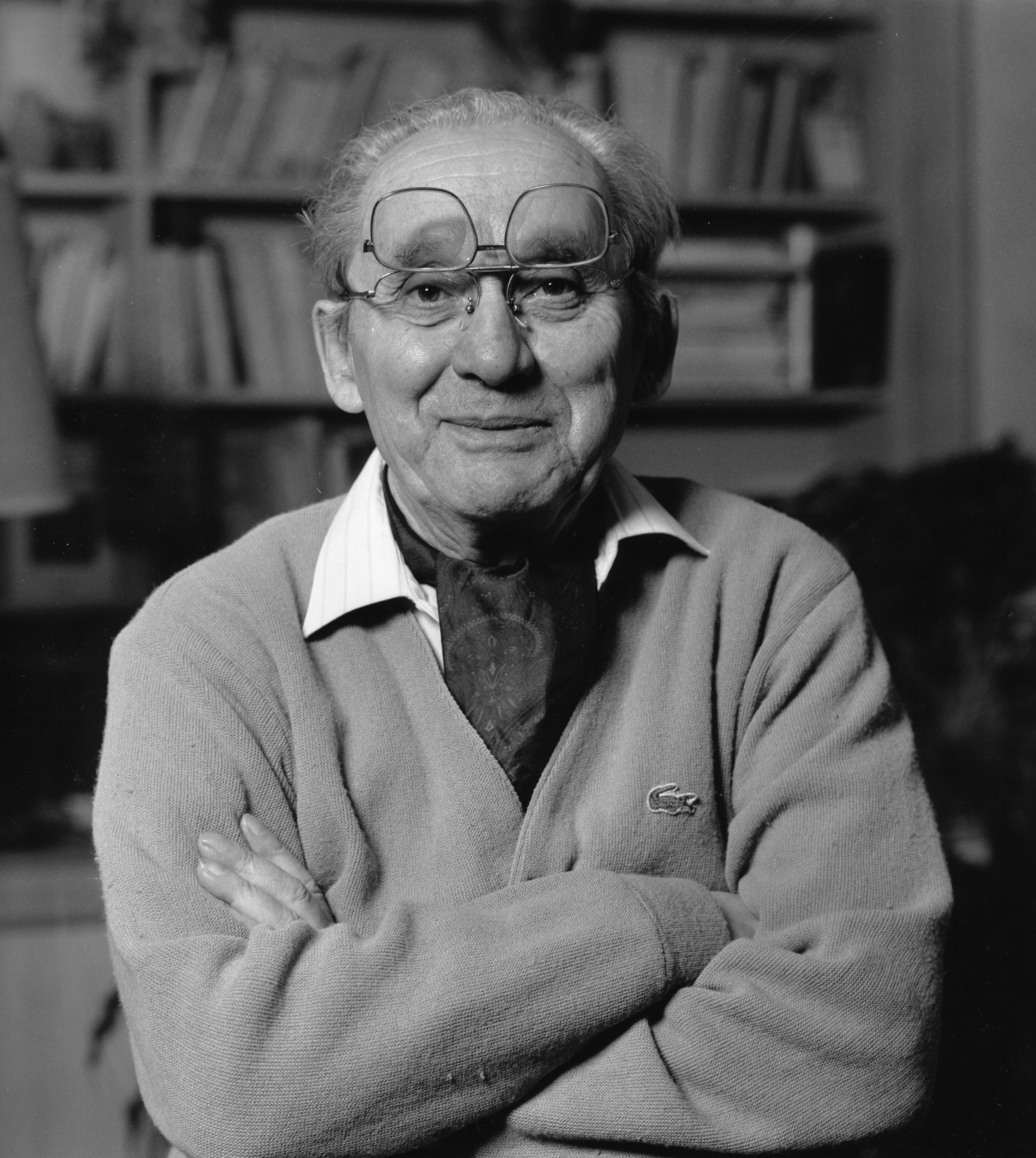
Paul Ricœur


Puisque ça a toujours été l'objectif de ce blog de ne pas perdre de vue mes lecteurs francophones, j'ai choisi de m'orienter maintenant pour quelques articles sur quelques citations de Paul Ricoeur avant de reprendre Lord Jesus Christ, par Larry Hurtado. En effet, j'ai reçu une demande de développer ce qui m'interpelle chez cet auteur français vis-à-vis de la Trinité, son rôle d'arbitrage étant important dans la question du déploiement de l'articulation de la place centrale dans la foi chrétienne qu'ont toujours occupé le Père, Fils et Saint Esprit dans l'esprit Chrétien.

The title I am referring to is The Conflict of Interpretations, which speaks directly to the sharply differing views to which I have been exposed over the last few years, and in many senses encapsulates the direction taken by the Triune Hub model I have been developing. English citations are my translations (which, since I am still grappling with Ricœur, may not be perfect, apologies). Page numbering is from the 2013 edition of Conflit des Interprétations: Essais d'Herméneutique, by Editions du Seuil, which is virtually unchanged from the original 1969 edition by the same publisher.

Our first citation seems to confirm this conviction that interpretation is integral not only to our acquisition of historical information but also the way in which that was originally composed itself in the past:
No striking interpretation can be drawn without borrowing from the modes of understanding available at a given time: myth, allegory, metaphor, analogy, etc. (p. 24)


Nulle interprétation marquante n'a pu se constituer sans faire des emprunts aux modes de compréhension disponibles à une époque donnée: mythe, allégorie, métaphore, analogie, etc. (p. 24)

Le titre auquel je fais allusion est Le Conflit des Interprétations, ce qui se situe pil là où il faut pour répondre aux perspectives fortement contradictoires auxquelles j'ai été confrontées ces dernières quelques années, et répond bien à l'orientation prise par le modèle du Noyau Trinitaire que je développe. Les citations sont tirées de l'édition 2013 de Conflit des Interprétations: Essais d'Herméneutique, par Editions du Seuil, ce qui reste pratiquement inchangé de l'édition 1969 par le même éditer. Cette première citation semble confirmer que l'intérpretation est intégrale non seulement à notre acquisition d'informations historiques mais aussi à comment ces dernières ont elles-mêmes été composées. Ce constat nous conduit à un deuxième: puisque le cercle herméneutique agit à travers des périodes de l'histoire qui dépassent la simple vie d'un tel ou tel interprète, nous pouvons constater qu'il existerait surement un niveau de réflexion, de compréhension et d'interprétation collective dont l'Eglise est le titulaire. Cette appropriation collective pourrait se rapprocher au sens voulu par Chad McIntosh dans ses illustrations de "personnes groupales" dans sa quête d'ouvrir de nouvelles possibilités philosophiques pour un Dieu multi-personnes (voir mon article de 2015: "Jésus Sois Le Centre").

Not only can we note that it that interpretative processes are constantly active, both now and the periods in the past that seems so vital to us, but that this leads us to a second observation: because this hermeneutic circle hugely exceeds the lifespan of any given interpreter, we should surely consider a real collective thought, comprehension and interpretation ascribable to the Church. This collective consideration may be close to Chad McIntosh's illustration of "Group Persons" in his exploration of new philosophical possibilities for a tri-personal God (see my 2015 article: "Jésus Sois Le Centre").

In surveying the early 20th century efforts to place Hermeneutics more centrally within the scope of human sciences, Ricœur covers Dilthey and his hermeneutic problem, which is profoundly psychological. This is because interpretation (e.g. of a text) is a small part of an individual's wider field of semantic reference, his "comprehension". To understand another person thus becomes seriously problematic and requires some form of conscious reception mechanism:

"To understand is to transport oneself into the life of another; historical comprehension brings into play the full force of historical inquiry: how can a historical being understand historically his history?... This is the major difficulty that can justify how phenomenological search for a reception mechanism, like grafting it onto a young plant" (p. 26).

Comprendre c'est... se transporter dans une autre vie; la compréhension historique met ainsi en jeu tous les paradoxes de l'historicité: comment un être historique peut-il comrendre historiquement son histoire? ... Telle est la difficulté majeur qui peut justifier que l'on cherche du côté de la phénoménologie la structure d'accueil, ou.... le jeune plant sur lequel on pourra enter le greffon herméneutique. (p. 26)

En reprenant les efforts du début de 20ème siècle pour placer l'herméneutique au centre des sciences humaines, Ricœur note le problème fondamental de l'herméneutique décrit par Dilthey. L'hermeneutique est profondément psychologique, puisque l'interprétation (d'un text notamment) est en effet une petite part d'une masse sémantique de référence plus large de la "compréhension". Comprendre donc l'autre devient sérieusement problématique et nécessite un méchanisme de réception qui joue sur le conscient (voir citation dessus de p. 26).

On est au point de voir la pertinence absolue de l'hermeneutique à la question de l'émergence du Dieu trinitaire à la fin du quatrième siècle et faire face aux choix que l'herméneutique pose devant nous.

And so we are just about ready to observe the absolute relevance of this study of hermeneutics to the question of the late fourth-century emergence of the Triune God and face the choices hermeneutics place before us.

"There are two ways to root hermeneutics phenomenologically, the short route and the long route. The short route is that of ontological comprehension"

Il y a deux manières de fonder l'herméneutique dans la phénoménologie...la voie courte et la voie longue. La voie courte c'est celle d'une ontologie de la compréhension (p. 26-27)

The short route, to cut a long story short (!), is more problematic. It's like attempting historical surgery, and, most fascinatingly for our own interest in the Trinity, is obsessed by ontology. Guess what? That is precisely the form of expression (I choose these words carefully) that the victorious fourth-century bishops were so concerned adopting their understanding: identification of the Son with the Father and the Spirit, via... something ontological a.k.a. ousia. Here I need to be very careful not to mix up two independent critiques. We can criticise the fourth-century "Homoousians" (those who believed in the "consubstantiality" of the Father, Son and Holy Spirit) for inappropriate hermeneutic integration of their predecessors, or we can criticise later (e.g. 21st-century) historians for inappropriate hermeneutic integration - presuming some of the ontological categories to be valid while simultaneously stating that such categories cannot be applied to the Father, Son and Holy Spirit. Assuming those ontological categories are biblical, you could perhaps continue to say the usage of those categories is downright "unbiblical", transgressing stacks of sound exegetical practice, and so on, while not seeking out what lay behind the form.

La voie courte, pour aller vite (!), est plus problématique. C'est un peu comme tenter une intervention historique chirurgicale et serait particulièrement concernée par l'ontologie, d'un intérêt tout particulier pour notre sujet de la Trinité. C'est tout à fait dans cette forme d'expression (je choisis mes mots avec prudence) que les évêques victorieux du quatrième siècle voulaient exprimer leur compréhension: l'identification du Fils avec le Père et l'Esprit, via... quelque chose de l'ordre ontologique, notamment "ousia". 

Ontological comprehension, says Ricœur, is an all-or-nothing affair, black and white. You've either got 1 God or three. You've either got a Unipersonal God or a Tripersonal God, etc.
La compréhension ontologique, dit Ricœur, c'est une approche tout-ou-rien, noir ou blanc. Soit vous avez un Dieu ou trois dieux. Soit vous avez un Dieu unipersonnel ou tripersonnel, etc.

The Long Route, on the other hand, will not devoid itself of ontology, but will access it via nuanced semantics, "by degree". That is a good term for my model of the Triune Hub: "semantics", which would seem to be situated within Ricœur's second category of hermeneutic. Why is that? I have a hard time explaining to some seasoned philosophers who reason in more black and white categories what I mean by this "hub". Semantic is a very good word to describe it. I also like "space" - I am referring to the Jewish mindset that, while not yet embracing a vocabulary of monotheism, had some strict semantic parameters in place about what could hitherto be said of Yahweh/[the] LORD via his agents and what could not. I like using the word "hitherto" very much; by it, I am of course referring to the events surrounding the life of Jesus, whose Jewish followers felt obligated to modify and reorganise their own monotheistic semantics and God's place within it.
Image taken from https://www.centre4innovation.org/

La Voie Longue, en contre partie, n'abondonnera pas l'ontologie, mais l'accédera par la sémantique, "par degrés" (p. 27). Cela est un mot important pour mon modèle du Noyau Trinitaire: "la sémantique", ce qui correspondrait à la deuxième catégorie de Ricœur. Pourquoi? J'ai du mal des fois à essayer d'expliquer ce que j'entend par ce "noyau" à des philosophes bien rodés qui raisonnent avec des distinctions catégorielles bien plus noir et blanc. La sémantique est une bonne expression pour le décrire. J'aime aussi "l'espace" - je fais allusion à l'esprit Juif qui, même si pas encore doté d'un vocabulaire de "monothéisme", intégrait des paramètres sémantiques strictes de ce qui pouvait être dit des agents de Yahweh/L'Eternel et de ce qui nous pouvait pas être dit d'eux. Cependant, cela était jusqu'à l'arrivée de Christ qui a modifié cette sémantique et la place de Dieu dans cette organisation sémantique.

Pour s'interroger sur l'être en général [référence ontologique], il faut d'abord s'interroger sur cet être qui est le "là" de tout être..., c'est à dire sur cet être qui existe sur le mode de comprendre l'être. (p. 28, mon accentuation)

To inquire about the being of something in general [reference to ontology], we first need to inquire about the being that is the "that" of all being, that is to say, this being that exists in and through its mode of being understood.

This last quote is quite a lot of philosophical mumbo-jumbo and a difficult one to translate (for me), especially Ricœur's use of the preposition "sur" (typically simply "on", which I have rendered "in and through"). But if you get the contrast that Ricœur is driving his readers toward, especially when you are motivated by a key "conflict of interpretation" like I am in the case of fourth-century interpretations of the Trinity, we can maybe start to grasp the distinction in slightly less philosophical lingo. What I am saying is that Ricoeur is right in his drive to help us look at the mode of transmission of important theological information - we cannot strip it down naked so to speak. The bones always have flesh. But here is where we and the church can hit confusion because the very subject at hand is ontology (ousia, divine "substance" or "essence" linking the three Persons as one Godhead, then simply "God")! But we mustn't allow ourselves confusion between the packagin and the contents here, via this double usage of ontology. There is a "mode" at work of transmission of important theological information that has as much ontological importance as the ontology explicitly described.

Cette dernière citation contient pas mal d'expressions difficiles et la traduction en anglais pour moi n'était simple, surtout l'emploi de Ricœur de la préposition "sur". Mais si vous comprenez le contraste que Ricœur veut mettre en lumière, surtout lorsqu'on est motivé par "conflit d'interprétation" comme je le suis dans le cas des interprétations du quatrième siècle de la Trinité, peut-être que nous pouvons commencer à saisir la distinction par des termes moins philosophiques. Ce que je veux dire c'est que Ricoeur a raison lorsqu'il insiste à ce qu'on regarde le mode de la transmission d'informations théologiques importantes - on ne peut pas les réduire comme informations brutes. Les os sont toujours recouverts de la chaire. Mais c'est bien là où nous et l'Eglise pouvons nous heurter à la confusion puisque le sujet même c'est l'ontologie ("ousia", la substance divine qui relie les trois Personnes dans un seul Dieu)! Mais nous ne pouvons pas nous permettre à confondre ce contenu ontologique de son emballage ontologique. A l'oeuvre ici est et était un "mode" de transmission d'informations théologiques importantes aussi important que son contenu.

More tomorrow! A suivre demain!

Thursday, 8 June 2017

Lord Jesus Christ, by Larry Hurtado, Part 6: mid-first century and late-first century Christian worship perspectives

MONOTHEISM IS NOT a dry, crusty constraint, some sort of doctrinal binding placed on a particular religious group. Of course, nothing prevents it from becoming that in a spiritually dead context, but the point for first century Judaism in the Roman period is that Jewish faith and practice were holistically fused into not just a cerebral understanding of Israel's God being the One True God, but that he was the one to whom worship was due, and to him alone. It is what Torah requires. Torah - roughly the first five books of the Old Testament - is so clear about this point, especially in Deuteronomy: stay true.

That is a key point for Hurtado as he now develops what he means by monotheism, because although he has answered some critics of his position on Jewish monotheism (see previous post), he also senses the need to redefine what monotheism means for those who have seen it is a pure constraint for second temple Jews. Either monotheism is "in force" or it is "broken"; cultic practice is not sufficiently taken into account. The three scholars Hurtado particular wants to refute here are Harvey, Casey and Dunn, but it is Hurtado's interaction with Dunn that I particularly want to focus on today.

James Dunn argues for a later Christological development than Hurtado, and particularly distinguishes Pauline church faith and practice from Johannine church faith and practice:

It seems very important to Dunn to attribute a mental monotheistic “reserve” to Paul that was “soon lost to sight” in Johannine Christianity. (KL 860), and: Dunn has not sufficiently appreciated the import of the devotional pattern that is already attested in Paul’s writings. (KL 863)

Here I would like to add a point that Hurtado does not make, which is not surprising since it appeals to a philosophical framework that is insufficiently utilised by this kind of historical-biblical inquiry. So while Hurtado may be correct that Dunn has not looked enough at the "binitarian" devotional pattern in Pauline Christianity, neither Dunn nor Hurtado seem able to recognise how Johannine material might be interpreting the Pauline corpus (along with other first century beliefs, practices and texts no longer extant) or earlier Christianity more generally. The hermeneutical question asks: what must we do in today's context in order to preserve what was taught before? That question will become critical in exploring why God became Triune, and it will become important at seeing why baptism became trinitarian toward the close of the first century. It is what Paul Ricoeur means when he says: Interpretation, let us say, is the work of our thought that consists in decoding the hidden meaning within the apparent meaning, and lay out the various layers of meaning implicated within the literal meaning (my translation, from Le Conflit des Interprétations: Essais d'herméneutique, Ed. du Seuil, 2013, p. 35: l'interprétation, dirons-nous, est le travail de pensée qui consiste à déchiffrer le sens caché dans le sens apparent, à déployer les niveaux de signification implliquées dans la signification littérale).

In Hurtado's case, although he issues in a good number of statements that he wants to avoid linear developments and simplistic analysis, he nonetheless would advocate a binitarian worship pattern that is consistent across the New Testament. In Dunn's case, he would see Jesus worship kicking Christianity out of Judaism when it later came to threaten Jewish monotheism in John's writing era (end first century), something which was not the case in Paul's era.

Biblical interpretation is often seen as a preservation of the initial model meaningfully into a new context, but it has not yet been (as far as I can tell) sufficiently within the canon itself. In a bid to make uniform the fundamental first century worship dynamic, as I fear Hurtado may be doing here, is to risk ignoring the interpretive work of the Johannine communities as our models par excellence on how to do hermeneutics. To overly separate the Pauline from the Johannine, as I fear Dunn does, is to fail to see the early emergence of an all-new worship practice in even pre-Pauline Christianity.

Let's lay out simplistically, then, how the two first century perspectives may, in fact, have differed and attempt to define quite what "binitarian" might mean between the two.


These two structures are indeed different. However, they do satisfy Hurtado's framework in that Johannine devotion remains "binitarian", if we are to define binitarianism loosely as two recipients of a single worship practice. I actually think that this might be what Hurtado has in mind, although he does use the term "alongside" without necessarily connecting his referred instance to one configuration or the other since, since he may view them as fundamentally *the same*. I say that because for me, when Hurtado talks of Christ receiving religious devotion alongside God, that language speaks more of this Johannine model. If I were the sort of interlocutor that Hurtado would answer, then he might reply to assert that Christ being seated (or stood) at the right hand of God goes back a lot earlier in the first century than the Johannine window in question. To that, I would wholeheartedly concur, pointing out that this is precisely why the worship practice might have evolved away from the nuanced earlier practice in (1) above, exemplified famously in Philippians 2, if indeed it did. In this very early text cited in Philippians 2, Jesus receives divine worship, but it is to the glory of God the Father, i.e. not ultimately for his own glorification. That is perhaps why humility is such an important factor of Jesus' character for the early church, in order that such a religious intensity of worship would not "go to his head", so to speak. To receive that quantity and intensity of worship would surely need an equivalent depth of humility to pass it all on to his God and Father.

The break-through nuance of (1) is that whereas second temple Judaism knew some striking examples of divine agents, acting in the Name of Yahweh (or Name of LORD), this is the first time that an agent can mediate a hitherto divinely reserved right back to God. That, combined with exclusion from the Jewish synagogues and Jewish communities, and the image of Christ reigning and God's right hand, may have led later Christian communities to interpret the earlier nuance in a new, more "alongside" fashion, while carefully (at that time) ensuring that God still remain the greater of the two (which I failed to encapsulate in the diagramme). Ensuring ultimacy to the Father was by no means a "given" in the context of the new emergent worship practice.

That, I think, is more than enough for today. Suffice it to say I think this disagreement between Hurtado and Dunn provides a perfect illustration of how Ricoeur's Conflit des Interprétations can provide fresh insights for our historical analysis.