
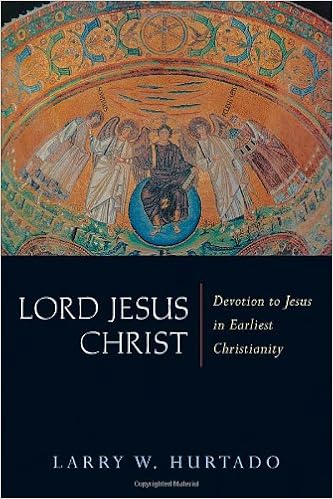
THIS UNUSUAL “BINITARIAN” devotional pattern certainly requires further analysis and adequate explanation.
These words constitute Hurtado's opening line for this section in which we will see the effects that Jewish monotheism probably had on Christian worship - needless to say, I will have some extra questions regarding quite what the inclusion of Gentiles into this context might have signified - needless to say, however, Hurtado is going to continue to masterfully fill out for us the major contour lines we need.
Before we go any further, however, let's stop a second. Do you see how Hurtado is using this word, "binitarian"? It is a crucial question, and one that this book does not explore specifically (although see expansion below), but we have to ask it. Is he implying that *someone* is binitarian or that *something* is binitarian? It's a thing. That thing is called here a "devotional pattern". Everything hinges on this distinction for my hypothesis, which, just to remind anyone joining the cruise here, agrees that there are most certainly two distinct but joined stages of trinitarian development in the first four centuries of Christianity. In the first century, monotheistic faith came to be reshaped around two additional entities. The faith - not God himself - became trinitarian in its discourse and practice. So do I agree with Hurtado's usage of "binitarian"? Yes and no - although mainly yes. Yes, for the point I just made about it relating to some aspect of faith. My two itty bitty "no" components are to do with the fact that I don't agree that not explicitly making this distinction is completely fine. Some readers - maybe many - who are reading this may gloss over this language, excited to see that Trinitarianism (capital T) starts as early as they hoped. I hope I am just as excited. Only I want to keep my excitement in line with what careful historians are actually piecing together.
Hurtado introduces now a new term, which we need to understand as a direct translation of his previous preference for "mutation": "variant". This is a curious choice for me - apparently, the reason he makes this switch (although he doesn't give up on mutation completely and has a palette of equivalent terms) is twofold. Firstly, since he wrote One God, One Lord, in which "mutation" was used on scores of occasions, mutation language has received some criticism in the academy as somewhat derogatory, although I have no idea by whom. Secondly, he feels like "variant" is an informative illustrative term because, as he knows, and as some of his readership will know, a textual variant has a specific meaning in the field of textual criticism. But that is a highly specialised and less graphic illustration than mutation, and I won't hide constitutes a peculiar choice for me. So this "variant" is, in fact, monotheistic Christianity, and more specifically, the binitarian worship practice within Christianity that still holds to there being precisely one God. This central feature of monotheism in earliest Christianity, we would do well to remember (and I don't think Hurtado feels the need to remind his readership of this, probably assuming prior knowledge), is not something that was defined in quite those terms. Coincidentally, or perhaps not so coincidentally, I believe it is in the context of worship that the word monotheism first arises, as far as we know, with μονόθεον occurring in a Byzantine hymn (see an old post I did on this here). A hymn! I think Hurtado would have liked that.
But we've still not got much further than simply affirming that Christianity represents a mutation of a nonetheless monotheistic Judaism. Hurtado will go on to emphasise the exclusive force of monotheism on Christianity when he states: "Inasmuch as exclusivist monotheism is manifested essentially...in a refusal to offer worship to any figure other than the one God" (my italics). OK, so you might think maybe Hurtado does mean something more by "binitarian" after all! Sometimes it is difficult to track, to be honest, but I think it's an imperfect line out of step with his wording throughout this section. Indeed, I can also say that from reading quite a bit of Hurtado that this line seems odd. Why? Because Christ is another figure (see below) and is consistently referenced by Hurtado as such, albeit with the usual caveats of distinct-yet-joined. One of my favourite lines in Revelation is chapter 12, verse 10, which I think can bring some clarity about how in the first century we might talk of God and Christ together:
Then I heard a loud voice in heaven say:‘Now have come the salvation and the power and the kingdom of our God, and the authority of his Messiah. For the accuser of our brothers and sisters, who accuses them before our God day and night, has been hurled down.
Christ is God's Messiah, according to this passage. Elsewhere we can see co-ownership of the kingdom described through the powerful (presumably) single "throne of God and of the Lamb" in Rev 22:1 and 22:3, and most spectacularly here in 11:15:
Then the seventh angel blew his trumpet, and there were loud voices in heaven saying: "The kingdom of the world has become the kingdom of our Lord and of his Christ, and he will reign for ever and ever."
Religious priestly activity is also now organised in a binitarian way in Rev 20:6, but look at how it is articulated:
Blessed and holy are those who share in the first resurrection. The second death has no power over them, but they will be priests of God and of Christ and will reign with him for a thousand years.
So this would seem, to me at least, that this sentence of Hurtado's needed some further explanation, that indeed another figure - God's Messiah, the lamb - is indeed in view, albeit in the same devotional snapshot (God would not be able to take a selfie in Revelation without Jesus being in the shot), as my examples seem to demand. Further, the constraints of monotheism must be satisfied from within the Judeo-Christian worldview. This is also an important consideration, as although first century Jewish "converts" to Christianity were able to understand a way in which they were, in fact, being faithful to God's command to worship him and Christ alongside him (or maybe firstly of himself via Christ, his "icon", to adopt Dunn's perspective), that this view was precisely not acceptable to mainstream Judaism, along with other characteristics of the Christian faith.
Hurtado's point, though, for Christianity is that its monotheistic inheritance meant that Jesus could not be deified as a separate deity. That is also crucial, that is the one thing to remember from this section - not my quibbles. We might also add that he could not replace the deity (I wonder if that might be the context behind John remembering Jesus saying "the Father is greater than I", John 14:28, but see also Luke 6:35, 1 Cor 15:27-8). This limitation on Jesus is helpfully termed by Hurtado as "the constraining effect of monotheism".
Turning specifically to how Jesus might be legitimately worshipped now. How was he perceived in this radical new configuration? "[H]is divine significance is characteristically expressed in terms of his relationship to the one God." OK, so we are more comfortably, I would say, back in line with the thrust of the New Testament texts and finding Hurtado's crucial breakthrough of divine endorsement. God knows about this worship, he even desires it and is glorified through it, it's all part of his great Plan. Hurtado has this masterful way of turning back to all those who like me who have pulled their hair out at all those blatant "and"-s separating Jesus and God throughout the New Testament, and saying "you see it but you don't see it"! That is a point I think he also made in an interview somewhere, that it is actually difficult for a New Testament author to speak of God without also speaking of Jesus within a verse or two. The two now function in the first-century mindset together. Hurtado also calls this in the present section "the programmatic inclusion" of Jesus. I quite like this, but programmatic feels slightly too exclusively intentional for me - I don't know what I'd say instead either, but I'd like to appeal also to the organic, natural inclusion of Jesus-worship into Jewish worship practices somehow. Hurtado is also now able to revisit his usage of "binintarian", expanding it slightly: it is still a worship pattern (not a god), around two figures ("God and Jesus", KL 969), operating within a monotheistic framework.
Finally, Hurtado asserts the various ways in which Jesus plays off pre-existent ideas of divine agents developed during second temple times, but also how he has adapted that category in the case of worship - but not in all the other cases. God's accomplishment of salvation for his people through this agent is unprecedented as it has catapulted the people, unexpectedly, into a new era of the Spirit indwelling all peoples. This is my addition, and leads to my question that is not posed in this section: what about the inclusion of Gentiles into this mix? The very fact that they are supposed to be there (although some failure to include is confronted by Paul, as is well known) is also a paradigm-shifting indicator. The first resurrection has happened, of God's messiah, no less. God has operated this inclusive and universal salvation through this Jesus. The presence of monotheistic Jewish Jesus-followers in the meetings is significant, but so is the presence of ex-pagan believers, who have renounced polytheistic practices, accept social discrimination and hardship for not performing the appropriate sacrifices on behalf of their trust in God's open invitation through his son, the Messiah, and the ongoing confirming seal of the Spirit. Thus, this inaugurated age in which all peoples can now come and glorify God is heavily associated by the New Testament authors with the outpouring of his Spirit on "all peoples". So to what extent could we already say that in another sense, this worship practice might, in fact, be "trinitarian", given that "binitarian" didn't have to mean a "binitarian god"? We will be asking questions of the Spirit again when we reach the experiential factors a few posts later.
Next section for tomorrow: how Jesus himself shaped his future worship.
Hope you're enjoying it - any feedback you'd like to leave? Anyone you can think of who might like joining us? Would you please consider forwarding the link to the blog? Thanks so much.
These words constitute Hurtado's opening line for this section in which we will see the effects that Jewish monotheism probably had on Christian worship - needless to say, I will have some extra questions regarding quite what the inclusion of Gentiles into this context might have signified - needless to say, however, Hurtado is going to continue to masterfully fill out for us the major contour lines we need.
Before we go any further, however, let's stop a second. Do you see how Hurtado is using this word, "binitarian"? It is a crucial question, and one that this book does not explore specifically (although see expansion below), but we have to ask it. Is he implying that *someone* is binitarian or that *something* is binitarian? It's a thing. That thing is called here a "devotional pattern". Everything hinges on this distinction for my hypothesis, which, just to remind anyone joining the cruise here, agrees that there are most certainly two distinct but joined stages of trinitarian development in the first four centuries of Christianity. In the first century, monotheistic faith came to be reshaped around two additional entities. The faith - not God himself - became trinitarian in its discourse and practice. So do I agree with Hurtado's usage of "binitarian"? Yes and no - although mainly yes. Yes, for the point I just made about it relating to some aspect of faith. My two itty bitty "no" components are to do with the fact that I don't agree that not explicitly making this distinction is completely fine. Some readers - maybe many - who are reading this may gloss over this language, excited to see that Trinitarianism (capital T) starts as early as they hoped. I hope I am just as excited. Only I want to keep my excitement in line with what careful historians are actually piecing together.
Hurtado introduces now a new term, which we need to understand as a direct translation of his previous preference for "mutation": "variant". This is a curious choice for me - apparently, the reason he makes this switch (although he doesn't give up on mutation completely and has a palette of equivalent terms) is twofold. Firstly, since he wrote One God, One Lord, in which "mutation" was used on scores of occasions, mutation language has received some criticism in the academy as somewhat derogatory, although I have no idea by whom. Secondly, he feels like "variant" is an informative illustrative term because, as he knows, and as some of his readership will know, a textual variant has a specific meaning in the field of textual criticism. But that is a highly specialised and less graphic illustration than mutation, and I won't hide constitutes a peculiar choice for me. So this "variant" is, in fact, monotheistic Christianity, and more specifically, the binitarian worship practice within Christianity that still holds to there being precisely one God. This central feature of monotheism in earliest Christianity, we would do well to remember (and I don't think Hurtado feels the need to remind his readership of this, probably assuming prior knowledge), is not something that was defined in quite those terms. Coincidentally, or perhaps not so coincidentally, I believe it is in the context of worship that the word monotheism first arises, as far as we know, with μονόθεον occurring in a Byzantine hymn (see an old post I did on this here). A hymn! I think Hurtado would have liked that.
But we've still not got much further than simply affirming that Christianity represents a mutation of a nonetheless monotheistic Judaism. Hurtado will go on to emphasise the exclusive force of monotheism on Christianity when he states: "Inasmuch as exclusivist monotheism is manifested essentially...in a refusal to offer worship to any figure other than the one God" (my italics). OK, so you might think maybe Hurtado does mean something more by "binitarian" after all! Sometimes it is difficult to track, to be honest, but I think it's an imperfect line out of step with his wording throughout this section. Indeed, I can also say that from reading quite a bit of Hurtado that this line seems odd. Why? Because Christ is another figure (see below) and is consistently referenced by Hurtado as such, albeit with the usual caveats of distinct-yet-joined. One of my favourite lines in Revelation is chapter 12, verse 10, which I think can bring some clarity about how in the first century we might talk of God and Christ together:
Then I heard a loud voice in heaven say:‘Now have come the salvation and the power and the kingdom of our God, and the authority of his Messiah. For the accuser of our brothers and sisters, who accuses them before our God day and night, has been hurled down.
Christ is God's Messiah, according to this passage. Elsewhere we can see co-ownership of the kingdom described through the powerful (presumably) single "throne of God and of the Lamb" in Rev 22:1 and 22:3, and most spectacularly here in 11:15:
Then the seventh angel blew his trumpet, and there were loud voices in heaven saying: "The kingdom of the world has become the kingdom of our Lord and of his Christ, and he will reign for ever and ever."
Religious priestly activity is also now organised in a binitarian way in Rev 20:6, but look at how it is articulated:
Blessed and holy are those who share in the first resurrection. The second death has no power over them, but they will be priests of God and of Christ and will reign with him for a thousand years.
So this would seem, to me at least, that this sentence of Hurtado's needed some further explanation, that indeed another figure - God's Messiah, the lamb - is indeed in view, albeit in the same devotional snapshot (God would not be able to take a selfie in Revelation without Jesus being in the shot), as my examples seem to demand. Further, the constraints of monotheism must be satisfied from within the Judeo-Christian worldview. This is also an important consideration, as although first century Jewish "converts" to Christianity were able to understand a way in which they were, in fact, being faithful to God's command to worship him and Christ alongside him (or maybe firstly of himself via Christ, his "icon", to adopt Dunn's perspective), that this view was precisely not acceptable to mainstream Judaism, along with other characteristics of the Christian faith.
Hurtado's point, though, for Christianity is that its monotheistic inheritance meant that Jesus could not be deified as a separate deity. That is also crucial, that is the one thing to remember from this section - not my quibbles. We might also add that he could not replace the deity (I wonder if that might be the context behind John remembering Jesus saying "the Father is greater than I", John 14:28, but see also Luke 6:35, 1 Cor 15:27-8). This limitation on Jesus is helpfully termed by Hurtado as "the constraining effect of monotheism".
Turning specifically to how Jesus might be legitimately worshipped now. How was he perceived in this radical new configuration? "[H]is divine significance is characteristically expressed in terms of his relationship to the one God." OK, so we are more comfortably, I would say, back in line with the thrust of the New Testament texts and finding Hurtado's crucial breakthrough of divine endorsement. God knows about this worship, he even desires it and is glorified through it, it's all part of his great Plan. Hurtado has this masterful way of turning back to all those who like me who have pulled their hair out at all those blatant "and"-s separating Jesus and God throughout the New Testament, and saying "you see it but you don't see it"! That is a point I think he also made in an interview somewhere, that it is actually difficult for a New Testament author to speak of God without also speaking of Jesus within a verse or two. The two now function in the first-century mindset together. Hurtado also calls this in the present section "the programmatic inclusion" of Jesus. I quite like this, but programmatic feels slightly too exclusively intentional for me - I don't know what I'd say instead either, but I'd like to appeal also to the organic, natural inclusion of Jesus-worship into Jewish worship practices somehow. Hurtado is also now able to revisit his usage of "binintarian", expanding it slightly: it is still a worship pattern (not a god), around two figures ("God and Jesus", KL 969), operating within a monotheistic framework.
Finally, Hurtado asserts the various ways in which Jesus plays off pre-existent ideas of divine agents developed during second temple times, but also how he has adapted that category in the case of worship - but not in all the other cases. God's accomplishment of salvation for his people through this agent is unprecedented as it has catapulted the people, unexpectedly, into a new era of the Spirit indwelling all peoples. This is my addition, and leads to my question that is not posed in this section: what about the inclusion of Gentiles into this mix? The very fact that they are supposed to be there (although some failure to include is confronted by Paul, as is well known) is also a paradigm-shifting indicator. The first resurrection has happened, of God's messiah, no less. God has operated this inclusive and universal salvation through this Jesus. The presence of monotheistic Jewish Jesus-followers in the meetings is significant, but so is the presence of ex-pagan believers, who have renounced polytheistic practices, accept social discrimination and hardship for not performing the appropriate sacrifices on behalf of their trust in God's open invitation through his son, the Messiah, and the ongoing confirming seal of the Spirit. Thus, this inaugurated age in which all peoples can now come and glorify God is heavily associated by the New Testament authors with the outpouring of his Spirit on "all peoples". So to what extent could we already say that in another sense, this worship practice might, in fact, be "trinitarian", given that "binitarian" didn't have to mean a "binitarian god"? We will be asking questions of the Spirit again when we reach the experiential factors a few posts later.
Next section for tomorrow: how Jesus himself shaped his future worship.
Hope you're enjoying it - any feedback you'd like to leave? Anyone you can think of who might like joining us? Would you please consider forwarding the link to the blog? Thanks so much.


