Showing posts with label Greek. Show all posts

Thursday, 28 June 2018

Yahweh Translation Survey Results Out Here!

Hi everyone, I have just completed an apparently needed survey of the Hebrew Bible and Septuagint to examine exactly how the most significant names of the Israelite god, Yahweh and Adonai, were translated into the Greek Kyrios, while also factoring in Greek case. Yahweh, it has long been considered, was convened as "anarthrous" in the Greek translation *Kyrios*, now at last we know quite how much, and what that looks like right across the OT canon. The upshot of this is that Peterson seemed to have sensed something significant when he translated Yahweh by GOD in The Message, not the redundant "the LORD".

But let's get back to the data before we run away with English translation implications.


This first graph tells us that the rates of article before Kyrios (nominative "the LORD") and Kyriou (genitive "of the LORD") are typically very scarce indeed, with Job being a radical outlier. Let's exclude Job now to zoom in on the rest.


So now we can access a more nuanced picture of the rest of the canon. We can summarise it to say that the Pentateuch is, as expected, super low and precedent-setting, although even those first five books we will see some interesting further variation in the following graph. The traditionally ranked "first" historical books of Joshua and Judges seem to follow that pattern before rates increase for 1 Samuel through 1 Kings. 2 Kings, Chronicles, Nehemiah and Ezra bring the rates back down. That is significant in re-evaluating Hong's claim that an early euphemism is evidenced in 1 Chronicles 17, "after" 2 Samuel 7 was written (there is clear literary dependence between the two, but either the Chronicler changes Adonai Yahweh into Yahweh Elohim (Hong) OR Samual changes Yahweh Elohim into Adonai Yahweh. This survey, along with other historical data around the trickiness of the Yahweh Name in particular, might favour the latter scenario, contra Hong. That's quite significant.

Psalms provides the greatest number of arthrous translations of Yahweh into ho kyrios and tou kyriou: 56 by my count. Clearly, this translator and the translator of Proverbs (if not the same) were aware of the translational practice but did not feel quite as bound to it. On the minor prophets, what we notice is quite a wide range of fluctuation of this awareness, which fits well into the likely ad-hoc nature of the establishment of the translation of the latter parts of the Hebrew Bible.

What about the other Greek cases?


Well, they're all over the place, mostly. Deuteronomy is a notable exception, however, and could point to it being the original blueprint for the anarthrous rule.

Note, the graphs exclude the books Esther, Ecclesiastes and Song of Solomon, none of which have retainable data on the question.

Monday, 11 June 2018

Exodus 8:22 - the Name and the Title side by side

JUST CHECKING, AS planned for unaccounted for double-occurrences of Yahweh in a single verse and stumbled over another interesting example perhaps worth sharing of how the title characteristics were associated with the Greek article (and the Name characteristics with its absence). In Exodus 8:22 in the NASB, based on Hebrew texts, we read:

“But on that day I will set apart the land of Goshen, where My people are living, so that no swarms of flies will be there, in order that you may know that I, the LORD, am in the midst of the land."

In the NETS translation of the Greek Septuagint we read:
"And I will distinguish gloriously on that day the land of Gesem, which my people are on, whereon the dog-fly shall not be, so that you may know that I am [the] Lord, the Lord of all the land.

In the NETS version, we have a repetition of the word "Kyrios" - first without the article, then, immediately after, with the article. It's a marvelous example of how the two characteristics complement one another and are expressed in the Greek grammar, much like the example of Isaiah 49:14 (But Zion said, “[The] LORD [Yahweh] has forsaken me, the Lord [Adonai] has forgotten me.”) we discussed in my previous post. In the first instance we have the personhood of God; in the second, that person, Kyrios, is the kyrios of what? Of all the land.

How else could NETS translate this? How about the following:
"And I will distinguish gloriously on that day the land of Gesem, which my people are on, whereon the dog-fly shall not be, so that you may know that I am GOD, the Lord (or Ruler) of all the land.

A less literal translation could dispense of the article of the second Kyrios:
"... so that you may know that I am GOD, Ruler of all the land.

What do you think?

Monday, 4 June 2018

"It Is Finished"!

IT HAS BEEN the most epic project ever taken on this blog, and probably one of the few things I'll be able to say I contributed during this tiny life: to have completed my Yahweh translation survey. Thank you so much for those of you who have followed this rather specific journey but have glimpsed its relevance for better biblical interpretation in the future, translation, our understanding of the relationship between the Old and New Testament Lords, and so on.

Where to go from here?

As readers might have become aware, I am increasingly enjoying using dynamic content, so why not even do that for my checklist? Follow this post to see my progress steadily checked off below!

Saturday, 4 November 2017

John’s third impacting figure: Dr Dale Tuggy

Fatscript Episode 7 show notes, John’s third impacting figure: Dr Dale Tuggy


Wednesday, 2 August 2017

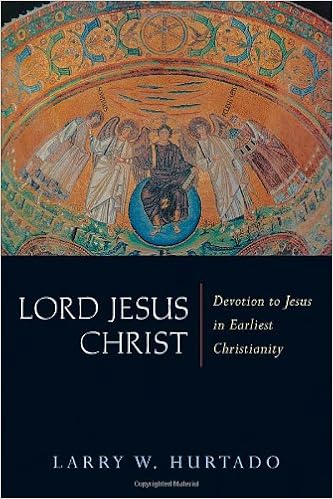
Lord Jesus Christ, S2 Part 3: Jesus as Lord or Jesus as LORD?

I HAVE BEEN really looking forward to this section. Some readers might know that I had some dialogue with Dr. Hurtado back in 2016 around the fascinating issue of Kyrios use in the Greek Septuagint, a compilation of Greek translations initiated in Alexandria in the third century BC for diaspora Greek-speaking Jews living in that area and beyond. The reason why this is of interest to us here is to recall that Lord Jesus Christ was written in 2003. Research into the Septuagint has been going on for many years, but new scholarship continues to shine fresh light on some aspects of the New Testament, and will certainly come up here in this section. Before we look any further, then, into Hurtado's 2003 perspective on Paul's use of Kyrios as a "divine title" for Jesus, let's recap what we know about the usage of Kyrios in Judaism in the second temple era.

When the LXX was written, certain theological understandings and tendencies had ultra-sanctified the name of Yahweh, God's revealed name for his people to call him by (paradoxically!), to such an extent that even uttering the name might be considered so terrible that the person might risk being divinely fried.

As a result, there were special ways of writing Jewish texts that had two forms - the proper form and the read-aloud form. Scholars ponder a lot about how Jews of the second temple era got around the numerous references to Yahweh (or Kyrios), but I believe that Kyrios represented a good route for the mainstream Greek-speaking diaspora. It is also a common term used for a human master and the Alexandrian translators had inserted a clever designator that this Kyrios was both different and personal. How? They removed the article. So, whenever we read in our English Bibles, especially from Genesis to Deuteronomy, "the LORD" said or did this or that, I recommend you start practising replacing that with either simply "Yahweh" or "LORD" (no "the"). The second option I still find the most stilted, even if loyal to an intermediate state of transmission of the text to us (which should make us ponder why we are so loyal to it, in fact).

Since we are talking about Paul, I will also say that I believe we have good evidence he was aware of this special translation practice. Not only do we have his testimony of his intensive religious training as a literate multilingual Jew, but I think I also stumbled over some interesting textual evidence that I have examined before on this blog in 2 Corinthians 3:16-18, see here. (Note: I am not at all convinced that such intimate textual knowledge can be postulated for other authors of the New Testament, Revelation being one example I noticed just recently.)

So before we get into this section of Hurtado's chapter on Paul, what should we be asking? Hurtado is on the lookout for special status for Jesus that would warrant the evidence of the binitarian worship patterns we have looked at in Chapter 1. I too am on the lookout for special New Testament treatment of Christ and the Spirit that could explain Father-Son-Spirit religious dynamics that would require a reconfiguration of the Jewish core view. But, as on this blog we have insisted over and over again: absolutely no shortcuts are allowed. Some apologists want to insist that Jesus "just is Yahweh", pointing to occasions when the New Testament authors, including Paul, apply Yahweh texts to Jesus who seems to become the Kyrios in question. Seems simple enough? But can it be as simple as that if anarthrous Kyrios is a personal name as well as a title?

We want to see if the simple theory neatly matches the fuller usage of the term. For me, seeing how sensitive Paul is to not only repeating anarthrous Kyrios citations but also applying that anarthrous principle to Yahweh elsewhere (that in context does not have the Lord Jesus in view, rather, Yahweh or "LORD", see the aforementioned post on 2 Corinthians 3:16-18), I would want to see how Paul responds to the question of the article when it is applied to the Lord Jesus, both inside and outside of Old Testament fulfilment passages. Of course, I also want us to learn from Hurtado what Kyrios could have meant as a title for the early Christian communities we learn of through Paul.

In response, Hurtado immediately opens with the obvious concession: Kyrios was used to refer to and address someone in a variety of socially superior positions (p. 108) It's the title a slave-owner would expect from his slaves, it could be a general term of respect like "sir", and came to be used in some Eastern provinces of the Roman empire. I would also expect John the Baptist's disciples to have referred to John in this way, as "master". Hurtado notes the usage of Kyrios for these eastern provinces in the same breath as noting that this is also where living emperors could be divinised, which was not possible in the west. Regardless, what we are looking at is a highly diverse word with ranges of meanings in multiple contexts, and so I would be more hesitant than Hurtado, when he states:

This pagan religious usage ... shows that pagans could easily have understood the term as connoting reverence for Jesus as divine (p. 108).

For Jewish understanding of the term, Hurtado recognises that we don't look first and foremost at the pagan culture, but at the ethnic and religious heritage of the Jewish people, introducing a word that is absolutely key to my own hypothesis of the Triune Hub: "semantic", a term Hurtado sadly leaves sadly underdeveloped with only five other meaningful occurrences (pp. 293, 302, 304, 305, and fn48 p. 506):

Most recent studies of these questions conclude that the key semantic background lies in Jewish tradition, and that the christological designation of Jesus as "Lord" goes back into the very earliest circles of Jewish Christians. (p. 109, emphasis mine)

But will that earliness really settle the questions we were asking just now, and what does Hurtado mean by "semantic background"? Recently, we have opened up the idea via Paul Ricoeur's work in Conflit des Interprétations; of the impact of "phenomenology" to our human processing, itself deeply impacted during its development by Freudian psychoanalysis, that insists on multiple layers of meaning. Suffice it to say for now that this bridge between phenomenology and "theological mutation" has not yet been sufficiently developed and articulated, despite its successful employment by Hurtado, Wright, Crossan and no doubt others (by the way, if blog readers could point me to other serious biblical scholars who reason in terms of mutation of Jewish worldviews/semantics, etc., please let me know). Regarding the question of earliness, I'm not sure. For Hurtado, everything has to be very early, that's how his model works. But if Jesus is by and large referred to largely in the non-special sense introduced by the Septuagint, then that should strongly nuance any unnecessarily strong assumptions about the divinity overhanging the word Kyrios. And yes, by the way, Jesus generally does have an article and, perhaps more importantly still, his lordship is personalised: "my Lord", "our Lord", etc. Yahweh, despite his thousands of mentions in the Old Testament, is never "my Yahweh" or "our Yahweh". Even other Hebrew words rendered Lord like Adonai are very rarely used in this possessive sense - twice in Nehemiah and four times in the Psalms. Jesus? 73 times. That is a totally different and unique usage that LJC simply does not account for as far as I can see in its bid to create a semantic divine overlap between Jesus and God, at least with respect to worship reserved for the One True God.

For other related posts on this subject (close to my heart, for some reason), please see the following posts, mainly from last year, one in French:

The name of [the] LORD


Monday, 31 October 2016

Why This Research Matters

In the previous post I presented some preliminary results of my Septuagint study of the divine Name renderings into Greek in the Psalms, noting only around 18% of nominative and genitive occurrences of the hundreds surveyed to include the definite article: the remaining 82% are "anarthrous", lacking the article.

I am now starting to see already why this research matters. Professor Albert Pietersma is the lead translator of the NETS New English Translation of the Septuagint. This is a major scholarly work combining expertise across the Septuagint field, including Larry Perkins, whose paper on Exodus we have already discussed on this blog.

Pietersma includes in the introduction to the NETS translation of the Psalter the following note (p. 546):

Since the Greek Psalter provides no evidence that the translator made any serious attempt at distinguishing between the divine names Yahweh, including the short form "Yah", and Adonai, I have in accordance with NETS policy rendered all occurrences of kyrios, when representing either, by "Lord".

The decision is a difficult one, because even if he is right about this (no serious distinguishing going on), then you still have to work around the Adonai plus Yahweh problem with increased difficulty if both are translated by "Lord" (see Psalm 68:20: Our God is a god to save, and to the Lord Lord belong the escape routes of death).

But I don't think he is quite right about that assumption of no difference, and here're two reasons why.

1. In contrast to the article treatment in Yahweh translations in Psalms (82% are rendered anarthrous in nominative and genitive forms), when Adonai is translated into Greek only half of the translations are anarthrous (53%, that is 9 out of 17 times with respect to genitive and nominative cases - note however that one of these anarthrous instances, Ps 16:2, could almost certainly never have been confused with Yahweh in that it translates a possessive, "my Yahweh" being unheard of). This partial similarity between Yahweh and Adonai translation policy may represent a vague gesture at the sanctity of the Yahweh solution, but nonetheless, a significant difference remains (from an albeit small sampling).

2. Less significantly, but most intriguingly, is a translation of Psalm 130:6, my soul waits for the Lord. Here the Greek reads: ἤλπισεν ἡ ψυχή μου ἐπὶ τὸν κύριον.  Since we are focussing on the more meaningful cases of nominative and genitive, I almost missed this accusative construction, but it rang a bell. As it turns out, "ἐπὶ" before κύριον when translating "to Yahweh" systematically removes the accusative article τὸν: Ps 4:5, Ps 21:7, Ps 22:8, Ps 31:24, Ps 32:10 and 11, Ps 37:3, Ps 40:3, Ps 55:22. Not so in Psalm 130:6 translating Adonai.

So to conclude, I can't help but wonder if Pietersma has considered these two important pieces of evidence when he dismisses the possibility of distinguishing efforts on the part of the Psalter translator. Only a more thorough investigation of the benchmark for anarthrous renderings, the Pentateuch, and the Adonai goldmine of Ezekiel will provide us with more evidence. If it can be shown that the "NETS policy" mi, in fact, be misrepresenting the translation practice of the Greek translators, then that should filter down to less clear-cut cases such as the Psalms.

Saturday, 18 June 2016

Confusion over a *case* in the NT: anarthrous Moses vs arthrous Peter

I am a bit confused, I must admit, to discover some quite curious statistics around the Greek in the New Testament. Some will know I am quite interested in the case of the presence or absence of articles in this fascinating language. It occurred to me that in order to better understand the practice of including articles with proper names, e.g. the John writing this blog post, it would make sense to look at other examples in the New Testament, and see how case  comes into it. If we include the vocative, there are actually five Greek cases: vocative, nominative, genitive, accusative and dative.

It had already become clear to me when I did the series of posts on arche that Greek case had a role to play, and other readings have confirmed that (BTW I remain a total novice to Koine Greek, but that does not prevent me from asking what I think should be a legitimate question, which I will get to in a second).

So I decided to take Moses, Peter and Jesus as three prominent proper names to look at. I haven't done Jesus yet - and I wish to re-count Moses and Peter before proceeding. What did I find?

I'll publish some stats when I have gone through it more thoroughly, but there was a surprising difference between Moses and Peter in the Nominative case. Moses occurs in the New Testament 80 times. Of those 80, slightly over half are in the nominative case. For example:

“Teacher,” they said, “Moses told us that if a man dies without having children...” (Matt 22:24). This Moses is in the nominative: Μωϋσῆς. And there is hardly ever an article with the nominative in the instance of Moses (my first count was 3 out of 43). However, in the case of Peter, it is quite different. Peter is mentioned 156 times in the New Testament, of which 100 are in the nominative case, Πέτρος. So my question is: why do we get so many articles with Πέτρος? Approximately half of these have the article appended. OR, why do we get so few articles with Μωϋσῆς? I hope the same enquiry into Jesus will highlight which of these two questions is the most pertinent.

UPDATE: While this discrepancy remains a little unclear to me, John (Ἰωάννης  OR Ἰωάννου) is more in line with what we might expect: anarthrous in the genitive and nominative cases to the tune of 18%, and especially in the genitive (only 8%).

Monday, 11 April 2016

Born from above or born again? Both are on the cards.

What does Jesus teach Nicodemus in John 3?


Everyone, or most people in the English-speaking world, has heard of the Christian-lingo "born again" Christians. For many Christians, being a "born-again" Christian is a crucial part of their identity. But is that what the Greek says? Let's look at the English NIV:

John 3:3 Jesus replied, “Very truly I tell you, no one can see the kingdom of God unless they are born again.” 

John 3:6-7 Flesh gives birth to flesh, but the Spirit gives birth to spirit. You should not be surprised at my saying, ‘You must be born again.’

Bart Ehrman frequently likes to make an interesting point about John's gospel here. He actually believes that in Greek this word, anōthen, means both "again" (i.e. born again) and "from above" (i.e. born from above), and that John is placing clever, double-entendre teaching on Jesus' lips via word play in Greek (for a conversation that almost certainly would not have taken place in that language, where the Aramaic translation for "born again" and "born from above" would vary).  But if John was uniquely talking about being born "from above", then there is no good explanation for Nicodemus' confusion about physical re-birth. Meanwhile, being born from above fits the clear flesh-spirit distinctions. So it's probably both. The problem we are left with, I guess, is that saying you are a born-again-this-time-from-above Christian doesn't role nearly quite so well of the tongue :)